
Wall art for a double-height living room should be sized to roughly two-thirds the width of your tall wall, hung so the visual centre sits 5–7 feet off the floor, and arranged as a vertical column — stacked set-of-3 canvas paintings, one oversize statement piece, or a sconce-flanked focal arrangement — so the eye climbs the wall instead of getting lost in it.
That sentence is the whole answer. The rest of this guide is the how — sizing maths, layout decisions, lighting tricks, vastu-aligned placement, and the specific Indian-home dilemmas (TV unit below the void, staircase landing folded into the same wall, balcony or mezzanine that overlooks the seating) that turn a beautiful tall wall into a styling problem most homeowners avoid for years.
Why double-height living rooms are hard to style
A double-height living room is any room where the ceiling extends through two storeys — typically 16 to 22 feet from floor to ceiling. They appear most often in villas, builder duplexes, penthouse units, and modern G+1 homes across Bengaluru, Hyderabad, Pune, Gurgaon, and the Mumbai suburbs. The Indian Council of Architecture lists vertical proportion as one of the five elements of Vastu-aligned spatial design, and modern interior surveys consistently rank "what to do with the tall wall" among the top three unresolved design problems in new villa builds.
The issue isn't the size of the wall. The issue is that almost every styling rule you've ever read — "hang art at eye level," "leave 8 to 10 inches above the sofa," "let the room breathe" — was written for an 8 to 10 foot single-storey ceiling. Apply those rules to a 20 foot wall and you end up with a single small canvas marooned in a sea of paint, which makes the wall look bigger, the art look smaller, and the whole room feel oddly empty. The fix is not more art. The fix is taller art, placed higher, and arranged so the eye has a path to climb.
The first rule: scale, not quantity
If you remember nothing else from this guide, remember this — for a double-height living room, the dominant piece of wall art should measure at least 65 percent of the wall's usable width. That number comes from interior-design pattern analysis of double-height spaces published in the architecture press: anything narrower than two-thirds the wall reads as a postage stamp, and anything wider than 85 percent crowds the wall and kills the breathing room a tall ceiling is supposed to give you.
For a typical 12 foot wide tall wall — common in Indian builder villas — that means the canvas (or the visual group, if you're using a set) should span roughly 7.5 to 10 feet edge to edge. A single 60 inch wide canvas hits the low end. A vertically stacked set of three 20" × 30" canvases hits the high end. A 36 inch wide single canvas, no matter how beautiful, will look like a coaster taped to a movie screen.
This is the most common mistake we see when we audit Indian living room photos — buyers default to the size they're used to (16 × 24 inches, because that's what fits above a single-storey sofa) and end up disappointed. Double-height walls need double-height thinking. Go big or go vertical.
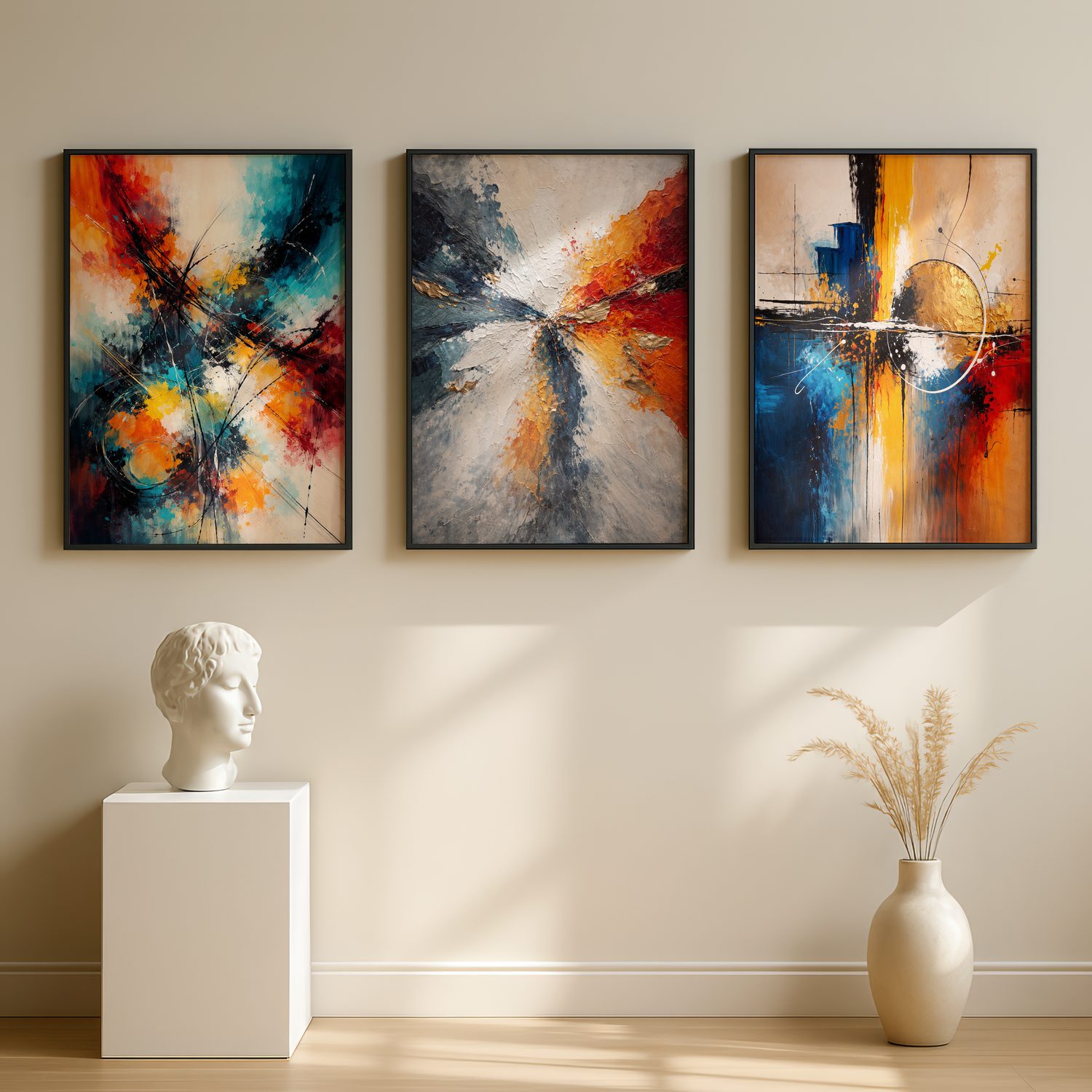
View Bold Abstract Expressionist Set on Rustic Charm → from ₹4,999
The four arrangement patterns that work
There are exactly four layouts that solve a tall wall well. Everything else is a variant of these four.
Pattern 1 — The Vertical Column. A set of three canvas paintings stacked one above the other, evenly spaced 4 to 6 inches apart, centred on the wall. This is the safest, most forgiving layout for first-time double-height styling. It works in living rooms with foyer overlap, behind sofas, and on the wall opposite a staircase. A set-of-three column on 20" × 30" canvases covers about 8 feet of vertical real estate, which is the lower half of most double-height walls — exactly where the human eye lingers.
Pattern 2 — The Oversize Statement. One very large canvas — 48 inches or wider on the long edge — hung as the single hero of the wall. Works best with abstract or impressionist subjects (a literal landscape can look like wallpaper at scale). The centre of the painting should sit between 5'3" and 6 feet off the floor — slightly higher than single-storey rules to compensate for the ceiling height, but never so high that you have to crane your neck from the sofa.
Pattern 3 — The Anchored Gallery. A loose grid of 4 to 6 mid-sized canvases (say, 16" × 24"), arranged in two rows and following the bottom 60 percent of the wall. Leave the upper 40 percent of the wall deliberately empty — that emptiness is the breathing room a double-height ceiling is designed to give you. Anchor the gallery's bottom edge about 8 to 10 inches above your sofa back.
Pattern 4 — The Sconce-Flanked Focal. Pair a vertical canvas (single or set) with two wall-mounted sconces on either side, mounted so the light spills upward across the painting. This is the trick architectural digest writers reach for when the wall is wider than 10 feet — the sconces stretch the apparent width of the art and give the upper half of the wall a soft glow at night.
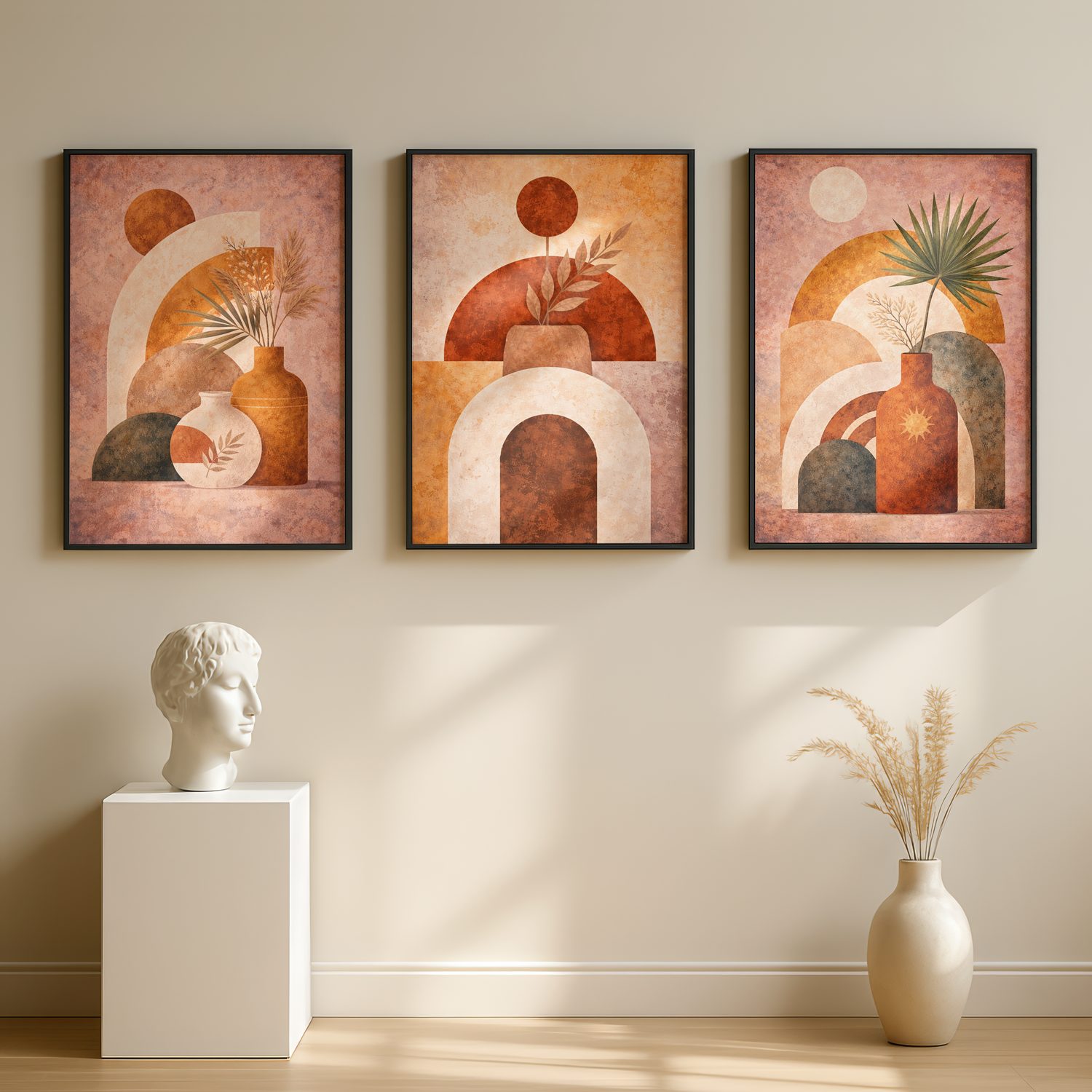
View Boho Abstract Arches Set on Rustic Charm → from ₹4,999
Sizing maths for the tall wall
Sizing is where most homeowners freeze. Here's the rule we use in our internal design briefs, derived from years of looking at "I bought the wrong size" customer photos.
| Wall vertical rise | Recommended canvas (single) | Recommended set-of-3 |
|---|---|---|
| 12–14 ft (mezzanine living room) | 40" × 60" | 3 × (16" × 24") |
| 14–18 ft (G+1 duplex villa) | 48" × 72" | 3 × (20" × 30") |
| 18–22 ft (penthouse, double-height) | 60" × 90" | 3 × (24" × 36") or larger |
| 22+ ft (cathedral / mezzanine-overlook) | Custom large-format or multi-set arrangement | 2 stacked sets of 3 |
A second rule that overrides the first: never let your art occupy less than 60 percent of the available wall width. If your wall is 14 feet wide and your canvas is 36 inches, the canvas is using only 21 percent of the wall — it will read as a misjudgment to every guest who walks in. Go up two size brackets or switch to a vertically-stacked set of three.
Sizing is also where the "set of three" format earns its place in Indian homes. A vertically stacked triptych — three canvases at 20" × 30" each with 5 inches of breathing room between them — covers 8 feet of vertical real estate while staying within a budget of ₹15,000–₹20,000 framed. A single 60" × 90" canvas at comparable visual weight costs three to four times as much, and is harder to ship, mount, and re-locate if you move flats.
A word on the vocabulary — "canvas painting" vs "canvas print"
In India, "canvas painting" is the everyday term for what the art industry calls a giclée canvas print — an ultra-high-resolution reproduction of an original artwork, printed with archival inks onto 300 GSM cotton canvas, then hand-stretched on a wooden frame. Unlike a hand-painted original (which ranges ₹50,000+ for a comparable size), a giclée canvas print delivers the same visual impact at D2C prices, with superior longevity and consistency. So when this guide talks about "wall paintings for double-height living rooms," it's referring to giclée canvas prints sized for that proportion. The hand-painted alternative exists, but it's a different conversation, a different price, and a different repair experience when monsoon humidity bleeds the colour.
What to do about the TV unit
The TV-wall problem is the single most common pain we see in Reddit threads about double-height living rooms — and one of the six recurring user mistakes our content team mined when planning this guide. A 55 to 75 inch television sits on the lower third of the tall wall, and the 12 to 16 feet of wall above it stares back, empty.
There are three good answers.
Option A — Build art around the TV. Hang the television at standard height (centre of screen 42 inches off the floor for a 65 inch TV). Above it, place a horizontal canvas — 36 to 48 inches wide — at least 12 inches above the TV's top edge, so the two never visually merge. Two smaller verticals flanking the TV can complete the grid. This is the safest fix when the TV is the wall's hero.
Option B — Let the art be the hero, demote the TV. Mount a slim-bezel TV on a swing-arm that tucks behind a vertical canvas column when not in use. The art becomes the room's identity; the TV is a tool that comes out at 9 pm. This requires fittings work, but it's the most photographed solution in Indian villa interior shoots.
Option C — Ignore the TV wall entirely. If your double-height wall is on the opposite side of the room (often the case in villas where the staircase wall is also the tallest), put the TV on a single-storey wall and let the tall wall be a pure art wall. This is the easiest fix and the one that frees you to use the biggest format the wall will take.
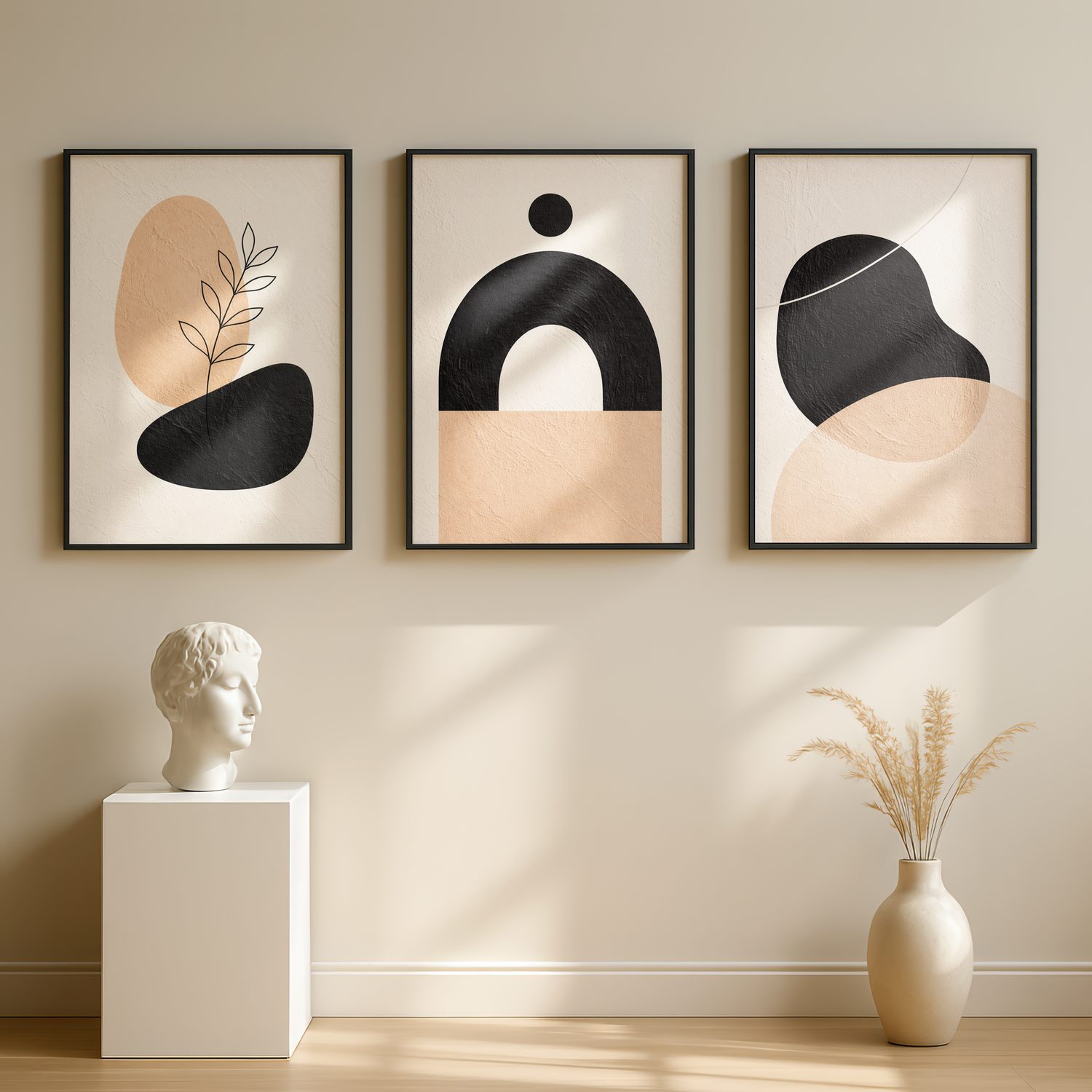
View Abstract Minimalist Set on Rustic Charm → from ₹4,999
The staircase-and-foyer overlap
In most Indian double-height villas, the tall wall is shared with the staircase landing — the stairs climb past the living-room wall, and the upper-floor balcony or mezzanine looks over the seating. This is both a problem and a gift. A problem because the art has to be readable from three points of view: sitting on the sofa, climbing the stairs, and standing on the balcony looking down. A gift because the same canvas earns three viewing moments per visit instead of one.
The trick is to centre the visual mass of the art roughly at the height of the first-floor landing — 8 to 10 feet off the ground-floor floor. This is the height at which someone halfway up the staircase sees the art at eye level. It's also high enough that the canvas reads as art-on-the-wall to a sofa-sitter (rather than art-above-the-sofa, which is the wrong scale for the space). And it's positioned where a balcony viewer looks straight across at the top edge of the painting, not down at it.
If your staircase has a landing window that lets in afternoon light, hang the canvas opposite the window so the light skims across the surface — but never directly across from a south-facing window, which will fade even archival inks faster than the 200-year manufacturer claim. Use sheer curtains on the landing window if you can't relocate.
Lighting the tall wall
Most Indian double-height living rooms are under-lit at the upper half of the wall. The pendant chandelier handles the centre of the room and the floor lamps handle the seating, but the wall art — especially anything mounted above 8 feet — sits in shadow after sunset. Three small lighting moves change the room.
Wall-mounted picture lights clip to the canvas frame and throw a warm wash of light across the surface. The 3000K warm-white LED versions cost ₹1,500 to ₹4,000 and run on a low-voltage transformer that hides behind the canvas. They work best with single oversize canvases.
Adjustable spot tracks in the ceiling — the same recessed-spot fixtures that light the dining table — can be re-angled to graze the canvas at a 30-degree angle. This is the museum-grade lighting trick. It removes shadows from texture and makes a hand-stretched canvas look three-dimensional.
Up-lit floor sconces in the corner of the room, pointing up the wall, soften the entire vertical plane. They don't light the art directly but they keep the upper half of the wall from going pitch-black at night, which preserves the tall-ceiling effect after sunset.
Vastu and directional placement for the tall wall
In Vastu-aligned interior planning, the tall wall — usually the north or east wall in a properly oriented Indian villa — carries a different energy responsibility than a standard single-storey wall. The vertical rise is meant to draw prana (life energy) upward, and the art on that wall is read as a directional cue, not just decoration. The classical text Mayamatam describes upward-facing imagery on tall walls as "movement-bearing" — placement that supports vitality, ambition, and household momentum.
Three working principles apply. First, prefer imagery that includes upward motion — abstract verticals, rising forms, flowers reaching skyward, mountains, the climb of a staircase, sunrises rather than sunsets. Second, lighter palettes and white/cream backgrounds suit the north-east wall; deeper earth tones (terracotta, indigo, charcoal) suit the south-west. Third, avoid imagery that "weights downward" — drooping branches, sleeping figures, water flowing down, low horizons — on a tall wall, where they can read as energy slumping rather than rising. None of this is dogma; it's directional pattern matching, useful even if you don't subscribe to the larger framework.
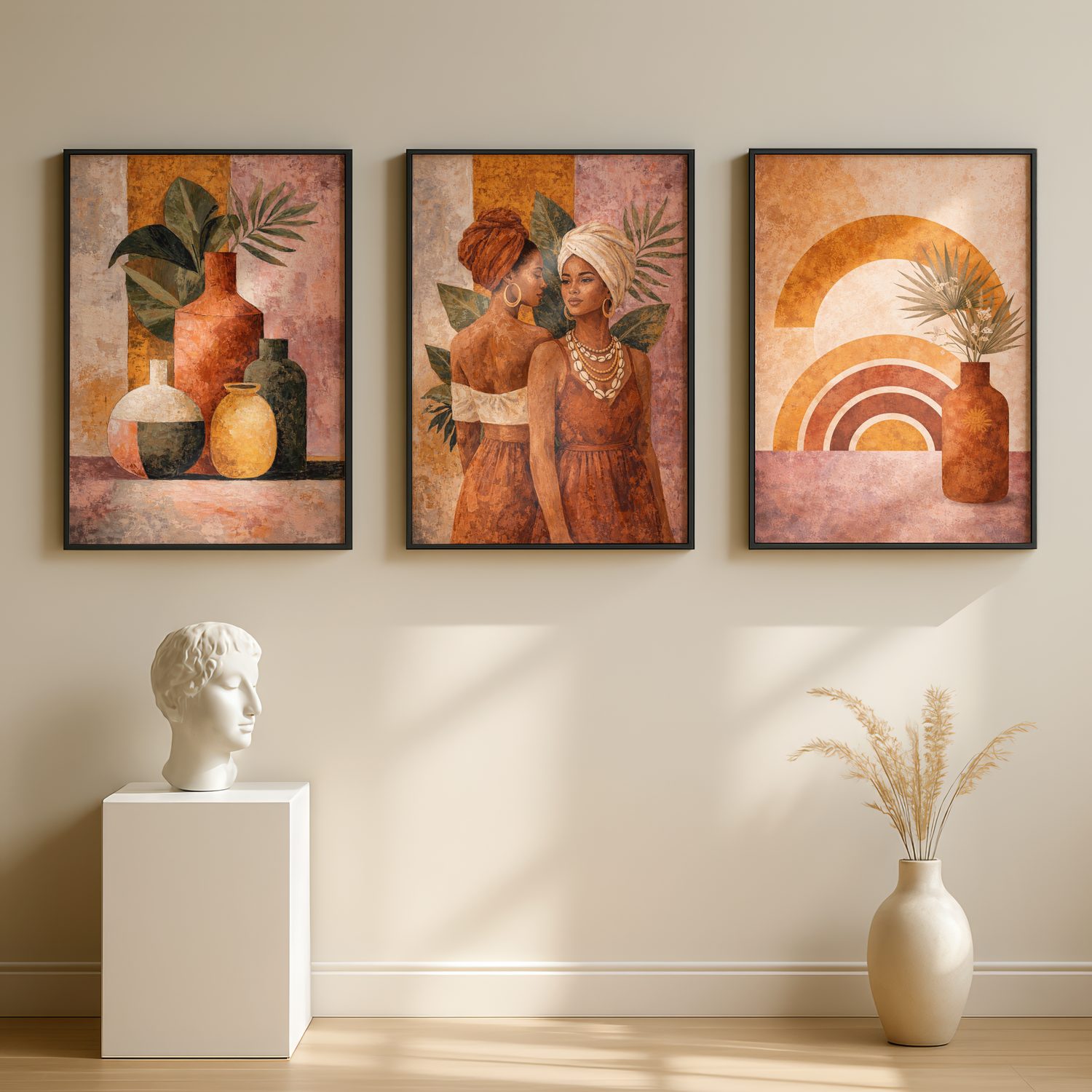
View Boho African Set on Rustic Charm → from ₹4,999
Five mistakes we see in customer photos
These five mistakes account for almost every "the canvas looks too small" or "the wall still feels empty" message we receive after a double-height delivery.
Mistake 1 — Centring a single 16 × 24 canvas on the wall. The size is right for a single-storey wall and entirely wrong for a tall one. Either size up two brackets or switch to a vertical set of three.
Mistake 2 — Hanging the canvas above the sofa at standard height. Standard height (centre of art 57 inches off the floor) puts the art well below the visual horizon of a double-height wall. Move the centre to 5'3"–6 feet, or stack vertically so the top of the column reaches 9–10 feet.
Mistake 3 — Treating the staircase wall and the living-room wall as separate styling problems. They aren't. The art on the shared tall wall has to work for both sight lines. Plan for the staircase climber, the balcony viewer, and the sofa sitter.
Mistake 4 — Ignoring the upper third of the wall. It doesn't need to be filled — empty is a valid choice — but it shouldn't be accidentally empty. Either commit to leaving the upper third bare (and use the lower two-thirds intentionally), or fill it with a tall vertical, a chandelier extension, or a sconce arrangement.
Mistake 5 — Buying a frame too thin for the size. A 60 inch wide canvas with a 1.5 inch gallery wrap looks underweighted. Specify a 1.75 to 2 inch frame depth on anything 40 inches wide and up — it gives the canvas a physical presence that matches the wall's scale.
Why we build canvas paintings specifically for tall walls
Almost every set-of-three canvas painting we ship is, in some sense, built for a tall wall — vertically stackable, frame-matched across the three pieces, and printed to a colour profile that holds up when grazed by directional light. The 300 GSM acid-free cotton canvas we use carries archival ink for 200 years of fade resistance, the hand-stretched wooden frame stays flat in monsoon humidity, and the gallery-wrap option lets the colour bleed onto the canvas edge — useful when the canvas is viewed from the side from a staircase landing.
We also build sets to a fixed visual rhythm — the same colour family carried across three canvases, with each canvas reading as a self-contained piece that also belongs to the group. That's the property a vertical stack needs to look intentional rather than coincidental. AI-generated art and free-art sites can replicate a single canvas convincingly. What they don't replicate — and what years of building these specifically for Indian double-height spaces teaches you — is the rhythm and edge-match of three canvases that have to live together on the same wall.
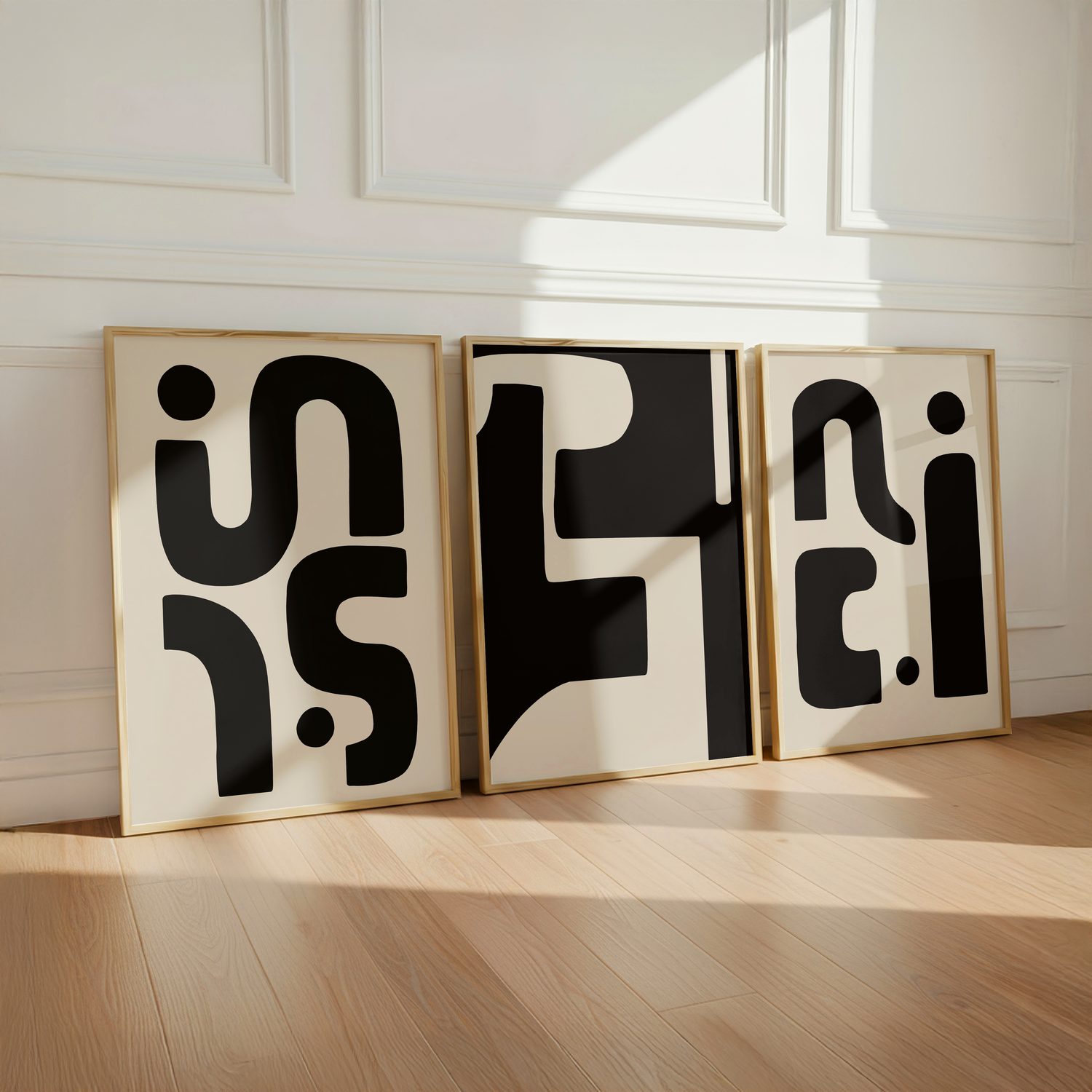
View Black White Abstract Set on Rustic Charm → from ₹4,999
A budget map
You don't need to spend more than ₹20,000 to do this well. Here's the actual price map for a fully styled double-height tall wall using our canvases.
The minimum-viable arrangement is a single 20" × 30" canvas painting in the gallery-wrap finish at ₹4,999 — but this works only on walls under 14 feet of rise. On a true 18-foot wall, plan for a set-of-three Canvas Prints Set of 3 starting at ₹4,999 for the gallery-wrap small variant (covers about 6 feet of vertical real estate) or ₹15,999 for the framed-medium variant in Black, Dark Brown, White, or Vintage Blue (covers about 8 feet — the most-photographed option in our customer galleries). Add a pair of brass-finish picture lights from a local lighting brand at roughly ₹3,000–₹5,000 the pair, and the entire wall costs ₹20,000 — less than most Indian families spend on a single piece of furniture.
If you want a more layered look, combine a vertical set-of-three column with two flanking single canvases (say, two Rose Garden or Wildflower Meadow florals at ₹1,899 each in small format) to create the Anchored Gallery layout from earlier in this guide. The total stays under ₹25,000 — and the wall earns its place as the room's identity.
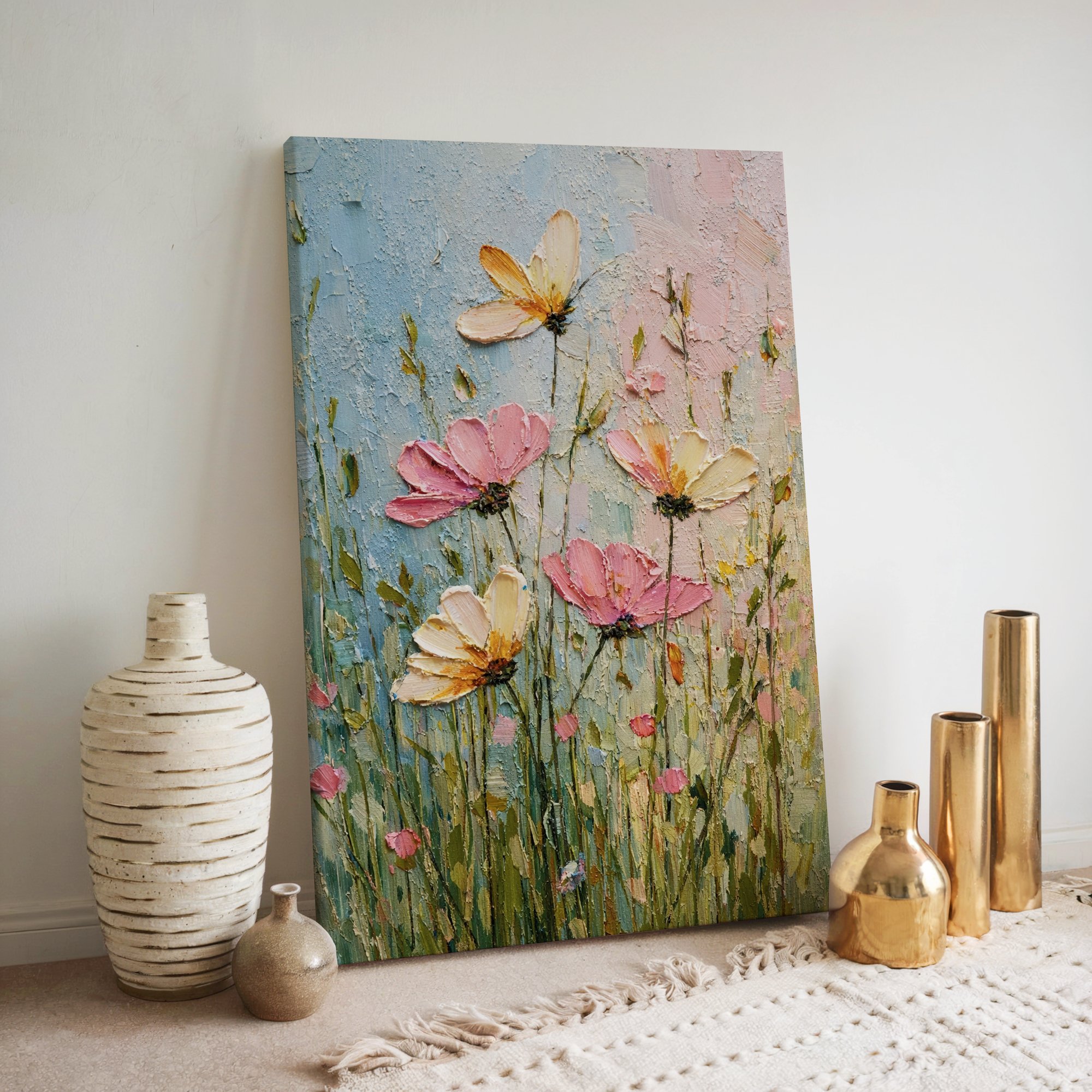
View Rose Garden Canvas on Rustic Charm → from ₹1,899
How this guide connects to the rest of the Rustic Charm playbook
If your double-height living room shares a wall with the staircase, our wall art for staircase landings guide covers the climber's-eye-view sizing and the directional Vastu placement specific to that overlap. If you're working with a more standard ceiling height, the wall art for living room Indian home decor guide covers single-storey layouts, sofa-relationship sizing, and Indian-room-specific styling. For the vertical-stacking arrangements specifically, our wall art set of 3 styling guide goes deeper on triptych composition, spacing, and how to read a three-canvas rhythm. And if you want to understand how art colour will land in a double-height room — where vertical scale amplifies tonal effects — the wall art colour psychology guide is the bridge between this guide and your final palette choice.
For the gallery layout in Pattern 3 above, the gallery wall ideas for Indian homes guide has the spacing and grid maths. For the hanging mechanics of any of the four patterns, the how to hang canvas art complete guide covers wall-anchor selection for the heavier set-of-three formats.
Ready to bring this look home?
Browse our full Canvas Wall Art Set of 3 collection and the Abstract Wall Art collection — giclée canvas paintings hand-stretched on 300 GSM acid-free cotton, delivered free across India on orders above ₹5,000.
Frequently asked questions
Q: What is the right size of wall art for a double-height living room? A: For a tall living-room wall, the dominant art should span at least two-thirds the wall's width and 40 to 60 percent of its vertical rise. On a typical 12 foot wide, 18 foot tall wall, that means a single canvas of 48"–60" wide, or a vertically stacked set of three 20" × 30" canvases (covering about 8 feet of vertical real estate). Smaller single pieces will look marooned — the wall is the canvas, the art has to match its scale.
Q: How high should I hang art on a double-height living-room wall? A: Hang the visual centre of the art between 5'3" and 6 feet off the floor — slightly higher than the standard 57-inch rule because the ceiling height changes the visual horizon. If you're using a vertical set-of-three column, anchor the bottom canvas about 12 inches above the sofa back, then let the column climb naturally — the top piece should land between 9 and 10 feet off the floor.
Q: How do I decorate the empty wall above the TV in a double-height living room? A: Three working answers — (1) hang a horizontal canvas 36 to 48 inches wide at least 12 inches above the TV's top edge, with two smaller verticals flanking the TV; (2) mount the TV on a swing-arm so it tucks behind a vertical canvas column when off; or (3) move the TV to a different wall entirely and treat the tall wall as a pure art wall. Option 3 is the easiest and most photographed.
Q: Should I use one large canvas or a set of three on a tall wall? A: A set of three is more forgiving and easier on the budget — a set-of-three at 20" × 30" each covers 8 feet of vertical real estate from around ₹4,999. A single oversize canvas (48" wide or larger) makes a stronger single statement but costs three to four times more, weighs more, and is harder to relocate if you move flats. For first-time double-height styling, start with a vertical set-of-three; size up to a single statement piece once you know the wall and the room.
Q: What colour wall art works best in an Indian double-height living room? A: Follow the directional rule. North and east walls — most-common in Vastu-aligned villas — take well to lighter palettes, white backgrounds, soft earth tones, and rising imagery (flowers, abstract verticals, sunrise scenes). South and west walls take well to deeper terracotta, indigo, charcoal, and grounding imagery. The actual subject matters less than the directional fit and the rhythm of the colour family — three canvases in the same colour family always outperform three canvases in three different palettes, no matter the wall.
Q: How do I light a tall wall so the art is visible at night? A: Three options, used alone or layered. Wall-mounted picture lights that clip to the canvas frame (₹1,500–₹4,000 each, warm 3000K LED). Adjustable ceiling spots re-angled to graze the canvas at 30 degrees — museum-grade lighting that costs nothing if your house already has track lighting in the living-room ceiling. Floor sconces in the corner pointing up the wall, which soften the entire vertical plane and prevent the upper half of the wall from going pitch-black at night. The combination of a picture light on the art plus a corner up-lighter is the gold standard for a true 18+ foot wall.
Q: Will a giclée canvas painting fade on a sunlit double-height wall? A: Our 300 GSM acid-free cotton canvas with archival inks is rated for 200+ years of fade resistance under normal indoor conditions. The catch is "normal indoor conditions" — direct sunlight all day through a south-facing window will accelerate fading on any pigment, archival or otherwise. The fix is simple: use sheer curtains on a south-facing window opposite the canvas, or hang the canvas on a wall that gets indirect light rather than direct beam light. Most Indian double-height walls are on the north or east side anyway, which is ideal.