
What is a wall art set of 3?
A wall art set of 3 — also called a triptych — is one composition split across three coordinated canvases, designed to hang side-by-side as a single visual statement. The format dominates Indian living rooms because it fills wide walls (sofas, dining sideboards, bed headboards) better than a single canvas can, while staying lighter on the wall and on the wallet.
You're reading this because you've already half-decided you want one. Good — sets of 3 are the most under-rated decorating tool in an Indian home. This guide explains exactly how to pick the right one, what size to buy, how to hang it, how to space the panels, and which mistakes quietly ruin most triptychs you've seen on Instagram.
In India, "canvas painting" is the everyday term for what the art industry calls a giclée canvas print — an ultra-high-resolution reproduction of an original artwork, printed with archival inks onto 300 GSM cotton canvas, then hand-stretched on a wooden frame. Unlike a hand-painted original (which ranges ₹50,000+ for a comparable size), a giclée canvas print delivers the same visual impact at D2C prices, with superior longevity and consistency.
Why the Set-of-3 Format Works Better Than a Single Canvas
A single 24" × 36" canvas is dramatic, but it's also a commitment — one frame, one focal point, one direction. A set of 3 distributes the same visual weight across a wider span (typically 60"–72" total when hung with proper spacing), which is closer to the actual width of an Indian sofa or king-bed headboard. Interior designers refer to this as the "two-thirds rule": art should occupy roughly two-thirds of the furniture beneath it. A triptych hits that ratio without forcing you to buy a single oversized panel that costs three times more to ship and is nearly impossible to align on the wall.
The 2024 Houzz India Home Decor Survey reported that 58% of urban Indian homeowners chose multi-panel art for living and dining spaces, citing "balanced look" and "fits long walls" as the top reasons. The format also makes mistakes more forgiving — if one panel hangs slightly off, the eye reads the trio as one unit and the imperfection blurs out.
A Quick Visual Check Before You Buy
Set-of-3 prints can go cohesive (same scene split into thirds), parallel (three variations of the same theme), or contrasting (three connected but distinct images). Cohesive triptychs feel calmer; parallel sets feel more curated; contrasting sets feel more editorial. Indian homes with bold floor tiles, carved furniture, or saturated upholstery usually look best with parallel or quietly cohesive sets — contrasting triptychs need a minimal room to read clearly.
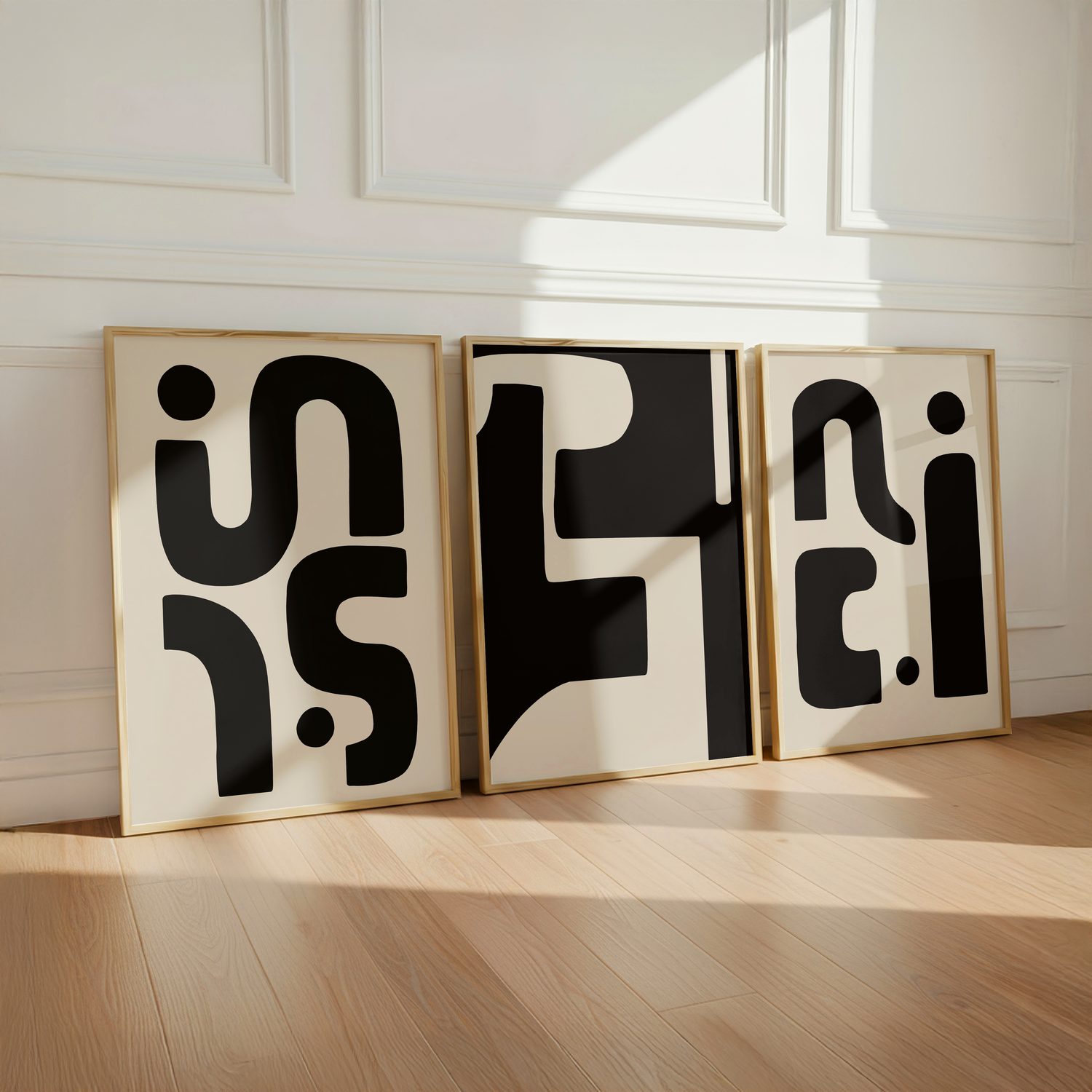
View Black & White Abstract Set of 3 on Rustic Charm → from ₹4,999
Step 1 — Measure Your Wall, Then Subtract
Most styling mistakes happen here. Before opening any shopping tab, measure the empty wall above your sofa, bed, or sideboard in centimetres. Multiply that width by 0.66 — that's your target triptych span (panels + the gaps between them). For a standard 6-foot Indian sofa (180 cm wide), the ideal span is roughly 120 cm. Three 12" × 18" canvases (each ~30 × 46 cm) hung with 5 cm gaps fill 100 cm — a touch short. Three 16" × 24" panels (each ~40 × 61 cm) hung with 5 cm gaps span 130 cm — the sweet spot.
If your wall is wider than 220 cm (over a 7-foot sofa or a king bed) move up to three 20" × 30" canvases. Anything smaller will look apologetic. The opposite is also true — squeezing a 20" × 30" set of 3 into a narrow alcove makes the wall feel cramped and the art feel oversized.
Step 2 — Choose a Style That Cooperates With Your Room
A set of 3 is louder than a single canvas, even when each panel is small, because the eye reads three frames as one wide event. That means the style has to negotiate with the existing room — not fight it. Below is a quick fit map drawn from styling 200+ Indian living and bedroom installs.
Boho earthy sets — terracotta, sage, rust, cream tones — pair well with cane furniture, natural fibre rugs, brass accents, and warm wood floors. They work especially hard in rooms with a lot of beige drywall that needs warmth.
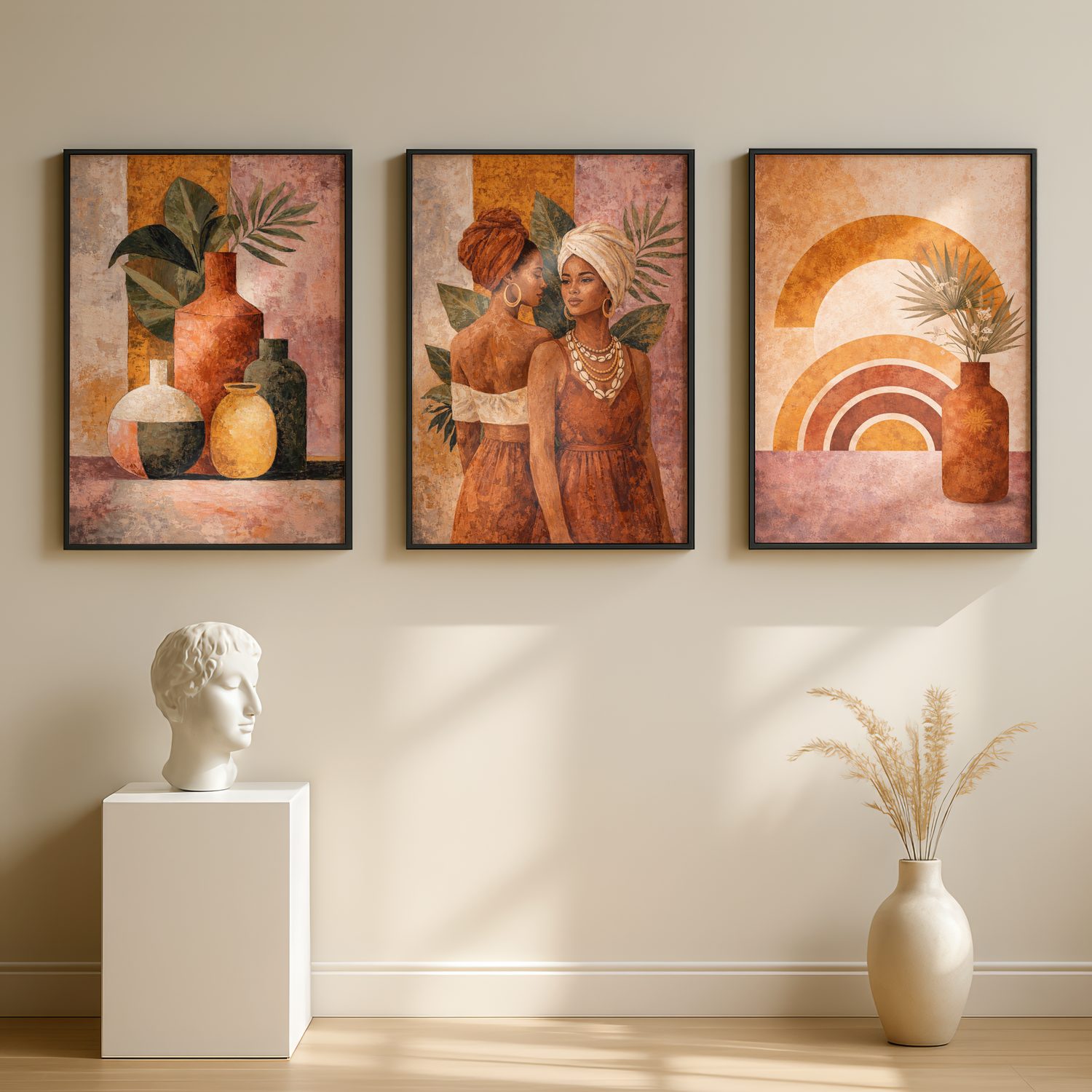
View Boho African Set of 3 on Rustic Charm → from ₹4,999
Minimalist sets — black, cream, peach, soft greys — slot effortlessly into Scandinavian-leaning Indian flats, white-walled rentals, and rooms with strong architectural lines (arches, exposed concrete, large windows). They're the safest pick if you change your sofa fabric every few years.
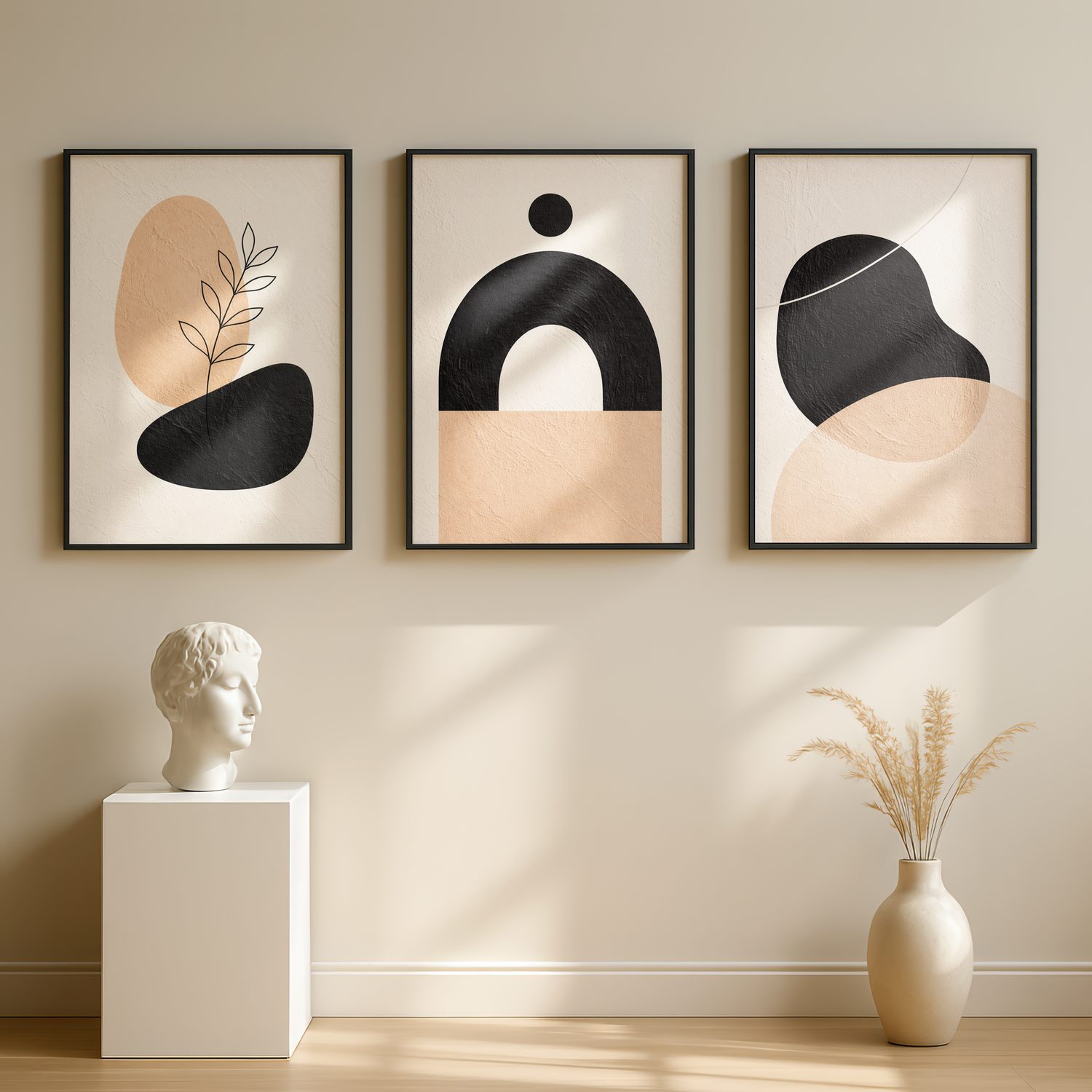
View Abstract Minimalist Set of 3 on Rustic Charm → from ₹4,999
Bold expressionist sets — teal, red, gold, burnt orange, electric blue — are the right call for rooms that already lean colourful: jewel-toned upholstery, dark wood, kilim rugs, gallery walls that need an anchor. Don't pair them with already-busy patterned walls.
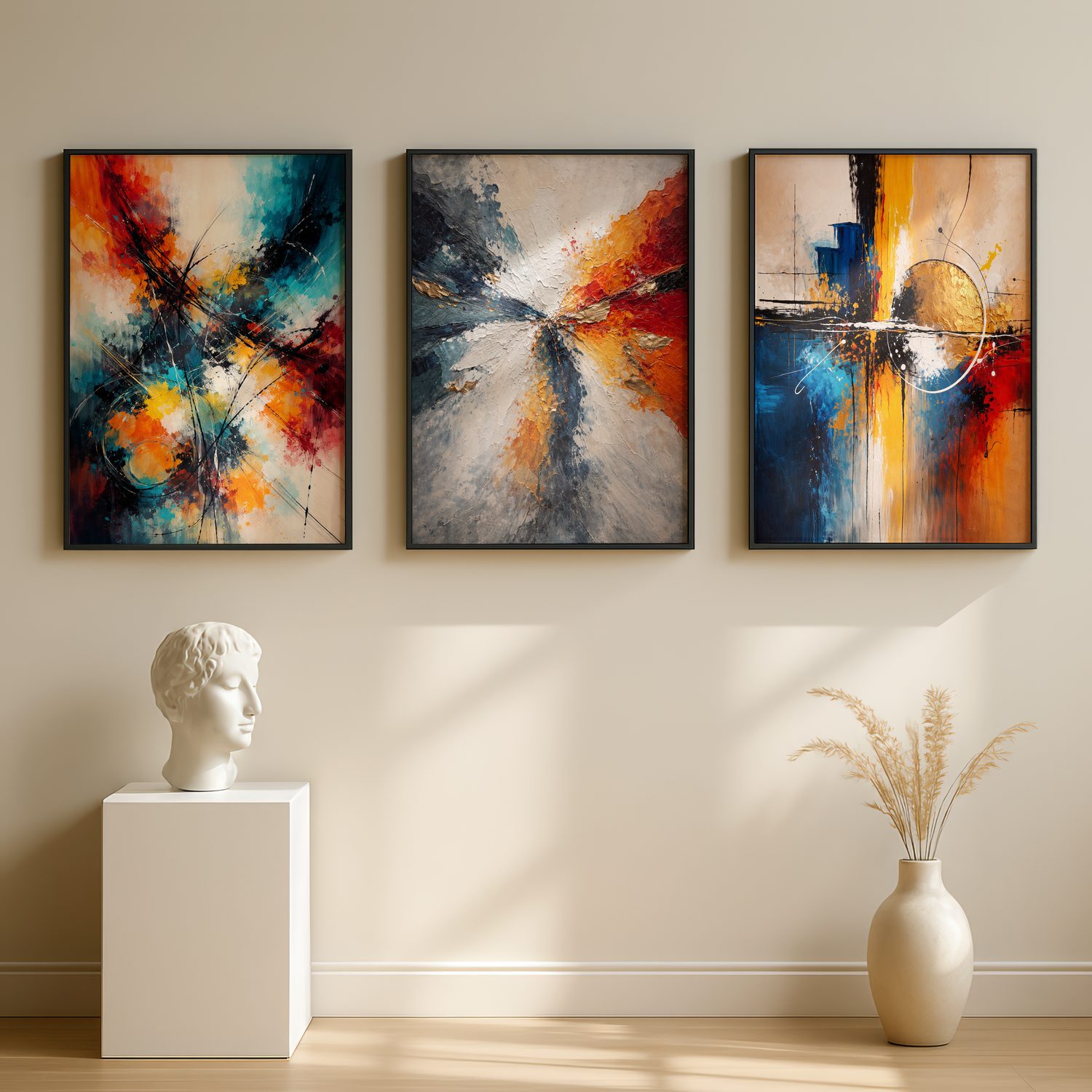
View Bold Expressionist Set of 3 on Rustic Charm → from ₹4,999
Step 3 — Decide Hanging Height and Spacing
Hang the centre line of the triptych at 145–155 cm from the floor — that's roughly average eye-level for an Indian standing adult, the same height museums use for single-panel art. If the set hangs above a sofa, leave 18–25 cm between the top of the sofa back and the bottom edge of the lowest canvas. Less than 15 cm and the art looks pinched against the furniture. More than 30 cm and the art floats — your eye won't connect the trio to the sofa beneath.
For panel-to-panel spacing, the working rule is 5–8 cm between canvases. Less than 5 cm and the gaps disappear from a normal viewing distance; the trio reads as one mismatched panel. More than 10 cm and the eye stops grouping them — they read as three unrelated frames. If you want a single-image-feel triptych (one painting cut into thirds), stay at 5 cm. If you want a curated-gallery feel (three coordinated but distinct images), go to 7–8 cm.
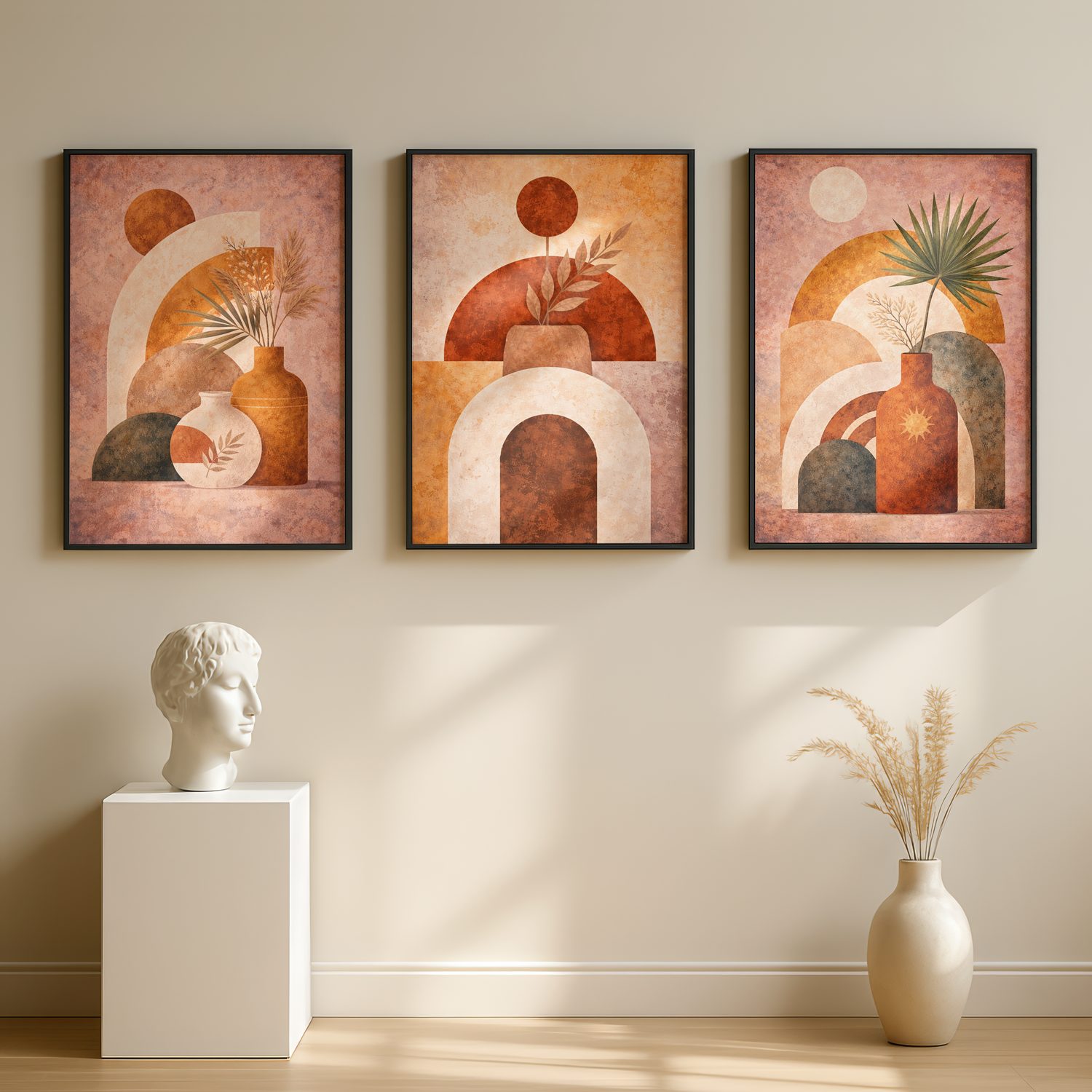
View Boho Abstract Arches Set of 3 on Rustic Charm → from ₹4,999
Step 4 — The Right Hanging Order Is Not Always Left-to-Right
Most triptychs are sold with a clear designed order — there's a left, a middle, and a right panel that read as one composition. Always check the product photos. Some Rustic Charm sets are numbered on the back of the stretcher bars.
If the set is parallel (three independent but coordinated images, no continuous lines crossing panels), you have flexibility. The general styling rule: place the visually heaviest or warmest-toned panel in the middle. The middle panel becomes the anchor; the two outer panels frame it. If two panels look similar and the third is distinct, the distinct one goes in the centre — never on an edge, where it makes the whole arrangement look unbalanced.
For vertical stacks (three panels hung one above the other in a narrow column — useful for stairwells, corridor walls, alongside tall doorways), keep 4–5 cm spacing and centre on the wall's vertical axis.
Step 5 — How to Hang a Set of 3 Without Drilling Six Holes Wrong
Indian walls are mostly RCC with a brick layer, which means every hole is a commitment. Measure twice, drill once. The fastest method: cut three sheets of newspaper to the exact size of each canvas, including the depth (most gallery-wrap canvases are about 3.8 cm thick). Tape the paper templates to the wall in the configuration you want. Step back. Walk into the room from the doorway. Sit on the sofa. Adjust until you genuinely like the look from every angle you'll actually see it from.
Once the templates are right, mark the hook position on each (most canvases use a sawtooth bracket that sits 5–10 cm down from the top edge — measure your specific frames). Drill, hammer in plastic anchors, then transfer the canvases. Use a 60 cm spirit level across all three canvases together — not panel by panel — to make sure the trio reads as a single horizontal line.
If you rent and can't drill, our renter-friendly hanging guide for Indian apartments covers Command strips, adhesive hooks, and picture rails that hold gallery-wrap canvases without damage.
Set of 3 Sizes — A Reference Table for Indian Homes
The numbers below are the spans we install most often. Each canvas is gallery-wrap on 300 GSM cotton with a 3.8 cm depth, so the wall presence is slightly more dramatic than the panel size suggests.
| Panel Size | Each Canvas | Total Span (5 cm gaps) | Best Wall Width | Typical Use |
|---|---|---|---|---|
| Small | 12" × 18" (30 × 46 cm) | ~100 cm | 150–170 cm | Bedroom dresser, kids' room, console table |
| Medium | 16" × 24" (40 × 61 cm) | ~130 cm | 180–210 cm | 6-foot sofa, queen-bed headboard, dining sideboard |
| Large | 20" × 30" (50 × 76 cm) | ~165 cm | 220–260 cm | 7-foot sofa, king-bed headboard, double-height living rooms |
If your wall is wider than 260 cm and you still want a triptych look, pick the large size and increase panel spacing to 8–10 cm — it carries the extra width without forcing you up to a custom oversized print.
Set of 3 vs Single Canvas vs Gallery Wall
A single oversized canvas (one panel, 30" × 40" or larger) makes the strongest single statement, but it's heavy, harder to pack and ship within India without damage, and inflexible — once you hang it, you cannot adjust the proportion. A set of 3 hits 80% of the visual impact at roughly the same total cost, ships in three smaller boxes (much safer in transit), and lets you rebalance the spacing as your sofa or upholstery changes. A gallery wall (5–9 mismatched frames in an organic cluster) is more personal and more time-consuming to plan; it's the right choice for staircases, long corridors, and homes with a strong collected-over-time aesthetic — covered in our gallery wall ideas guide for Indian homes.
A 2024 Mintel India Furnishings Report noted that 41% of decor purchases in the ₹4,000–₹6,000 bracket in tier-1 Indian cities were multi-panel canvases — the format has quietly become the default upgrade from a single framed print, especially in metro flats where wall space is fixed but tastes change.
Set of 3 in Specific Rooms
Above the sofa (living room): the most common placement. Pick medium or large, centre on the sofa (not the wall — the wall may be wider than the seating), hang at 145 cm centre line. If you have a long sectional, the triptych centres on the sectional's mid-point, even if that's off-centre to the wall. See our full wall art for living room guide for a deeper room-specific breakdown.
Above the bed (bedroom): keep the bottom edge 25–30 cm above the headboard so the panels don't clip you when you sit up. Soft palettes work better here than bold ones — bedrooms benefit from low-arousal colour. Calm sets in cream, sage, dusty rose, soft black, or muted blue are easier to live with than vivid sets.
Dining room: a triptych above the buffet or sideboard creates a strong frame for hosting photos. Indian dining rooms often have warm wall colours; choose a set that complements rather than competes — boho earthy or minimalist tend to land well. More guidance in our wall art for dining room article.
Home office / study: a black-and-white or minimalist set behind your desk lifts video calls and helps focus. Avoid high-saturation sets behind your chair — they pull attention in calls.
Entryway / foyer: a vertical stack of 3 narrow panels works better than a horizontal triptych here, since most foyer walls are taller than wide. See more on first-impression entryway styling.
Mixing a Set of 3 With Other Wall Art
Don't. Or at least, don't on the same wall. A triptych is already a complete composition — adding a fourth piece beside it almost always breaks the rhythm. If you need more art on the same wall, use a tall console table, a floor-standing plant, or a sculptural light to extend the visual line, not another frame.
On adjacent walls (for example, the wall perpendicular to your sofa wall), you can hang a single complementary canvas — preferably from the same colour family but a different scale and orientation. The trick is to repeat one element (palette, mood, or style) and vary another (size, format, placement height). This is the same principle interior designers call "rhyming, not matching."
Budget — What ₹4,999 Actually Buys You
A typical good-quality canvas set of 3 in India ranges ₹3,500–₹15,000 depending on size, material, and frame. Below ₹3,000, sets are usually thin paper-stretched panels with stapled MDF backs that warp in monsoon humidity within 18 months — the saving is rarely worth it. Above ₹10,000, you're typically paying for designer-licensed art, hand-finishing, or custom framing.
The Rustic Charm set-of-3 line sits at ₹4,999 across the range — three 16" × 24" panels printed on 300 GSM acid-free cotton canvas using giclée technology, hand-stretched on kiln-dried pine bars, with archival pigment inks rated for 200+ years of fade resistance when displayed away from direct sunlight. Frame options include gallery wrap (no external frame, the image continues around the canvas edges), black, dark brown, white, and vintage blue. Free shipping is included on orders above ₹5,000 across India.
Ready to bring this look home?
Browse our full Canvas Wall Art Set of 3 collection — coordinated triptychs in abstract, boho, minimalist, and bold expressionist styles, hand-stretched on 300 GSM acid-free cotton canvas, delivered across India.
Frequently Asked Questions
Q: What size wall art set of 3 should I buy for my sofa?
Match roughly two-thirds of the sofa width. For a standard 6-foot Indian sofa (180 cm), three 16" × 24" canvases hung with 5 cm gaps span 130 cm — the right ratio. For a 7-foot sofa or larger sectional, move up to 20" × 30" panels. Avoid the 12" × 18" small size over a regular sofa — it ends up looking under-scaled and floats.
Q: How much spacing should I leave between the three canvases?
5–8 cm between panels is the sweet spot. Less than 5 cm and the gaps vanish from normal viewing distance; the panels start to read as one mismatched canvas. More than 10 cm and the trio loses its grouping — your eye reads three unrelated pictures instead of one composition. Use 5 cm if the set is a single image split into thirds, and 7–8 cm if the panels are three coordinated but distinct images.
Q: Does the order of the panels matter?
Often yes. If the set is a continuous image — clouds, abstract waves, landscape — there's a designed left-middle-right order; check the product photos or the back of the stretcher bars. For parallel sets (three independent images), put the visually heaviest or warmest-toned panel in the middle and let the lighter panels frame it. The most off-balance arrangements come from putting the visually distinct panel on an edge.
Q: How high should I hang a triptych on the wall?
Centre line at 145–155 cm from the floor — the same height museums use, calibrated for average Indian standing adult eye-level. Above a sofa, leave 18–25 cm between the top of the sofa back and the bottom edge of the lowest canvas. Above a bed, leave 25–30 cm above the headboard so the panels don't clip you when you sit up.
Q: Can I hang a set of 3 without drilling holes — for a rental flat?
Yes, on most Indian rental walls. 3M Command strip large picture hangers hold each gallery-wrap canvas at this size without damage when applied to clean, smooth, primer-painted walls. For textured or distemper walls, adhesive hooks fail — use a leaning shelf, a picture rail, or wall-mounted brass rods instead. Full options are covered in our renter-friendly hanging guide.
Q: Gallery wrap or framed — which works better for a set of 3?
Gallery wrap (no external frame, image continues around the canvas edges) is the more contemporary choice and is what most Indian set-of-3 buyers pick — it hangs flush, weighs less, and lets the trio read as one continuous composition. Add a frame (black, dark brown, white, or vintage blue) when the room already has framed photos or framed mirrors and you want the art to match. Avoid mixing — either all three panels have the same frame, or none do.
Q: How do I clean and care for a canvas set of 3 in Indian humidity?
Wipe each panel gently with a dry, soft microfibre cloth every two weeks; never use water, glass cleaner, or kitchen sprays — they degrade the giclée pigment layer. During monsoon, ensure 5 cm of air circulation behind the canvas (gallery-wrap brackets handle this automatically) and avoid hanging directly above an unsealed window where rain spray reaches the wall. Acid-free 300 GSM cotton canvas, hand-stretched on kiln-dried pine, holds shape for decades when stored or displayed under these conditions.