Wall art for staircase landings should be sized to the wall's vertical rise and viewed from a moving angle — most Indian staircases work best with a single statement canvas at the landing turn or a 3-piece cascading set descending with the steps, hung at eye-level for the upward gaze, not the standing gaze.
That single sentence solves the most common staircase styling mistake: hanging art for someone standing still on flat ground, when in fact the viewer is climbing, descending, or turning. A staircase wall is not a normal wall. It is a moving canvas. The art has to work at every step, not just one.
This guide is built for Indian homes — narrow stairwells, mid-flight landings, marble or wooden treads, the tall foyer wall that a duplex opens onto, the awkward sloped bit between the ground floor and the first floor. We have pulled SERP data across the "wall art for staircase" cluster and 30+ Reddit threads from r/HomeDecorating, r/interiordecorating and r/IndianHomeDecor to get to the actual problems people hit (and the solutions that hold up). This is the styling guide that competing Indian e-commerce sites do not yet write.
A quick vocabulary note before we start. In India, "canvas painting" is the everyday term for what the international art industry calls a giclée canvas print — an ultra-high-resolution reproduction of an original artwork, printed with archival inks onto 300 GSM cotton canvas, then hand-stretched on a wooden frame. Unlike a hand-painted original (which ranges ₹50,000+ for a comparable size), a giclée canvas print delivers the same visual impact at D2C prices, with superior longevity and consistency. We will use "canvas painting" and "wall painting" through this guide as the search-friendly synonyms most Indian shoppers actually type — but the technical product is always a giclée canvas print.
Why staircase walls are different from every other wall in your home
A staircase wall has three constraints no other wall has. First, the viewing angle changes every second. You are walking. You see the art from below, at level, and from above — sometimes within five seconds. Second, the head tilt is upward, not horizontal — your eye is naturally pulled higher, so the art's centre needs to sit higher than the standard 57-inch (145 cm) gallery rule. Third, the wall surface is rarely flat or square — there is an angled rise, often a turn or a half-landing, and the dimensions are usually awkward enough that a single rectangular canvas centred on the wall will look slightly wrong.
The fix for all three problems is the same idea: let the art mirror the staircase's geometry instead of fighting it. If the steps go up diagonally, your art should either go up diagonally with them (cascading gallery wall) or hold a strong vertical anchor at the landing where everything pauses. Treating it like a living-room wall — one centred canvas at chair-rail height — is the single most common mistake on Indian Reddit threads about staircase walls.
According to industry data from the India Brand Equity Foundation (IBEF, 2024), India's home décor market is projected to grow at 12% CAGR to reach over $40 billion by 2027, with vertical-display walls (staircases, double-height living rooms, foyers) accounting for one of the fastest-growing styling categories in urban duplex and 3+BHK apartment homes. The demand is there. The styling guidance, particularly for Indian-format homes, is not.
The three layouts that actually work for Indian staircases
There are exactly three layouts that hold up across narrow, wide, straight, L-shaped and U-shaped Indian staircases. Pick one based on your stairwell's geometry, not on what you saw on Pinterest.
Layout 1: Cascading set of 3 (mirrors the steps)
This is the highest-converting layout for straight-flight staircases. You hang three canvases of the same size on a diagonal that follows the rise of the steps — each canvas sits roughly two to three steps above the previous one, with the bottom edge of each piece roughly aligned with the handrail or about 60 cm above it.
Because the layout repeats the staircase's angle, the eye never feels jarred. It is the only layout that reads correctly when you are mid-climb. A 3-piece cascading set also fills a tall, narrow surface without the "lonely canvas" problem that single pieces hit on long flights.
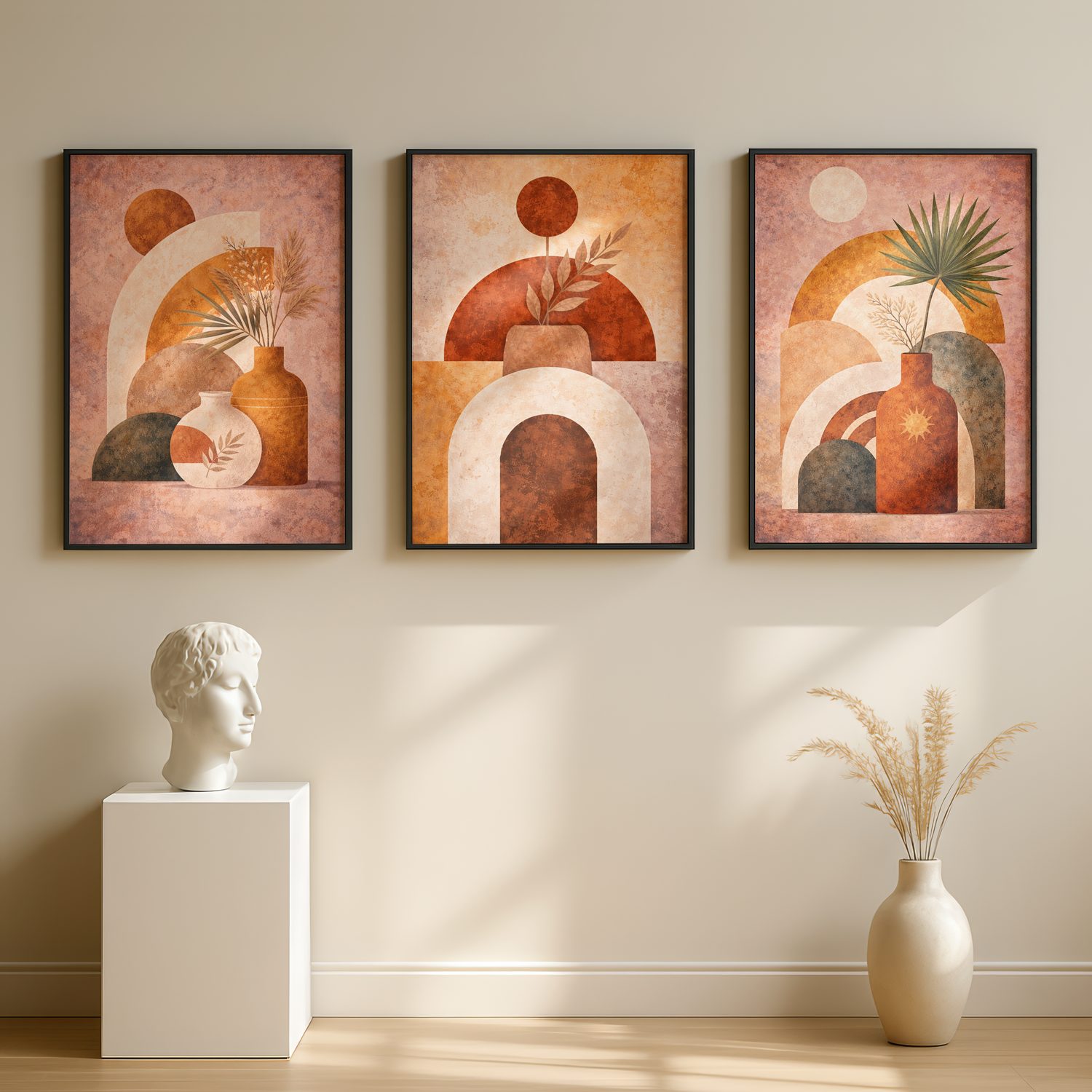
View Boho Abstract Arches Set on Rustic Charm → from ₹4,999
The Boho Abstract Arches set above works particularly well on staircases because each panel is independently composed — they read as three separate compositions cascading down, not three slices of one bigger image. That matters on a moving wall, because the eye needs a complete idea per step, not a fragment.
Layout 2: Single anchor on the landing wall (the pause point)
If your staircase has a half-landing (the small flat platform where the flight turns), that landing wall is the single best art real-estate in the entire stairwell. People physically pause there. Their eye stops moving. They actually look.
A single large canvas (60% to 75% of the landing wall's width) reads stronger than a gallery wall here. The viewer is already standing still — fragmenting the composition removes the impact. Pair this with empty space on the diagonal walls leading up to and away from the landing.
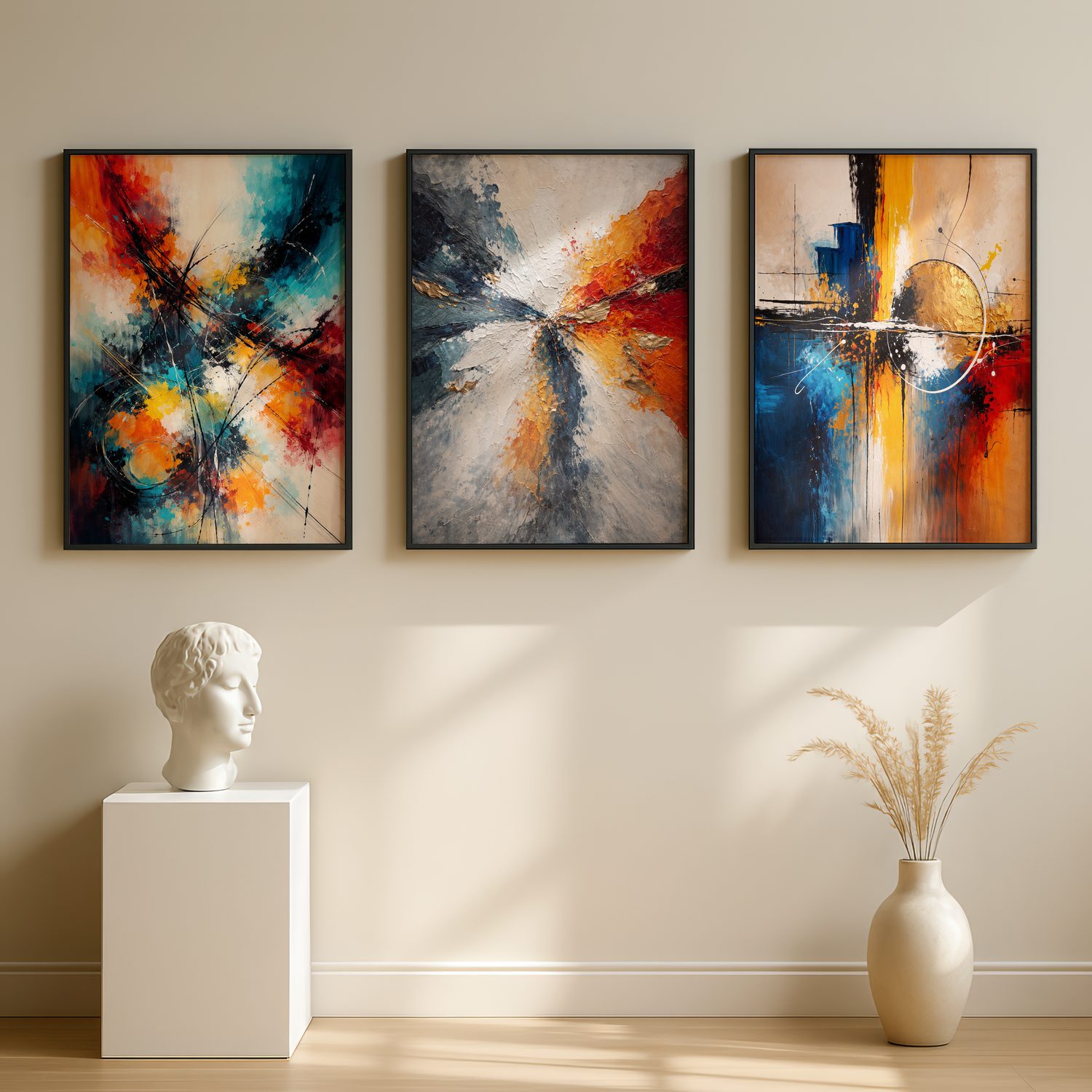
View Bold Abstract Expressionist Set on Rustic Charm → from ₹4,999
The Bold Abstract Expressionist piece works on landings because its colour saturation gives the wall enough visual gravity to anchor the entire stairwell — the diagonal walls leading up to it can stay bare, and the composition still reads as deliberate.
Layout 3: Photo grid or frame cluster (gallery-wall feel)
This is the layout most Reddit threads default to — and it works, but only if your staircase wall is long and visible end-to-end. A photo grid or frame cluster in a short, twisty stairwell looks busy and overwhelming. In a long, straight, well-lit flight, it reads as warm, personal and home-y.
The cluster needs internal order — same frame style across all pieces, even spacing (5 to 8 cm), and a consistent baseline that follows the diagonal of the stairs at roughly two-thirds of the wall's height. A gallery wall thrown together with random frame styles and no spacing rule is one of the most common Reddit pain points. (More on the rules in our gallery wall ideas guide.)
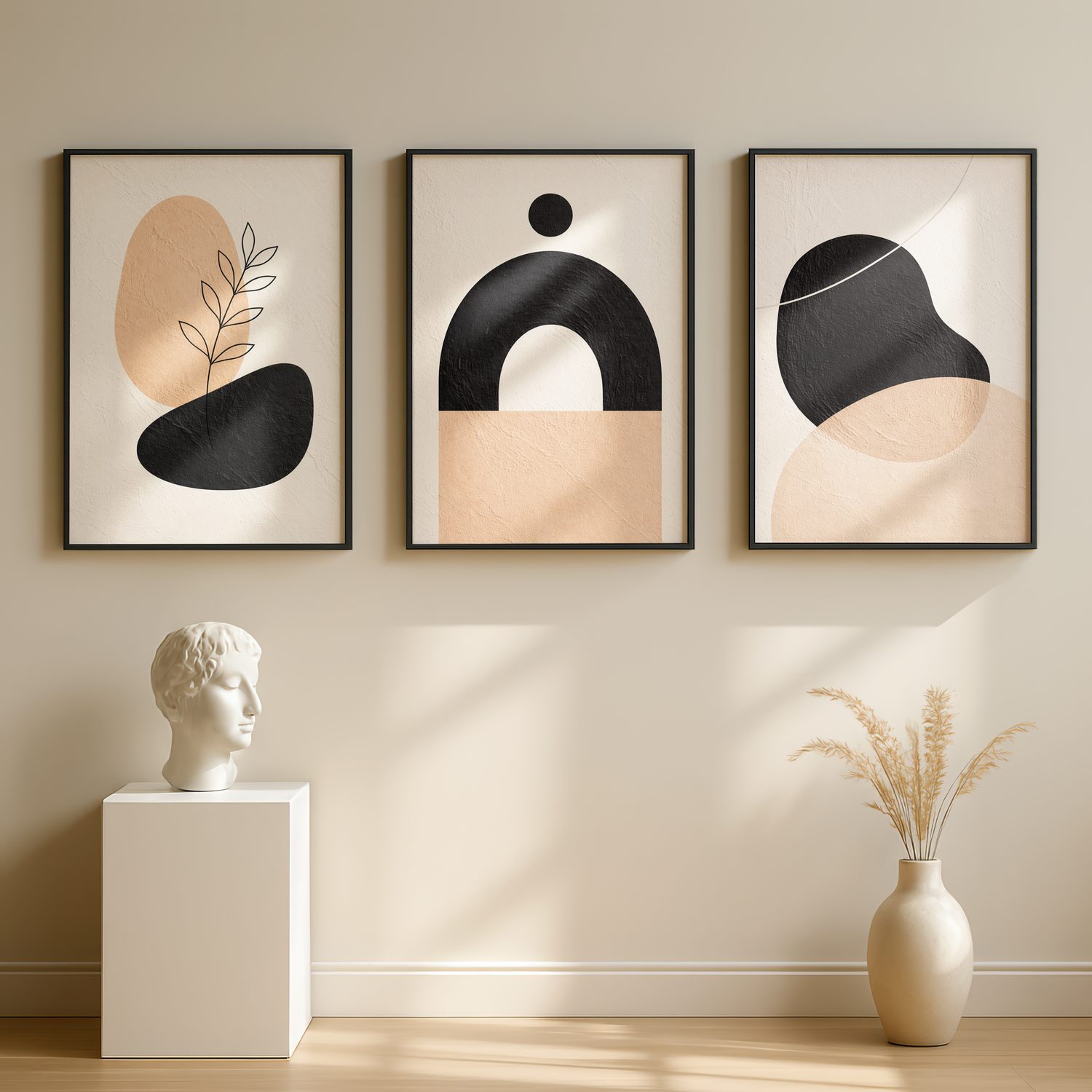
View Abstract Minimalist Set on Rustic Charm → from ₹4,999
A minimalist Scandinavian-leaning set like the one above works particularly well as a staircase gallery wall because the muted palette and consistent line weight let the three panels read as siblings — your eye accepts them as a coherent display even from a moving angle, which is exactly what a staircase wall needs.
Getting the size right (the part most guides skip)
Indian staircases vary wildly in width and rise, so a single "rule of thumb" does not survive contact with reality. What works is matching canvas size to wall height — not floor space, not handrail position, but the actual vertical rise of the wall the art sits on.
Use the table below to size it correctly the first time. Measurements are for the tallest canvas in your set; if you are using a set of three, the others can be the same size or one size smaller.
| Wall vertical rise | Single canvas width | Set of 3 individual width | Best layout |
|---|---|---|---|
| Under 6 ft (1.8 m) | 16 in (40 cm) | 12 in (30 cm) each | Cascading set |
| 6–9 ft (1.8–2.7 m) | 20 in (50 cm) | 16 in (40 cm) each | Cascading set or single landing anchor |
| 9–12 ft (2.7–3.6 m) | 24 in (60 cm) | 16–20 in (40–50 cm) each | Landing anchor or 3-piece grid |
| 12 ft + (3.6 m +) | 30 in (75 cm) | 20 in (50 cm) each | Anchor + cluster combo |
The 60–75% rule still applies — your art's total horizontal coverage should be 60% to 75% of the wall's width at the widest point. Wider feels overwhelming on a moving wall; narrower looks under-scaled and floating.
For frame-style guidance, both the Gallery Wrap option (border-less canvas, modern feel — ₹1,899 onwards for single canvases, ₹4,999 onwards for sets of 3) and the Black or Dark Brown floater frame (₹6,999 onwards for single, ₹6,999 onwards per piece for sets) work on staircases. Black frames read sharper from a distance, which is useful on tall flights. Gallery Wrap reads softer and cleaner up close, which suits half-landings and short staircases.
Hanging the art correctly on a staircase wall
Standard hanging height (the "centre at 57 inches / 145 cm" rule) does not apply on staircases. The viewer's eye is tilted upward, and the centre of the art needs to be roughly 8 to 12 cm higher than the rule would suggest, measured from the step tread immediately below the canvas. For cascading sets, the bottom edge of each canvas should align with a fixed visual line — usually two to three handrail-heights above the step, which works out to around 90–120 cm above the tread.
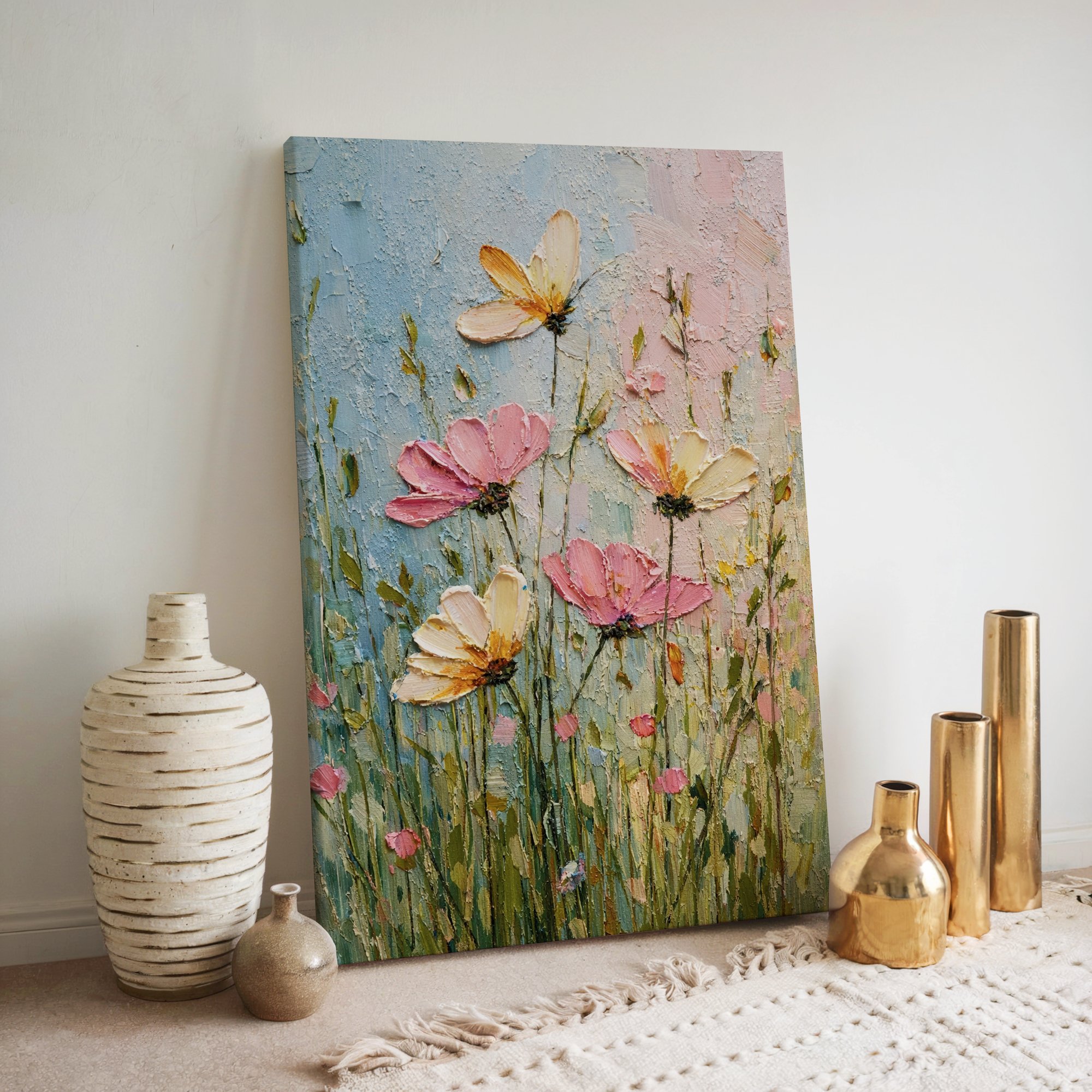
View Rose Garden Canvas on Rustic Charm → from ₹1,899
Three practical rules for hanging on the staircase itself. First, never hang art directly above a tread where someone might lose balance reaching for it — leave a clear arm's reach on the step you most often pause on. Second, anchor heavy canvases (anything over 5 kg, which includes most framed sets in M and L sizes) into wall studs or use proper rawl plugs in concrete walls — staircase walls in older Indian homes are sometimes load-bearing brick, and a single nail will not hold a 4 kg framed canvas through three monsoons. Third, use D-rings on the back of each canvas (not a single sawtooth hanger) — a D-ring on each side gives you adjustment room when the cascading set inevitably needs nudging by 1–2 cm to look right.
For the full mechanics of hanging on tricky walls (drywall versus brick versus concrete, hardware load ratings, alternatives for rental homes), see our complete guide to hanging canvas art. The basics there carry over directly to staircase walls — the only real adjustment is the height tweak above.
Choosing colour and theme — what works on a staircase
A staircase is a transition space. It is not a destination room. That changes what colour and theme will work — your eye is moving through, not settling in, so the art needs to set a mood quickly rather than hold a long visual conversation.
The rule that works on Indian staircases: pick the mood of the floor the staircase leads to. If your bedroom floor is calm and neutral, the staircase should ease you into that — botanical greens, soft floral, lavender, abstract neutrals. If the floor it leads to is your living room (active, social), the staircase can carry stronger colour — warm terracotta, bold abstract, statement portraiture. If the staircase climbs from the entrance foyer to the family floor, it is doing introduction duty — Indian-warm palettes (rose, peach, marigold) or family-oriented motifs work better than minimalist coolness here.
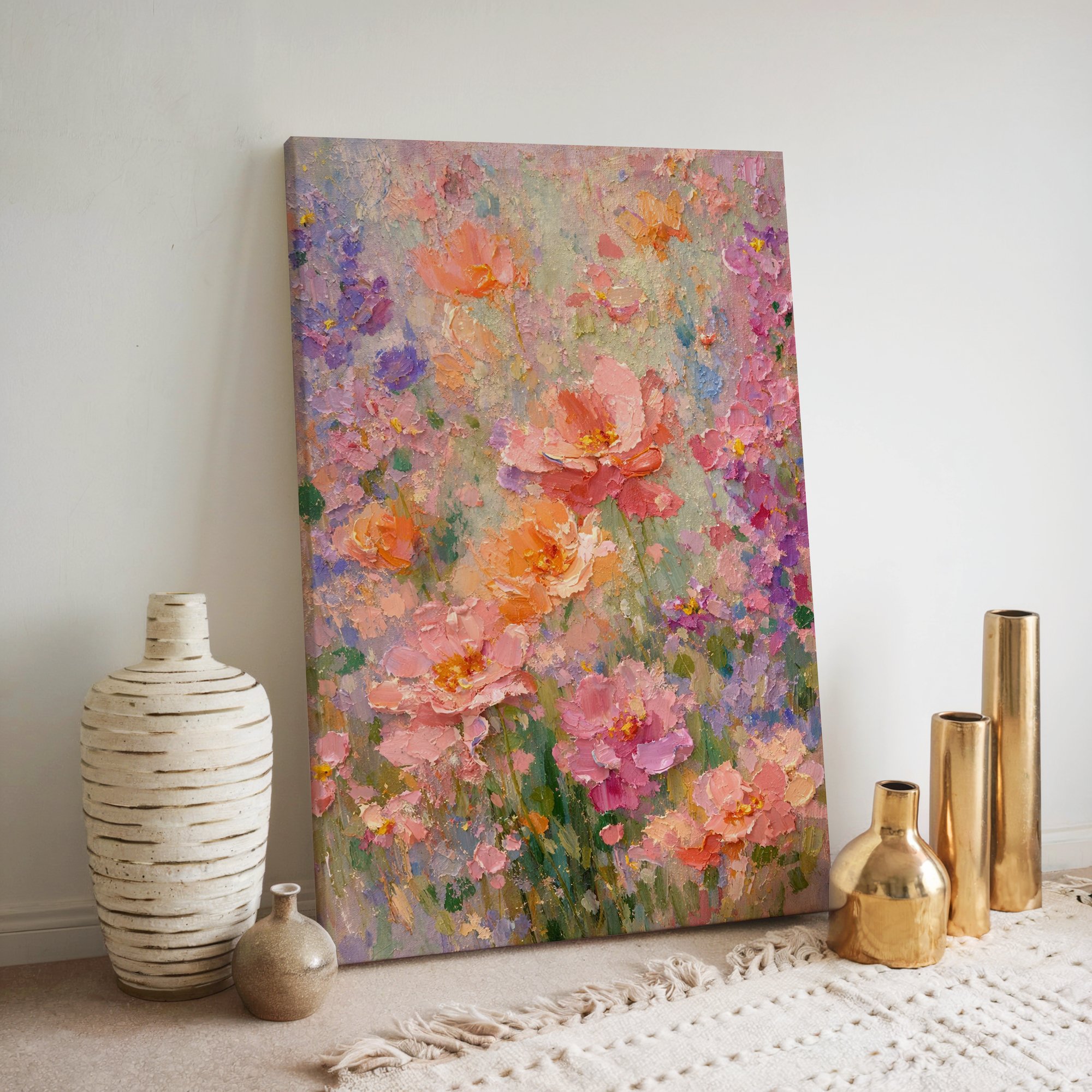
View Cottage Garden Canvas on Rustic Charm → from ₹1,899
The Cottage Garden piece above is a good example of "transition art" — soft enough that you do not get fatigued seeing it twenty times a day on the climb up, but warm enough that it sets a friendly mood for whoever is being led upstairs. Botanical themes (Cottage Garden, Wildflower Meadow, Lavender Field) are the safest staircase choice in Indian homes because they read calm-but-not-boring on the daily climb.
For more on how colour psychology shifts mood across rooms — and how to layer warm and cool palettes deliberately — see our wall art colour psychology guide, which covers the full transition logic between rooms.
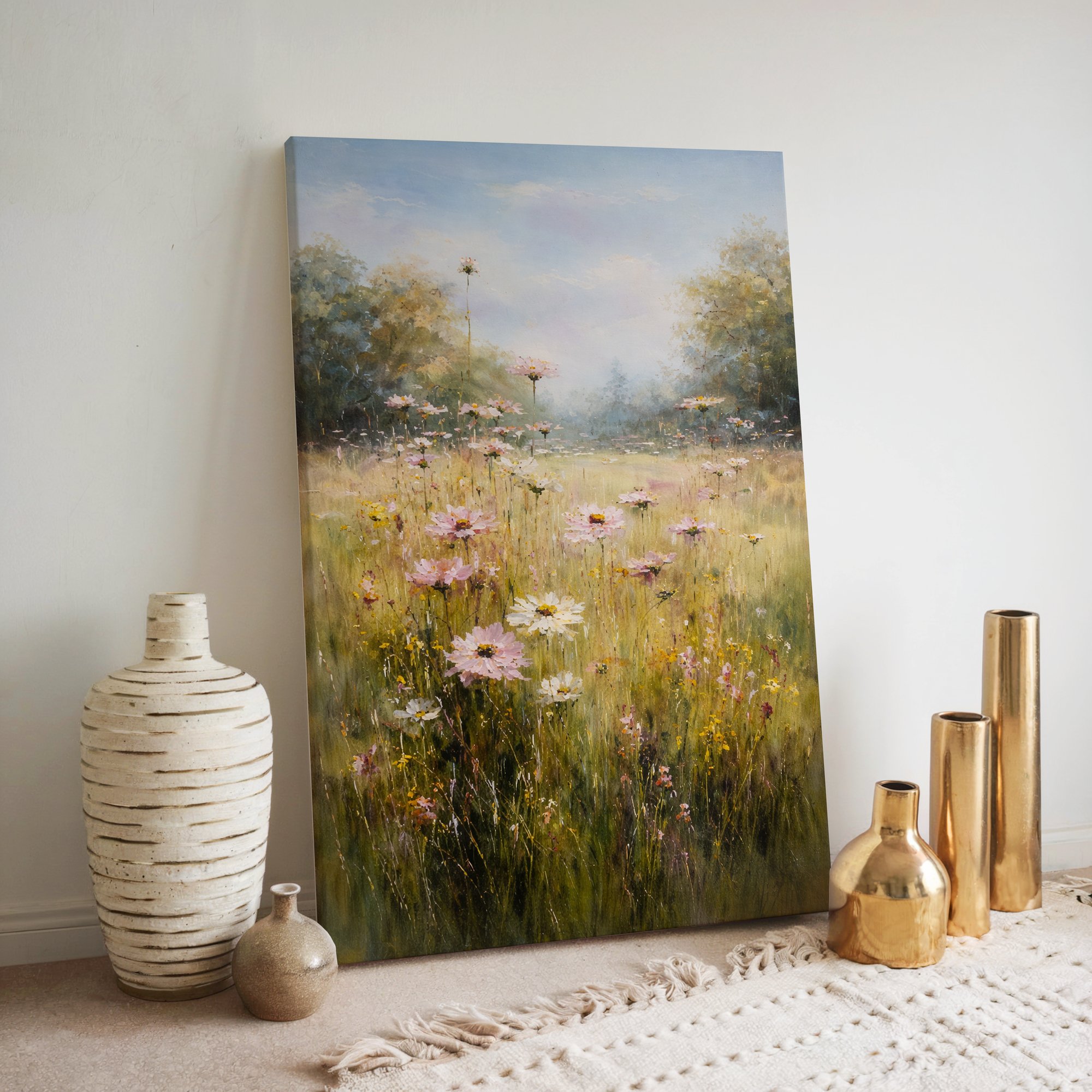
View Wildflower Meadow Canvas on Rustic Charm → from ₹1,899
Vastu and directional guidance for staircase art
In Indian homes where Vastu Shastra principles inform layout decisions, the staircase already carries directional meaning — and the art on its walls participates in that. The traditional reading is that staircases ideally rise clockwise (left-to-right when ascending), and the wall art on a staircase should reinforce upward, positive energy rather than block it.
Practical guidelines that align with both Vastu and good design: avoid heavy, dark, or melancholy imagery on staircase walls (no funeral-tone palettes, no portraits with downward gaze, no images of sinking objects or closed doors). Favour upward-moving compositions — botanicals reaching upward (lavender stalks, climbing roses, vertical wildflower meadows), abstract pieces with rising lines, light-coloured palettes that feel airy. The east-facing or north-facing staircase walls particularly benefit from green and warm-yellow palettes (Cottage Garden, Wildflower Meadow); south or west-facing walls suit cooler tones (Lavender Field, Abstract Minimalist) to balance afternoon heat. None of this requires devotional or symbol-specific imagery — secular floral, abstract and botanical art aligns with Vastu's directional principles when chosen with mood in mind.
Decision framework — which layout is right for your staircase
Use this decision matrix to choose without the back-and-forth. Map your staircase to the row that fits, then read across.
| Your staircase | Layout | Canvas count | Budget range |
|---|---|---|---|
| Straight flight, narrow (under 4 ft wide) | Cascading set of 3 | 3 | ₹4,999–₹15,999 |
| Straight flight, wide | Single landing anchor + 1 small piece on rise | 1–2 | ₹1,899–₹6,999 |
| L-shaped with half-landing | Single anchor on landing wall | 1 large | ₹4,999–₹15,999 |
| U-shaped with two flights | 3-piece cascading on each flight | 6 (two sets) | ₹9,998–₹31,998 |
| Spiral or curved | Single anchor at top landing | 1 | ₹1,899–₹6,999 |
| Duplex foyer / double-height | Statement set + matching single on landing | 4 | ₹6,898–₹22,998 |
Budget ranges assume Gallery Wrap S-size for the entry tier and L-size framed for the upper tier. Single canvases at Rustic Charm start at ₹1,899 (Gallery Wrap S, 12 × 18 inches). Three-piece sets start at ₹4,999 (Gallery Wrap S, three pieces of 12 × 18 inches each). Floater-framed L-size sets reach ₹15,999.
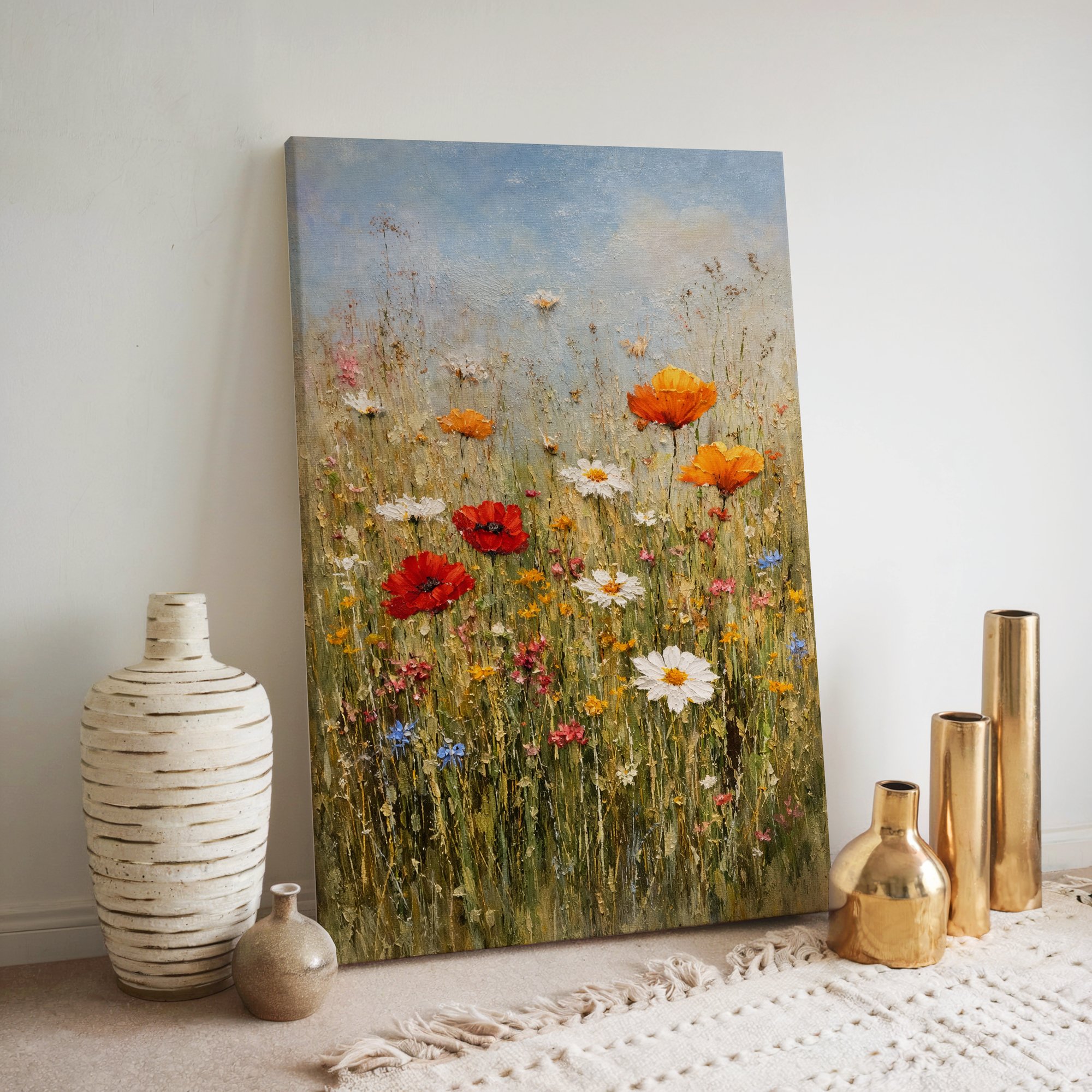
View Lavender Field Canvas on Rustic Charm → from ₹1,899
The Lavender Field piece above is particularly suited to staircases that lead up to a bedroom floor — the cool purple palette extends the bedroom's calming mood into the climb itself, so the transition feels intentional rather than abrupt.
Mistakes to avoid (mined from 30+ Reddit threads)
A focused review of r/HomeDecorating, r/interiordecorating and r/IndianHomeDecor threads on staircase wall styling surfaces five recurring mistakes. They are useful to read against your own plan before you commit to the hanging.
Centring a single canvas like it is a living-room wall. The moving viewer never sees the centre. The piece reads as floating and lonely. Either go cascading or shift the single piece higher to align with the upward gaze rather than the standing gaze.
Mixing frame styles in a gallery wall. The most-upvoted critique on multi-frame staircase displays is "the frames are fighting each other". Pick one frame style for the entire cluster — if you want variety, vary canvas size or composition, never frame style or finish.
Ignoring the landing. The landing is the only place on a staircase where someone actually stops moving. Leaving it bare while loading the diagonal walls with art reverses the natural attention pattern.
Hanging too low. Staircase art read at the wrong height is the single most-flagged Reddit complaint. The upward gaze means standard 145 cm centring will look low from below and very low when descending. Add 8–12 cm to the centre height, or align cascading-set bottom edges to a fixed two-thirds-of-wall-height line.
Choosing pieces that need close-up reading. Detail-dense pieces (intricate line work, small portraiture, fine-text typography) do not read on a moving staircase wall. Pick compositions that telegraph their idea from 6+ feet away. Botanicals, abstracts, bold simple portraiture all work; tightly-rendered pieces do not.
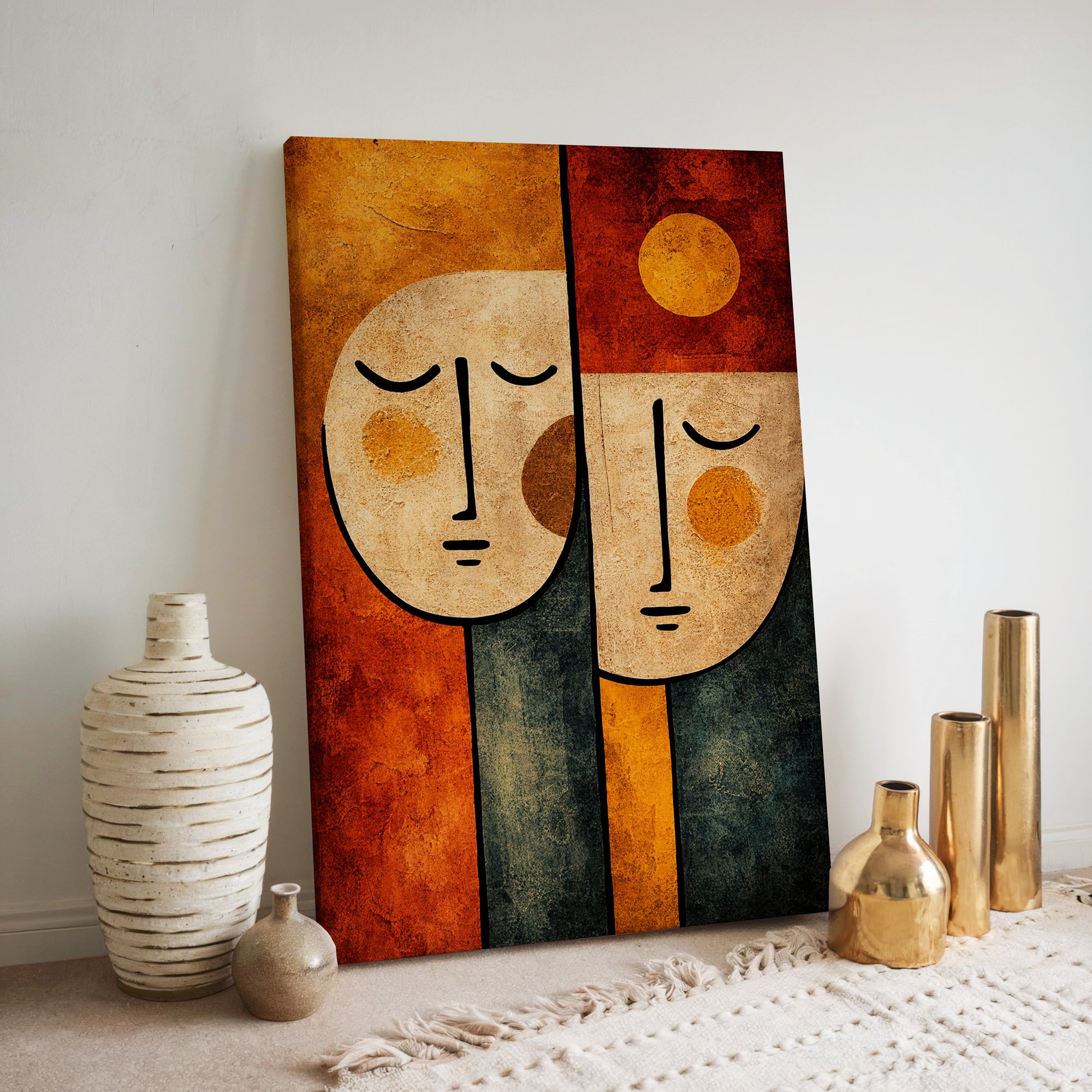
View Abstract Face Canvas on Rustic Charm → from ₹1,899
The Abstract Face piece reads correctly on a staircase because its idea is bold and singular — the composition telegraphs from the bottom of the flight, holds at the landing, and remains coherent even from the top of the next flight looking down. Bold-simple is the staircase rule.
Why Rustic Charm builds these for the climb (a quick honest note)
Every canvas on this page is a giclée print on 300 GSM acid-free cotton canvas, hand-stretched on a wooden frame in our facility. We do not use machine-stretched stock or thinner 200 GSM canvas, because both warp on long stair walls where temperature shifts (open foyers, monsoons, AC zones above and unconditioned air below) work the canvas hardest. The frames are kiln-dried Indian pine, which holds its line through humidity swings.
We are not a hand-painted-original brand. The artwork in our catalogue is original digital art and photography, reproduced as ultra-high-resolution canvas paintings. The price difference between a giclée canvas print and a hand-painted commissioned original (₹50,000+ for a comparable size) is not in the visual outcome — it is in production scale. We picked giclée canvas because the visual outcome on a staircase wall, at 6 feet away, is genuinely indistinguishable. The technical truth is that a well-printed giclée canvas can read as more vibrant than a hand-painted reproduction of the same image, because the inkjet array hits colour saturations a brush cannot.
We are also not, despite the brand name, a "rustic" brand in the wood-and-rope sense. The name reflects the rural Indian art motifs we draw from in select collections — botanicals, garden florals, vernacular abstracts — not a stylistic preference for distressed wood. Just so the staircase art you order matches the website you saw it on.
Ready to bring this look home?
Browse our full Canvas Wall Art Set of 3 collection for cascading staircase displays, or our Abstract Wall Art collection for landing-anchor pieces — every canvas is a giclée print on 300 GSM acid-free cotton, hand-stretched in India, delivered across India in 5–7 working days.
FAQ
What size canvas should I hang on a staircase wall?
For walls with under 6 ft of vertical rise, use a 16-inch wide canvas (or three 12-inch canvases as a cascading set). For 6–9 ft walls, use 20-inch single or 16-inch sets. For 9–12 ft walls (most Indian duplex staircases), use 24-inch singles or 16–20-inch sets. The art's total horizontal coverage should hit 60% to 75% of the wall's widest dimension.
At what height should I hang art on a staircase wall?
The standard 145 cm (57-inch) centring rule does not work on staircases — the viewer's gaze is tilted upward. Hang the centre of the art roughly 8–12 cm higher than the rule would suggest, measured from the step tread immediately below the canvas. For a cascading set, align the bottom edge of each piece with a fixed line at roughly two-thirds of the wall's vertical height.
Should I hang a single canvas or a set of three on a staircase?
A set of three (cascading down the flight) is the safer default for straight-flight staircases — it mirrors the angle of the steps and reads correctly from every viewing height. A single large canvas works best on the landing wall (where the staircase turns or pauses), because the viewer is physically standing still there and a fragmented composition loses impact at a stop point.
What kind of art works best for staircase walls?
Bold, simple compositions that read from 6+ feet away. Botanicals (Rose Garden, Cottage Garden, Wildflower Meadow), abstract geometrics (Boho Abstract Arches, Bold Abstract Expressionist), and statement portraiture (Abstract Face) all work because their idea telegraphs at distance. Avoid detail-dense pieces — fine line work, small portraiture, intricate text — because the moving viewer never gets close enough for long enough to read them.
How do I hang heavy framed canvases on a staircase wall safely?
Anchor any canvas over 5 kg (which includes most framed sets in M and L sizes) into wall studs or proper rawl plugs in brick / concrete walls. Use D-rings on each side of the canvas back, not a single sawtooth hanger — D-rings give you nudge-room when the cascading set inevitably needs adjustment by 1–2 cm. For the full hardware breakdown, our canvas hanging guide covers stud-finder, plug-rating and load-test mechanics.
Is wall painting on a staircase a Vastu issue in Indian homes?
Vastu Shastra guidance on staircase wall painting comes down to mood and direction, not specific symbols. Avoid heavy, dark, or melancholy imagery on the staircase. Favour upward-moving compositions (climbing botanicals, vertical wildflowers, rising abstract lines) and lighter palettes that reinforce positive, ascending energy. East and north-facing staircase walls suit warm-yellow and green palettes; south and west-facing walls suit cooler greens and lavenders. Secular floral, abstract and botanical art (which is what most modern Indian homes already buy) aligns with Vastu's directional principles when chosen with mood in mind — devotional or symbol-specific imagery is not required.
Will canvas wall art warp or fade on an Indian staircase wall?
A 300 GSM acid-free cotton canvas with archival giclée inks, hand-stretched on a kiln-dried wooden frame, is built for Indian conditions. The two real risks are direct sunlight (UV fades any pigment over enough years — keep canvases out of unfiltered south-facing window light) and constant humidity above 80% (long-monsoon coastal homes — use a wall-mounted dehumidifier or run AC). Standard staircase placements — interior walls, indirect light — see no measurable warping or colour shift in the first decade of normal use.