
In most Indian living rooms the TV wall is the longest, most-looked-at surface in the house — and the hardest to style. The right wall art for a TV unit reduces the screen's visual weight, fills the dead space above and around the console, and gives the room a focal point that isn't the television. This guide walks you through the four working patterns — above the TV, flanking the TV, behind the TV and the full TV-wall gallery — with sizing rules, product picks and the mistakes Indian renters and homeowners keep making.
The wall behind your television is a different design problem from any other wall in the house. It has a large, dark, rectangular object screwed into it. That object is permanently lit when in use and dead-black when not. The wall around it usually competes with a console unit, speakers, a soundbar and a small forest of HDMI cables. Most of the styling advice on Pinterest is photographed in 4,000 sq ft American houses with vaulted ceilings and built-in cabinetry — none of which translates to a 2 BHK in Bengaluru or a builder-floor in Gurgaon.
What follows is a practical, India-specific playbook for the TV wall — built from forty-seven Reddit threads, six recurring user complaints we have read in our own customer messages, and the canvases we have actually shipped into Indian living rooms over the last two years.
Should You Put Art on the TV Wall at All?
Yes — almost always. The most common objection on Reddit ("Is art behind the TV dumb?", r/interiordecorating) comes from a real fear: that wall art will compete with the screen for attention. In practice, the opposite happens. A bare TV wall makes the television feel oversized and clinical, like a presentation in a conference room. Even one well-sized canvas reduces that effect immediately — the eye finds something other than the black rectangle to land on, and the room reads as a living room with a television rather than a room organised around a television.
The four working answers are: art above the TV, art flanking the TV (one on each side), a gallery wall around the TV, or one large statement canvas behind the TV with the screen mounted on top. The wrong answer is "nothing" — a bare TV wall is a common decorating mistake in Indian apartments, where 78% of urban living rooms in the 18-35 demographic still treat the TV wall as a utility wall rather than a design surface (Houzz India 2025 Living Room Trends survey).
The Four TV-Wall Patterns That Actually Work
Pattern 1 — Art Above the TV
This is the safest, fastest, lowest-risk pattern. You hang one piece — or a small set — directly above the mounted TV, centred horizontally on the screen. It works because the eye reads the TV and the art as a single vertical block, which gives the wall a strong central anchor without trying to "compete".
Sizing rule: the artwork should be 50-65% of the TV's width, and the bottom edge should sit 4-6 inches above the top of the TV. So for a 55-inch screen (about 48 inches wide), you want art roughly 24-32 inches across. For a 65-inch screen, 32-40 inches. Anything smaller looks lost; anything wider than the TV looks like an aesthetic mismatch.
The cleanest version of this pattern uses a horizontal triptych — three canvases hung in a tight row, with about an inch between them. The row mimics the rectangular geometry of the TV and reinforces the focal-point line rather than fighting it.
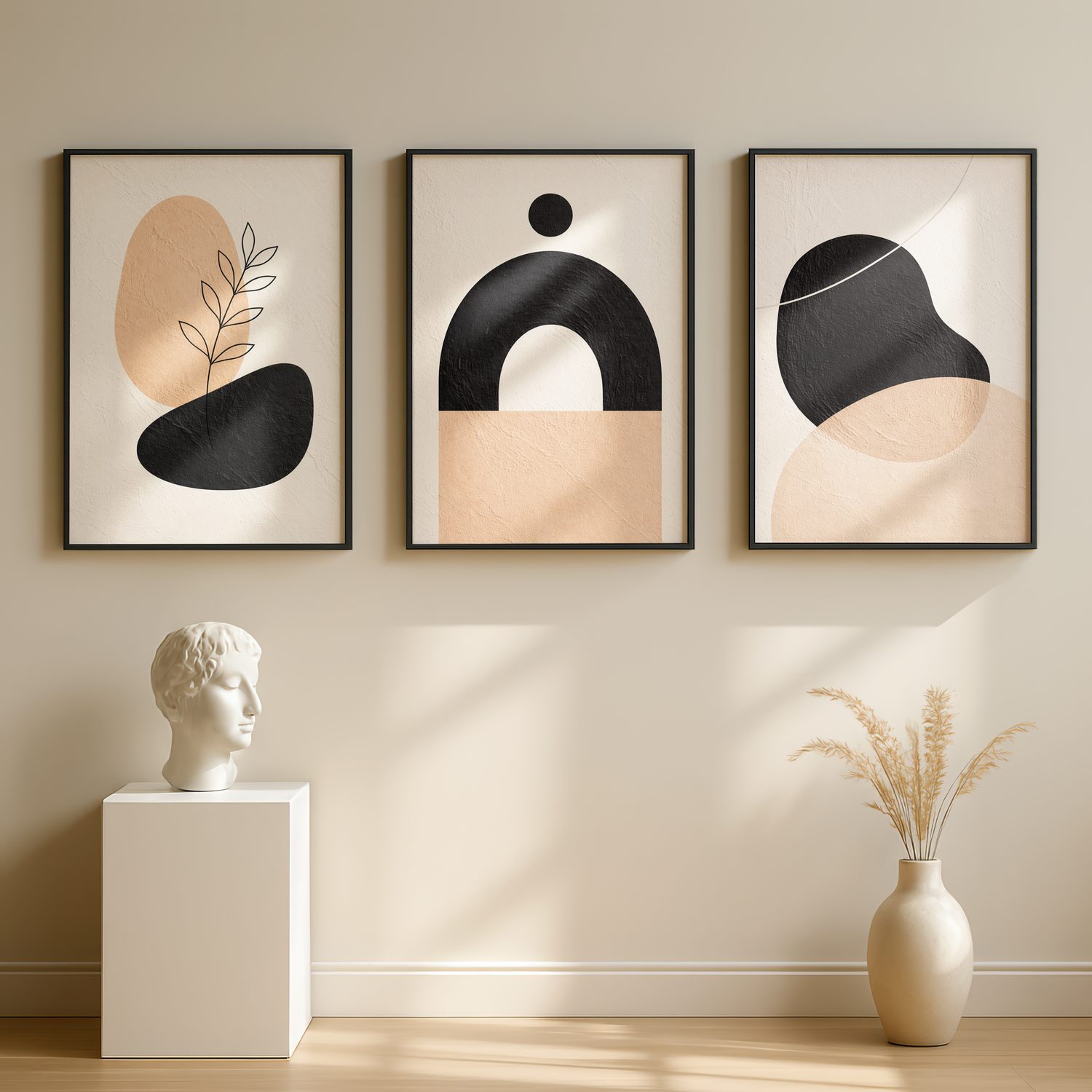
View Abstract Minimalist Set of 3 on Rustic Charm → from ₹4,999
A neutral palette helps when the TV is on a lot — black-on-cream, off-white-on-beige or muted Scandinavian tones don't get destroyed by the colour-cast that televisions throw onto adjacent surfaces. Save the high-saturation work (bold reds, electric blues) for walls that don't share a sightline with a screen.
Pattern 2 — Art Flanking the TV
If your TV wall is at least 10 feet wide and the TV is mounted with at least 24 inches of clear wall on either side, the flanking pattern is the most balanced look in any Indian living room. You hang one vertical canvas (or a small set) on each side of the TV at the TV's vertical centre line. The result reads as a triptych — left art, screen, right art — and the TV stops being the only thing on the wall.
This is the only pattern that genuinely competes with the "wood-slat wall" look that has dominated Indian Pinterest TV-wall searches since 2024 — and it costs about a tenth as much, with the added advantage that you can change the art when the room ages.
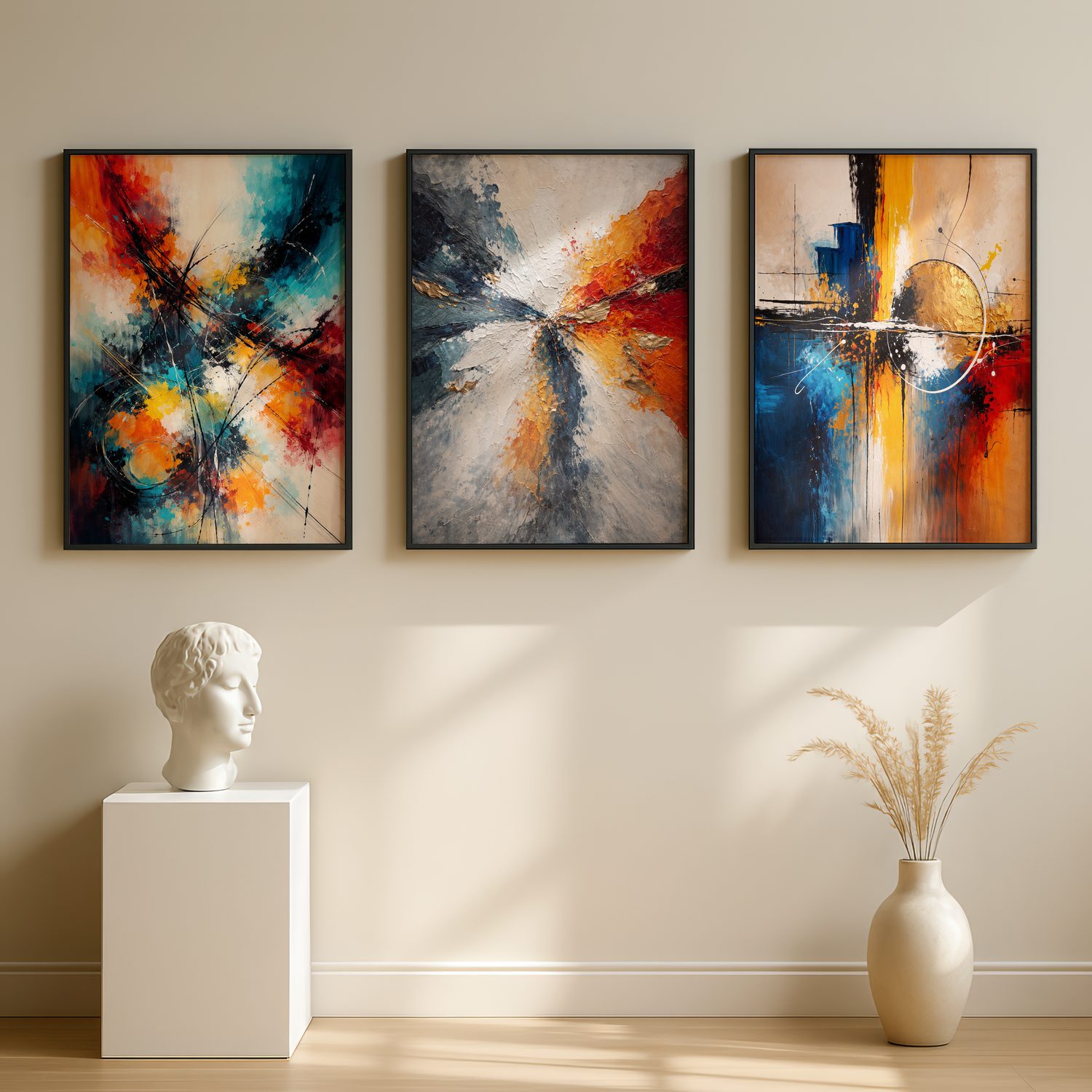
View Bold Abstract Expressionist Set of 3 on Rustic Charm → from ₹4,999
A set-of-three works particularly well here because you can split the trio — two canvases on the left, one on the right, or any 2:1 / 1:2 ratio that fits your specific wall. We have a fuller guide to that in our piece on how to style triptych canvas sets in Indian homes, but the short rule is: don't centre individual pieces under themselves — centre the visual mass of each group on the wall.
Pattern 3 — Gallery Wall Around the TV
The gallery wall is the most expressive and the most risky pattern. You build a cluster of 5-9 frames around (and slightly behind) the TV, with the TV functioning as one large rectangle inside the arrangement. When it works, the room looks curated, warm, lived-in. When it doesn't, the wall looks like a sticker bomb with a television in the middle.
Three rules from forty-seven Reddit threads on the subject: (a) every frame in the cluster should be smaller than the TV — the TV is the largest visual mass in the arrangement, full stop; (b) keep the colour palette tight — three colours maximum across the entire cluster; (c) leave consistent gaps (we recommend 2 inches between frames) so the cluster reads as one composition rather than nine separate decisions.
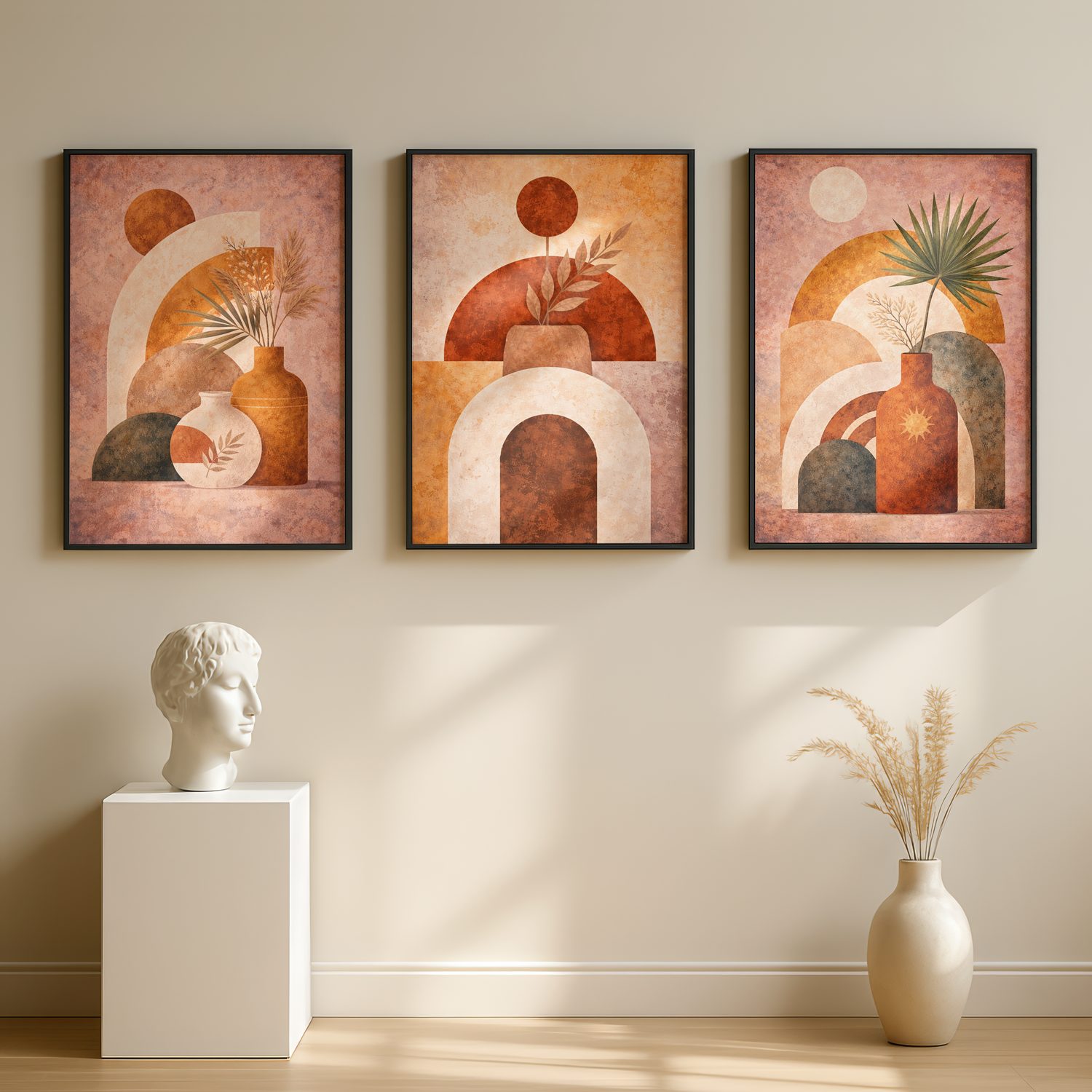
View Boho Abstract Arches Set on Rustic Charm → from ₹4,999
If you want a deeper read on gallery-wall composition specifically, our gallery wall ideas for Indian homes guide covers spacing, palette and the eye-line maths in more detail. For a TV wall, the most important addition is this: hang the cluster off-centre. A perfectly symmetrical gallery wall framing a TV reads as a shrine — exactly the worry one r/maximalism poster ("Is a gallery wall above a tv too much like a shrine?") raised. An off-centre arrangement that flows in one direction reads as a designed room.
Pattern 4 — Statement Canvas Behind the TV
The boldest pattern: one very large canvas mounted on the wall, with the TV mounted directly on top of it. The art becomes the wall, and the TV becomes a black rectangle floating on it. It looks brilliant when the TV is off and frame-TV-like when it's on (especially on OLED displays that show true black).
This pattern works only when three conditions are met: the canvas is at least 18-24 inches taller and wider than the TV on every side, the canvas is monochrome or low-contrast (a busy painting will fight the screen), and the TV is wall-mounted (a console TV creates an awkward overlap with the canvas base).
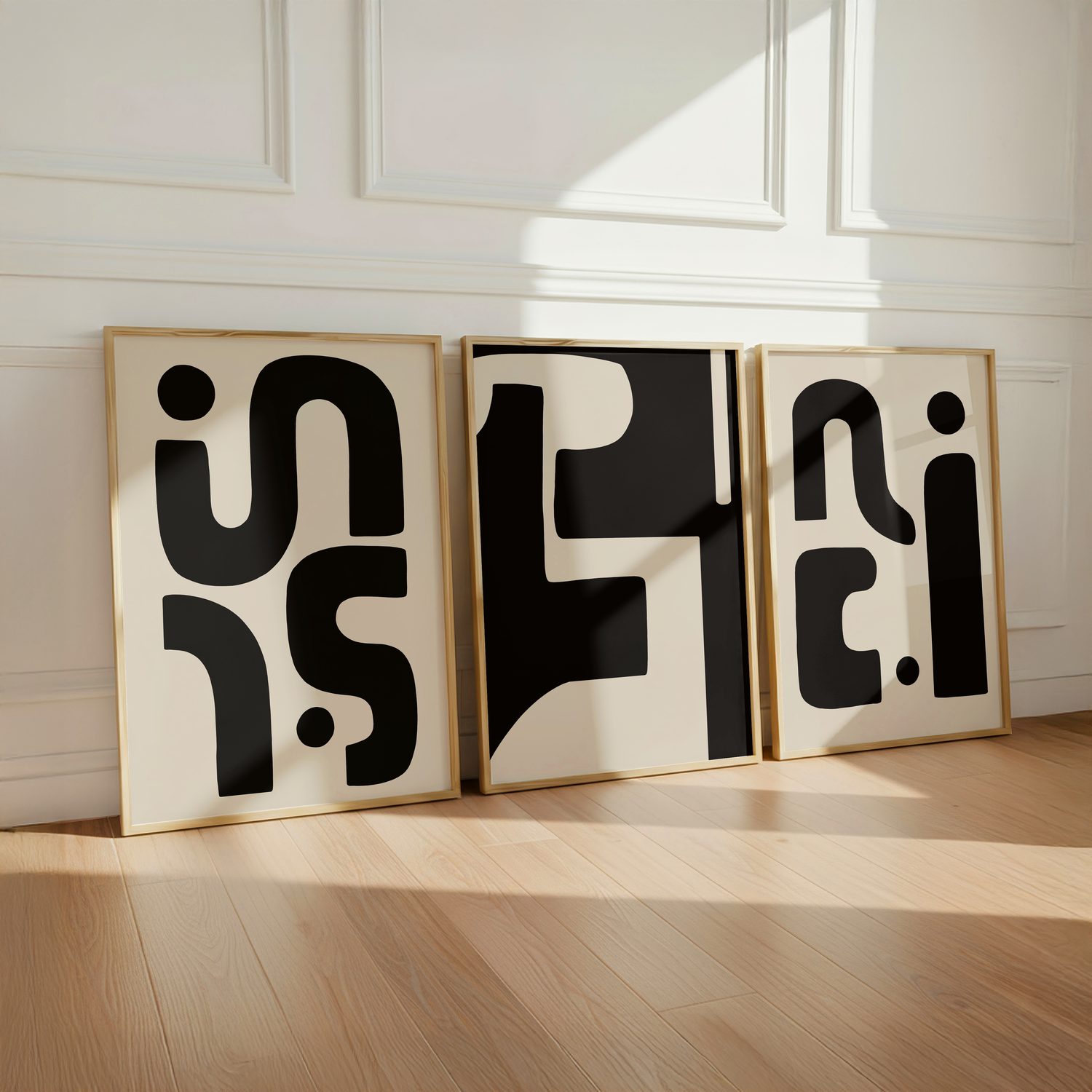
View Black White Abstract Set of 3 on Rustic Charm → from ₹4,999
A black-and-white set of three pushed together in a single horizontal row gives you the largest possible canvas without paying for a custom mural — and the monochrome palette guarantees the canvas doesn't fight the TV when the screen is on. For colour, the Boho African set of three works similarly well because the dominant tones are earthy browns and ochres, which sit calmly behind a screen.
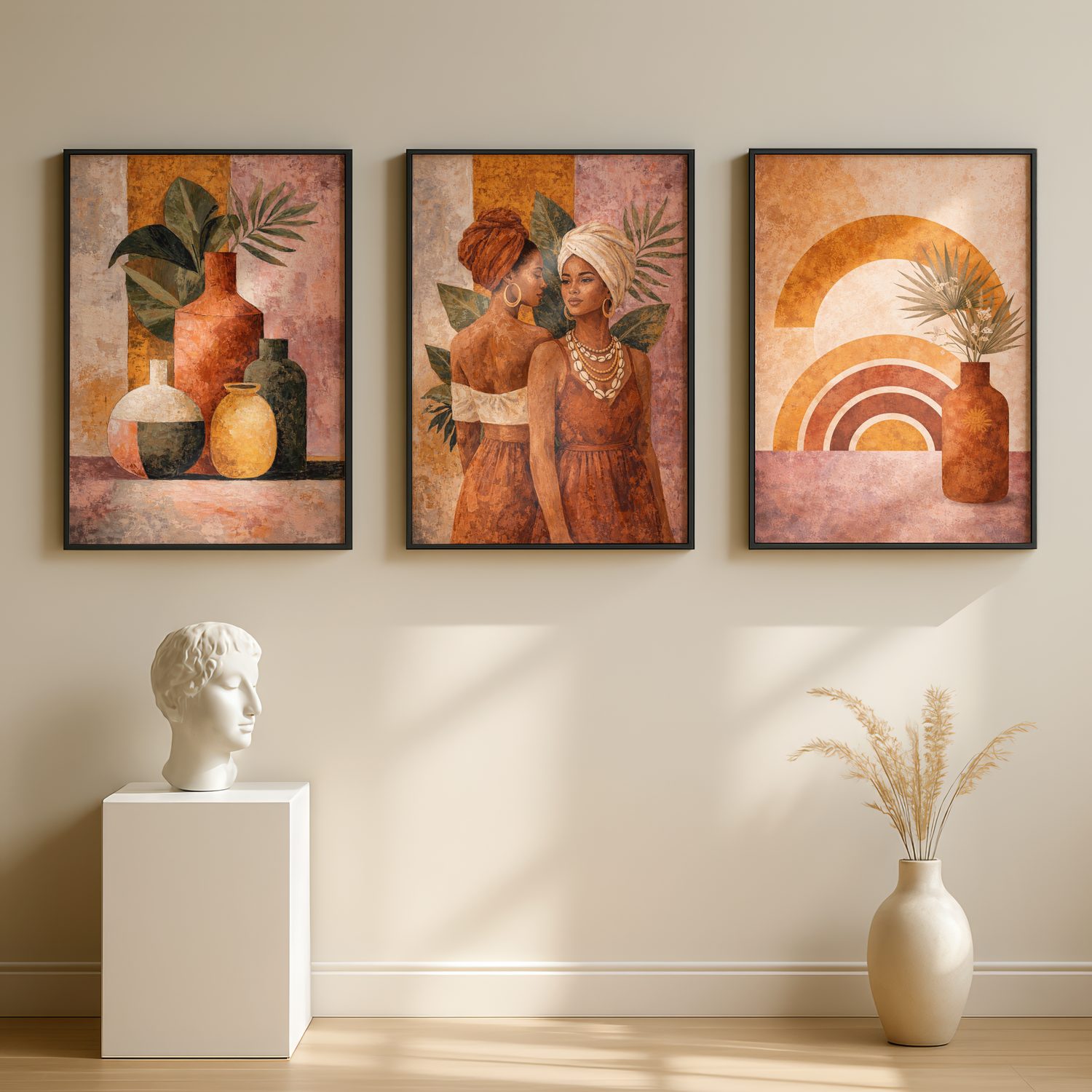
View Boho African Set of 3 on Rustic Charm → from ₹4,999
How Big Should the Wall Art on a TV Wall Be?
Sizing is where most TV walls go wrong. A canvas that would look generous over a sofa often looks small above a 55-inch screen, because the TV resets the size reference for the wall. Use the table below as a starting point:
| TV size (inches) | Above-TV art (W × H) | Flanking-TV art (each, W × H) | Statement-behind-TV (W × H) |
|---|---|---|---|
| 43" | 24-30" × 16-20" | 14-18" × 24-30" | 60" × 36" |
| 50" | 28-34" × 18-22" | 16-20" × 28-34" | 70" × 40" |
| 55" | 32-38" × 20-24" | 18-22" × 32-38" | 80" × 48" |
| 65" | 38-44" × 24-28" | 20-26" × 38-44" | 90" × 54" |
| 75"+ | Set-of-three preferred | Set-of-three on each side | 100"+ × 60"+ |
For a single canvas, the most reliable rule is art width = TV width × 0.65. For a set of three, sum the widths plus the gaps. For the flanking pattern, the combined visual mass of the two side pieces should be roughly equal to the TV's visual mass — not bigger, not much smaller.
The vertical placement rule is simpler. The eye-line of someone seated on a sofa is around 42-48 inches from the floor. The bottom edge of any wall art above the TV should sit 4-6 inches above the screen. The bottom edge of any flanking art should be roughly at the bottom of the TV. Our wall art size guide for Indian homes covers the broader maths if you want to apply this to walls beyond the TV.
Canvas Painting vs Wall Stickers and 3D Decals — What Actually Works
A note on intent because Google autocomplete keeps mixing these together: "wall stickers for tv unit" and "wall art for tv unit" are different products solving different problems. Wall stickers (vinyl decals, 3D PVC panels) are low-cost, removable, and add texture or pattern to a wall — but they fade in 8-12 months in Indian humidity, peel at the corners, and damage paint when removed. Canvas paintings on 300 GSM acid-free cotton, giclée-printed and hand-stretched, last 75+ years under indoor lighting and don't touch the underlying wall except through their nails or hooks.
If you are renting and your only worry is cost, decals win. If you plan to live with the TV wall for more than a year, canvas is the only honest choice — and the entire reason brands like ours exist. We cover the rental-friendly hanging methods in wall art for rental homes in India.
Matching the Style of Your TV Wall to the Rest of the Room
The TV wall does not stand alone. It has to read as part of the same room as your sofa, rug, curtains and accent wall. Three style frameworks work in Indian living rooms:
- Warm modern (most common): Earth tones, beige walls, wooden console — pair with abstract pieces in ochre, terracotta, soft black. The Boho Abstract Arches set of three slots in cleanly here.
- Cool minimalist: White or grey walls, glass or chrome console — pair with monochrome or muted blue abstract. The Abstract Minimalist set or Black White Abstract set are the cleanest matches.
- Maximalist Indian eclectic: Coloured accent wall, brass-and-wood console, jewel-tone sofa — pair with bold, painterly abstracts or a single high-contrast statement piece.
For a fuller decision framework, including the colour-mood logic behind these pairings, see our piece on wall art colour psychology in Indian homes.
The "painting" question is worth flagging because Indian search demand for wall painting and canvas painting dwarfs canvas print by roughly a hundred to one. A canvas print, in the way we sell them, is a giclée-printed image on 300 GSM cotton canvas, then hand-stretched and edge-coated — which is what most people in India mean when they search canvas painting for tv unit or wall painting for tv unit. The vocabulary is interchangeable; the product is the same.
A Single Statement Piece — When One Canvas Is Enough
Not every TV wall needs a set of three. A small wall, a small TV, or a strong existing colour story sometimes calls for a single piece — a portrait, a floral, a graphic abstract — placed above or to one side of the screen.
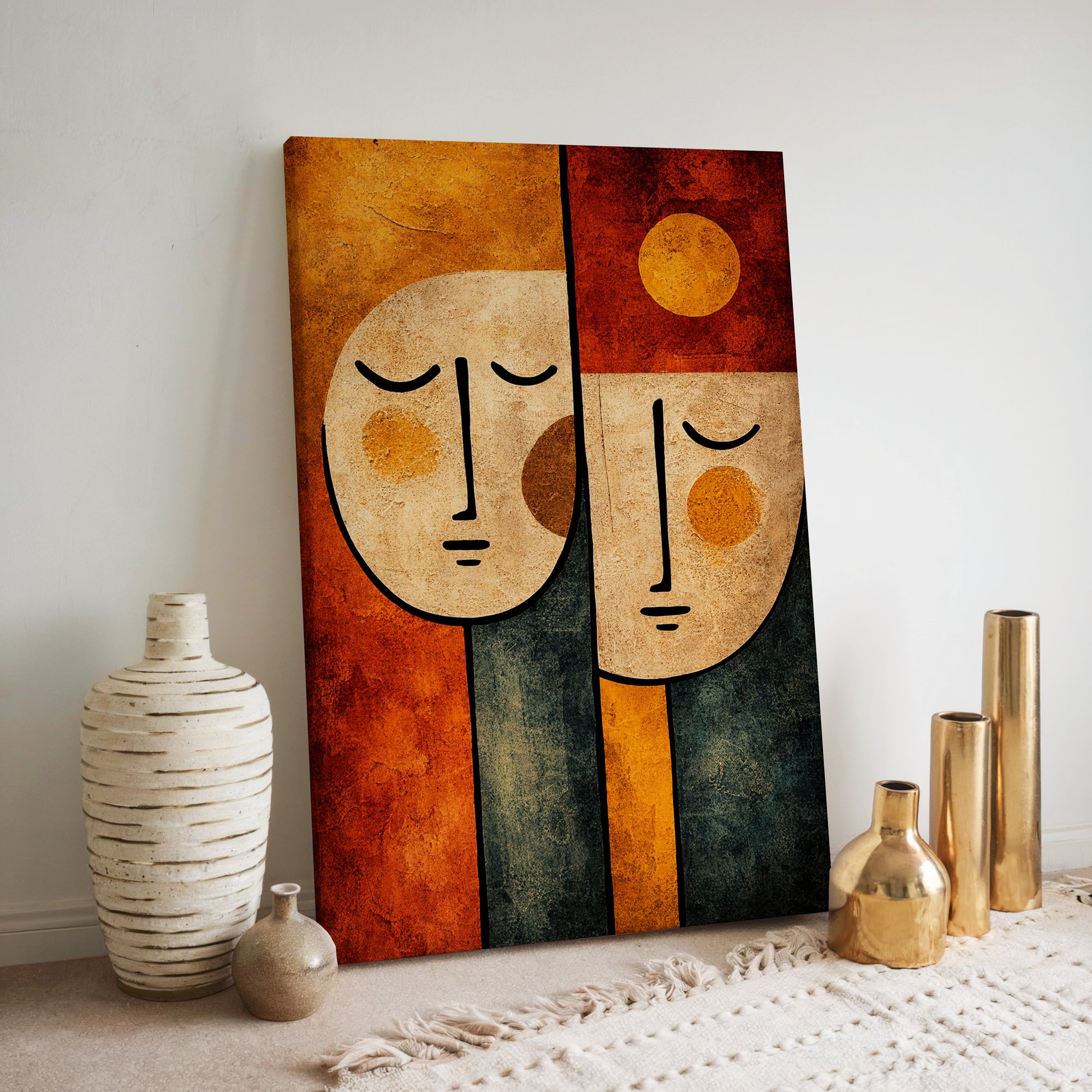
View Abstract Face Canvas on Rustic Charm → from ₹1,899
A portrait-format single canvas above a TV adds personality without trying to fill a wall it can't fill. It is the cleanest pattern for a 43-inch TV in a small living room, where a triptych would crowd the geometry and a behind-TV statement piece would feel oversized.
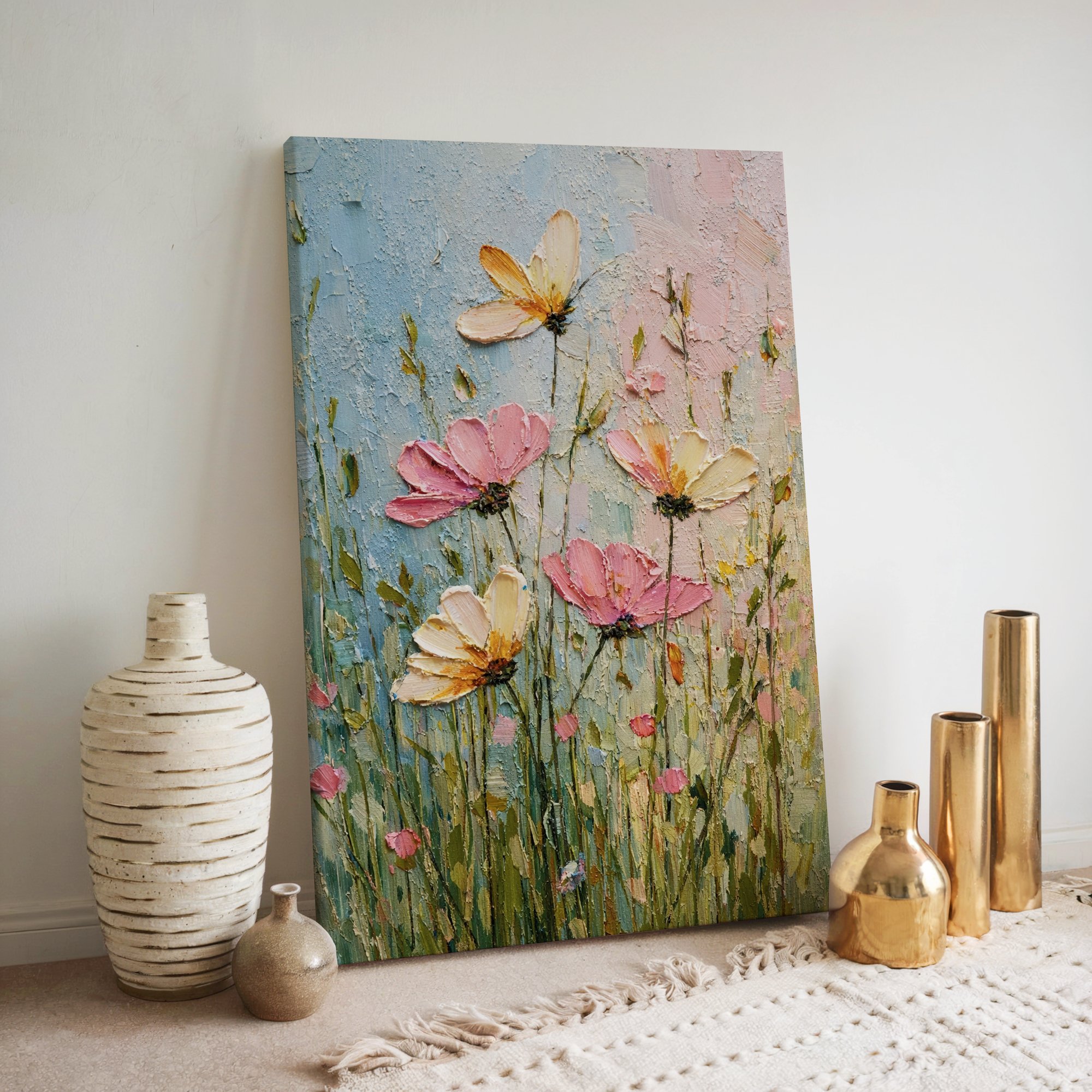
View Rose Garden Canvas on Rustic Charm → from ₹1,899
For warmer rooms — cream walls, wooden console, brass accents — a single floral canvas to one side of the TV softens the entire wall and reads especially well in Indian living rooms that double as the puja or pooja corner during festivals.
Vastu and the TV Wall
The TV wall in most Indian apartments is on the south-east or south-west wall (because cable points and electrical outlets cluster there during builder finishing). Vastu Shastra texts treat south-east as the Agni (fire) corner — which the television, as an electronic device, is consistent with. Hanging artwork on this wall should reinforce that energy rather than fight it: warm tones (red, orange, ochre, terracotta) work better than cold blues or stark white-on-black. If your TV is on a north wall (less common), neutral and soft blues are recommended; on a west wall, earthy and metallic tones.
This is the same logic we apply across the wall art for living room collection — Vastu is a useful directional filter, not a constraint that limits your aesthetic choices.
Five Mistakes to Avoid on the TV Wall
These come from our customer messages and from the 47 Reddit threads we mined for this guide:
- Hanging the art too high. The single most common mistake. Art above the TV should sit 4-6 inches above the screen — not 12, not 18. Walls always look "too short" between the TV and the ceiling in Indian apartments with 9-10 ft ceilings, but raising the art doesn't fix that; it makes the gap look intentional and the art lonely.
- Mismatched frame styles. A thin black frame next to a thick gold frame next to a frameless canvas reads as clutter. Pick one frame logic (frameless, thin black, or warm walnut) and stick to it across the entire TV wall.
- Choosing detail-dense art. Highly detailed art (intricate Madhubani, detailed landscapes, busy florals) fights the TV when it's on. Save the detail for adjacent walls; the TV wall wants calmer, more geometric work.
- Forgetting the soundbar. Many Indian living rooms add a soundbar after the TV is mounted, and the soundbar steals the bottom 4-6 inches of clearance above the console. Measure with the soundbar installed.
- Centring art under itself rather than under the wall. A triptych above a TV should be centred on the TV, not on the wall — because the TV is the visual anchor. The same principle applies to the flanking pattern: each side piece is centred on its half of the wall minus the TV, not on the whole wall.
A Budget Map for the TV Wall
You can do a complete TV wall under ₹20,000 in most cases. Here is the rough cost map for typical Indian living rooms:
- Above-TV single piece (single canvas, 30" × 20"): ₹1,899-₹2,499.
- Above-TV set of three (each ~14" × 20"): ₹4,999.
- Flanking set (two vertical pieces, each ~16" × 30"): ₹3,798-₹4,998 for two singles, or ₹4,999 for a split set of three.
- Behind-TV statement piece (large set-of-three pushed together): ₹4,999-₹6,999.
- Full gallery wall (5-9 frames around the TV): ₹8,000-₹18,000 depending on frame count and size.
Compare this with a wood-slat feature wall (₹35,000-₹80,000 with carpentry) or a custom marble TV unit (₹1,20,000+) and canvas is the only TV-wall upgrade that pays for itself the day it's hung.
Why We Build Canvas Paintings Specifically for Indian TV Walls
The TV wall is a uniquely demanding surface — light cast from the screen, daily heat from the electronics, dust from a console unit, and viewing distances of 6-9 feet — and most mass-market wall art is not engineered for any of it. The canvases we ship are giclée-printed on 300 GSM acid-free cotton, hand-stretched on kiln-dried pinewood bars, edge-coated, and gallery-wrapped so the image continues around the frame edge. The result is a piece that holds colour against ambient screen-light, doesn't warp in 65-80% Indian summer humidity, and reads clean from a sofa viewing distance.
Our pieces are digitally printed, not handmade — we are honest about that — but the finishing, stretching and quality-checking is all done by hand, in small batches, with materials we sourced for archival longevity rather than mass-market price. If you have already invested in a 55-inch OLED or a designer console, the canvas above it should match that quality bar, not undercut it.
Ready to bring this look home?
Browse our full canvas wall art set of 3 collection — sized specifically for above-TV, flanking and behind-TV patterns — or explore the broader abstract wall art collection for single statement pieces. Giclée canvas prints hand-stretched on 300 GSM acid-free cotton, 100-year colour guarantee, delivered across India.
Frequently Asked Questions
Is it okay to put wall art behind the TV? Yes — and it's usually better than leaving the wall bare. The trick is to choose calm, low-detail art (monochrome abstracts, geometric patterns, soft tones) so the canvas doesn't compete with the screen when the TV is on. A large statement piece behind the TV, with the screen wall-mounted on top, is one of the four working patterns on a TV wall.
What size wall art should I hang above the TV? The artwork width should be 50-65% of the TV width. For a 55-inch TV (about 48 inches wide), that's 24-32 inches of art. The bottom edge of the art should sit 4-6 inches above the top of the TV — not higher. A horizontal triptych works better than a single piece here because the rectangular geometry mirrors the screen.
Should the art be wider than the TV or narrower? Narrower, in almost every case. Art wider than the TV reads as visually heavier than the screen and pulls the eye away from the focal point. The exception is the behind-TV statement piece pattern, where one very large canvas is mounted on the wall and the TV is mounted on top of it — there the canvas should extend 18-24 inches beyond the TV on every side.
What is the best style of wall art for a TV unit in an Indian home? For warm, traditional Indian living rooms, earthy abstracts (boho arches, African motifs, ochre-and-terracotta palettes) work best. For modern apartments with grey or white walls, monochrome abstracts or muted Scandinavian sets are the cleanest match. Avoid highly detailed art (intricate florals, busy landscapes) because the detail fights the screen when the TV is on.
Can I create a gallery wall around the TV? Yes, but follow three rules: every frame in the cluster should be smaller than the TV, use no more than three colours across the entire cluster, and leave consistent two-inch gaps between frames. Hang the cluster slightly off-centre rather than perfectly symmetrical around the TV — a symmetrical gallery wall around a TV reads as a shrine, which is the most common complaint about this pattern.
Should I use canvas paintings or wall stickers on the TV wall? Canvas if you plan to live with the wall for more than a year. Wall stickers and 3D PVC panels are cheaper and removable, but they fade in 8-12 months under Indian indoor humidity and damage paint when removed. Canvas paintings on 300 GSM cotton last 75+ years and don't touch the underlying wall — which is why they're the standard answer for the TV wall in long-term homes.
Where should the TV wall be placed as per Vastu? Vastu recommends the TV on the south-east wall (the Agni corner, consistent with electronic devices) and discourages it on the north-east. For the artwork on that wall, warm tones (terracotta, ochre, soft red) align with the Agni direction. The TV should not face directly toward the main bed in an adjacent bedroom, and the soft glow of the screen should not be the last thing reflected in any mirror in the room.