
Indian folk art is the family of regional painting traditions — Madhubani from Bihar, Warli from Maharashtra, Pichwai from Rajasthan, Gond from Madhya Pradesh and more — each with its own motifs, rules and meaning. Together they are among the oldest living art forms in the world, some traced back more than 2,500 years.
For a long time these traditions lived on village walls, festival floors and temple cloth. Today they are moving onto the walls of modern Indian apartments — and for good reason. A single Madhubani fish, a Warli wedding circle or a Pichwai lotus carries more story, colour and rootedness than almost any imported print, and it reads as unmistakably, confidently Indian in a way Scandinavian line art never will.
This guide walks through the major Indian folk art styles, what their motifs actually mean, and how to bring them into a contemporary home as canvas art — including an honest answer to the question every careful buyer asks: should you buy a hand-painted original, or a good print?
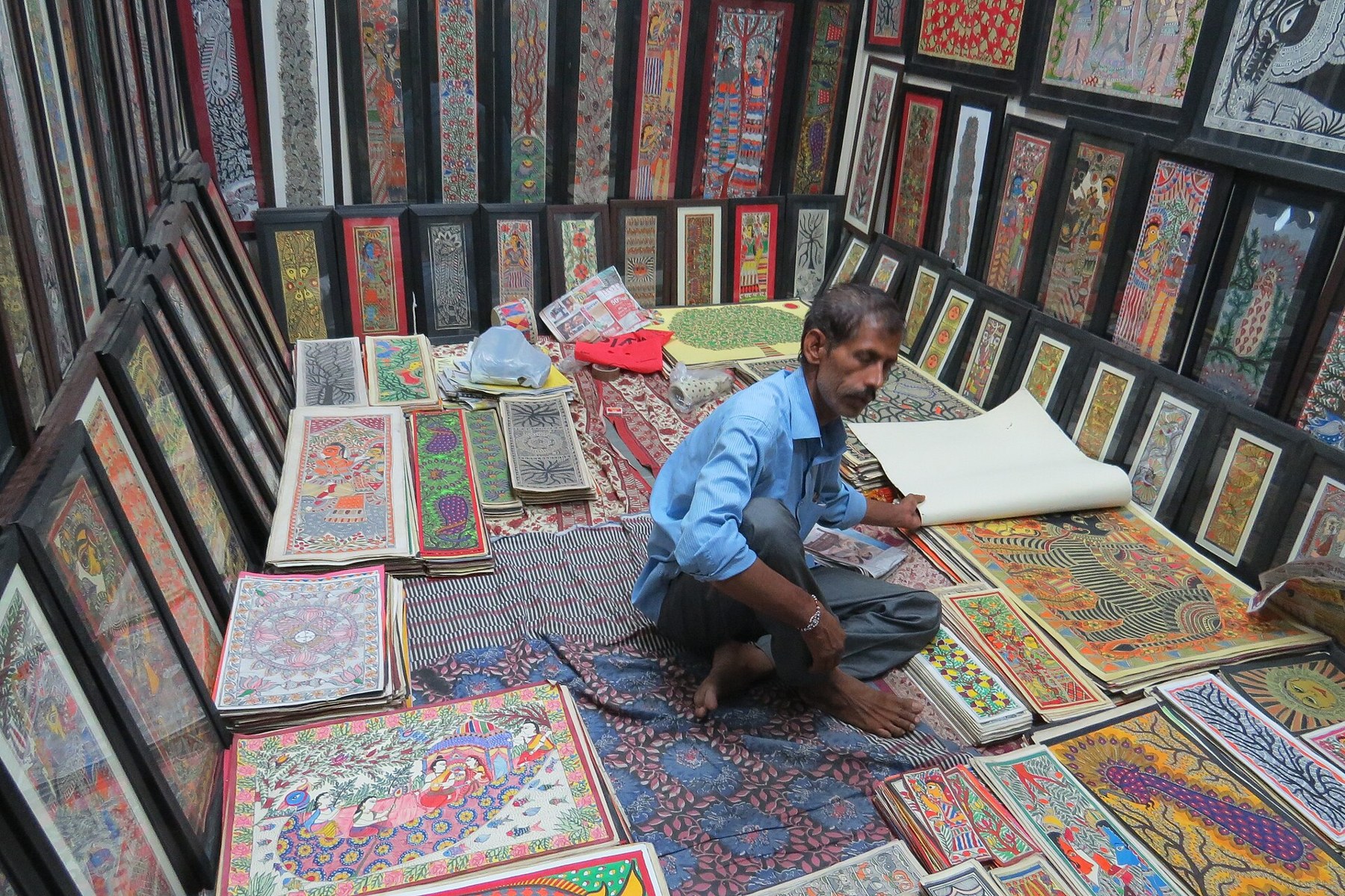
Madhubani (Mithila) painting. Photograph by Raj Gopal Singh Verma, CC BY 2.0.
What Counts As Indian Folk Art?
Indian folk art refers to the regional, community-rooted visual traditions passed down outside the formal art academy — usually tied to a specific place, community and ritual purpose. Unlike gallery "fine art," folk art follows inherited rules: a fixed vocabulary of motifs, a traditional palette, and a reason for being painted (a wedding, a harvest, a deity, a season).
India has dozens of distinct folk and tribal traditions. The four most recognised — and the easiest to live with on a modern wall — are Madhubani, Warli, Pichwai and Gond. Each began as something painted onto walls, floors or cloth, and each has now found a second life as framed and canvas art for homes. Searches for these styles run into the hundreds of thousands every month in India, with "madhubani painting" alone drawing roughly 165,000 searches a month — evidence that the appetite for rooted, traditional Indian decor is large and growing.
Madhubani (Mithila) Painting
Madhubani — also called Mithila painting — comes from the Mithila region of Bihar and Nepal, where women have painted it on the walls and floors of their homes for centuries. It is defined by dense, every-inch-filled compositions, double-line borders, and natural-pigment colour. Nothing is left blank: gaps are packed with flowers, dots and crosshatch.
The motifs carry meaning. A fish signifies fertility and prosperity — a point Mithila artists themselves make repeatedly. Peacocks stand for love and romance, the tree of life for growth and continuity, and the sun and moon for permanence. A traditional Madhubani is hand-painted by Mithila artists over many days, which is exactly why an original commands the price it does.
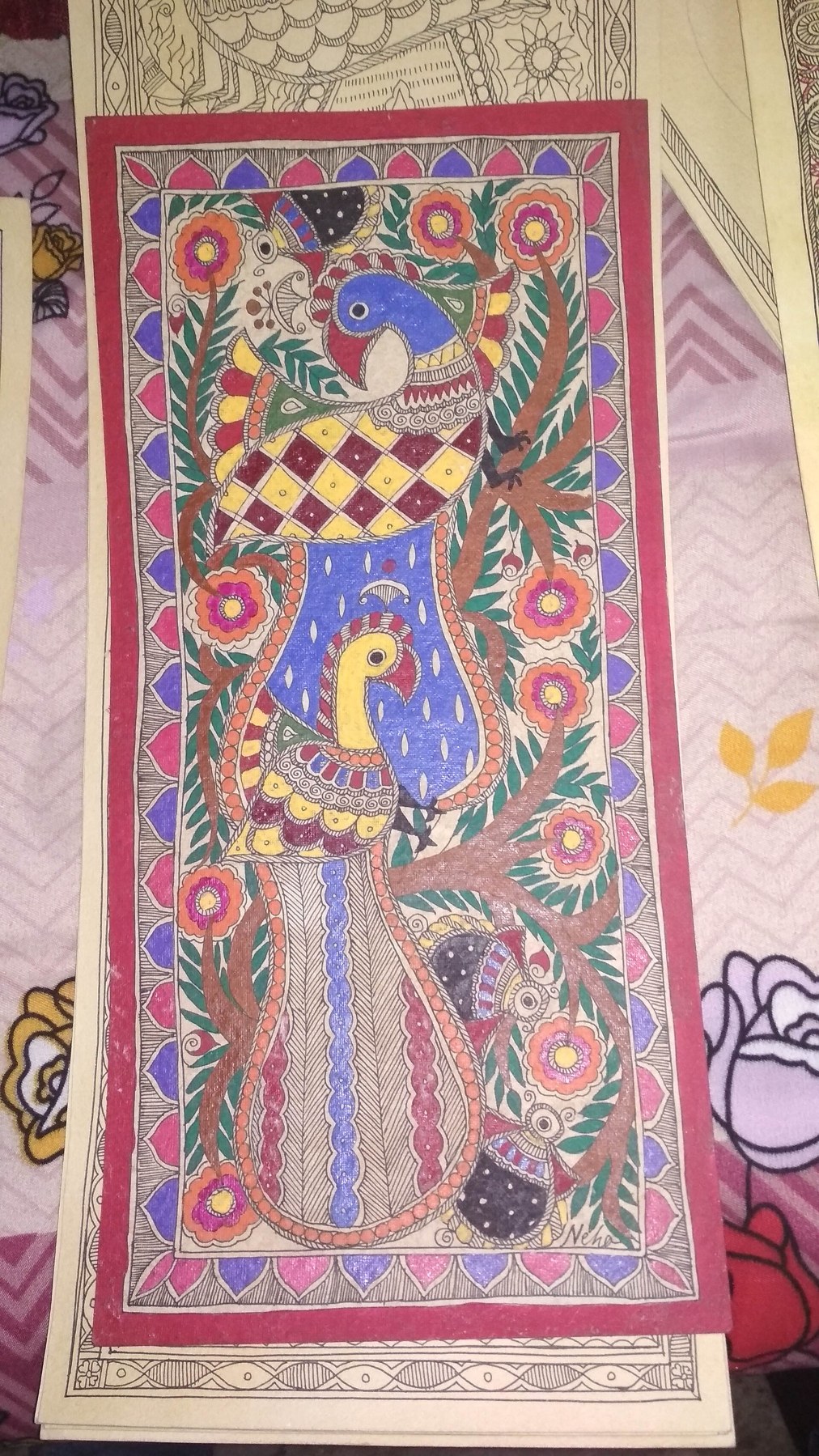
Madhubani painting detail. Photograph by Sarcastic_Speedster, CC BY-SA 4.0.
For a modern home, Madhubani works best as a single confident statement — a tree of life over a console, a pair of fish in an entryway, or a peacock panel in a puja or prayer corner. Its busyness wants calm around it, so give it a plain wall and breathing room rather than a crowded gallery cluster.
Warli Painting
Warli is the tribal art of the Warli people of the North Sahyadri range in Maharashtra, and it is the visual opposite of Madhubani. Where Madhubani is dense and colourful, Warli is spare and monochrome: white rice-paste figures on an earth-brown ground, built almost entirely from triangles, circles and lines.
The most famous Warli motif is the tarpa dance — a spiral of figures circling a musician, symbolising the cycle of life. Warli scenes show farming, fishing, weddings and trees: everyday community life rather than gods. That restraint is exactly why Warli suits minimal and contemporary interiors so well — it brings warmth and story without colour clutter, and sits naturally beside neutral walls, wood and cane.
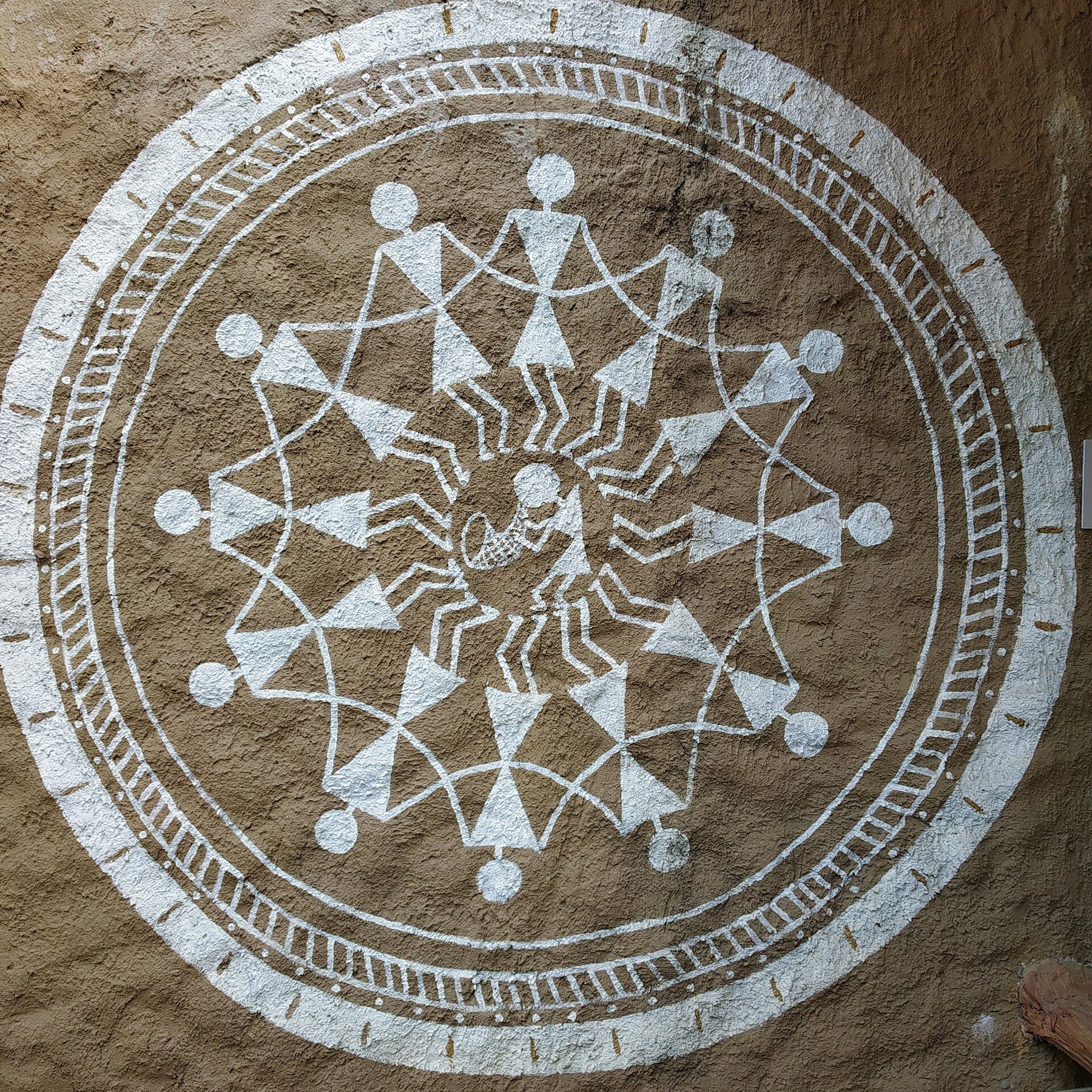
Warli painting by Omrmankar, CC BY-SA 4.0.
A Warli panel is one of the easiest folk traditions to live with: the earthy palette flatters beige, terracotta and grey-green rooms, and a single large piece reads as quietly sophisticated above a sofa or bed.
Pichwai Painting
Pichwai comes from Nathdwara in Rajasthan, where large painted cloths are hung behind the idol of Shrinathji (a form of Krishna) in the temple. The word itself means "that which hangs at the back." Pichwai is the most ornate of the four — lush with lotuses, cows, peacocks and Krishna in deep jewel tones, often with real gold detailing in the originals.
Because Pichwai was made to sit behind a deity, it carries a built-in sense of devotion and ceremony, which makes it a natural fit for a puja room, a prayer corner or a feature wall meant to feel sacred and calm. The lotus and cow motifs in particular have become popular as standalone art for living and dining rooms.
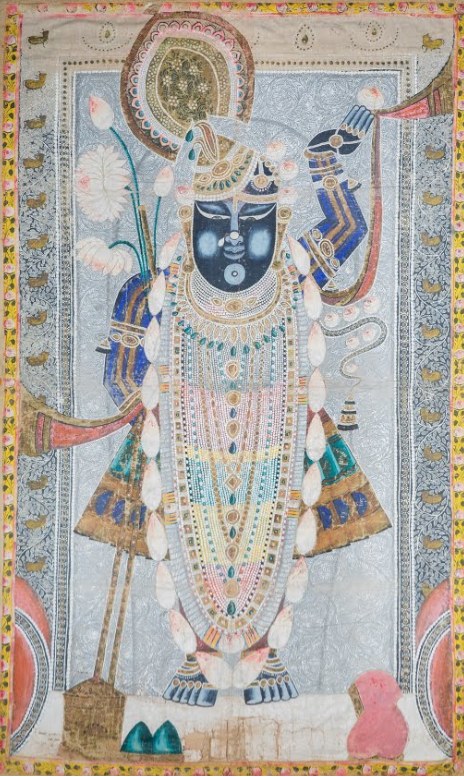
Pichwai of Shrinathji, Nathdwara tradition. After Karodimal/Kajodimal Ratan Lal, CC BY-SA 4.0.
If you love the Pichwai palette but want something less overtly religious for a living space, the lotus is the bridge motif — sacred enough to feel rooted, soft enough to live anywhere.
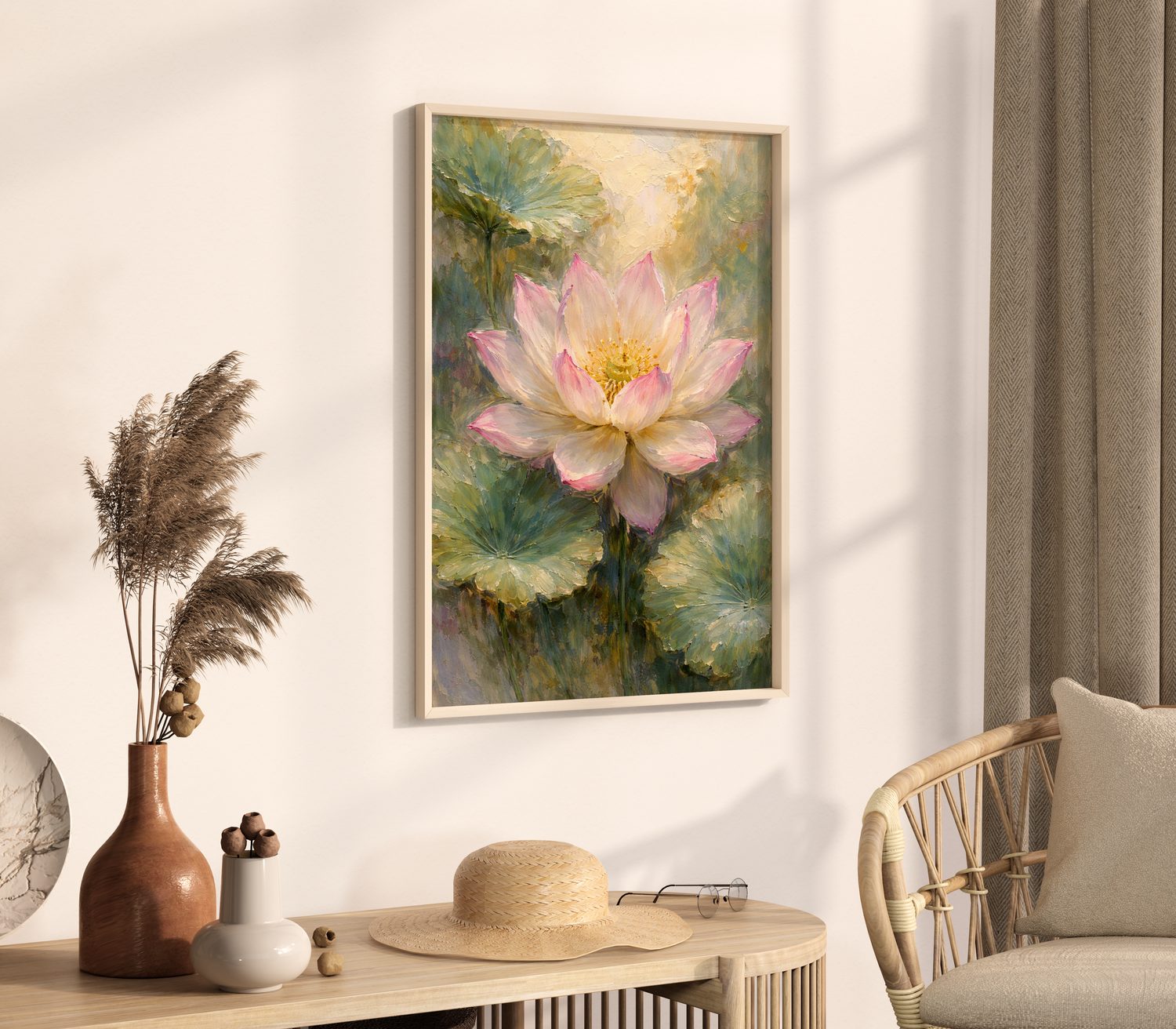
View the Lotus Flower canvas on Rustic Charm → from ₹1,899
Gond and Other Traditions
Gond painting, from the Gond community of Madhya Pradesh, builds animals, trees and deities out of fine dots and dashes in bright, almost neon colour. Beyond these four, India holds dozens more — Kalamkari from Andhra Pradesh, Phad from Rajasthan, Patachitra from Odisha and Bengal, Kerala mural art, and more. The shared thread is that every motif means something; nothing is decorative for its own sake. For a deeper look at how a single artist carried Indian tradition into the modern era, see our guide to Raja Ravi Varma's famous paintings.
Hand-Painted Original vs Canvas Print: An Honest Answer
This is the question that matters, and it deserves a straight answer. A traditional Madhubani, Warli or Pichwai is hand-painted by a folk artist, takes days of skilled work, and is genuinely one of a kind — if you can buy directly from a Mithila or Warli artist or a fair-trade cooperative, that is the most meaningful way to own the art, and it supports the tradition at its source.
A canvas print is a different thing, and we are clear about which one we sell. Rustic Charm's folk-motif pieces are giclée canvas prints — not hand-painted originals. Giclée (pronounced zhee-clay) is a high-precision digital printing method that reproduces an artwork in ultra-high resolution with archival inks, here onto 300 GSM acid-free cotton canvas, then hand-stretched on a wooden frame. That is precisely why a print costs a fraction of an original: a comparable hand-painted folk piece can run ₹50,000 and up, while a giclée canvas print delivers the same motif and visual impact at D2C prices, with consistent colour and 200+ year fade resistance away from direct sunlight.
So the honest framing is this: if you want to own and support living folk art, commission or buy an original from the artists. If you want the look of a Madhubani tree of life or a Warli wedding circle on your wall at an everyday price, a quality giclée canvas print is the right tool — just buy from someone who tells you plainly that it is a print, not an "original." Our explainer on canvas prints versus framed prints covers what separates a good reproduction from a cheap one.
How to Style Indian Folk Art at Home
A few rules make folk art sing in a modern room. Give a busy style like Madhubani or Pichwai a plain wall and space around it; pair a spare style like Warli with neutral, natural materials. Keep one folk piece as the hero of a wall rather than mixing three traditions at once — they each have a strong accent and can shout over one another. And lean into the room's purpose: Pichwai and lotus motifs in puja and prayer corners, Warli in minimal living spaces, Madhubani as a colourful entryway or dining statement. If you are unsure on placement and proportion, our guide to choosing wall art for Indian homes and the wall art size guide walk through it step by step.
For an ethnic, folk-adjacent look that works across a whole wall, a coordinated set can do the heavy lifting:
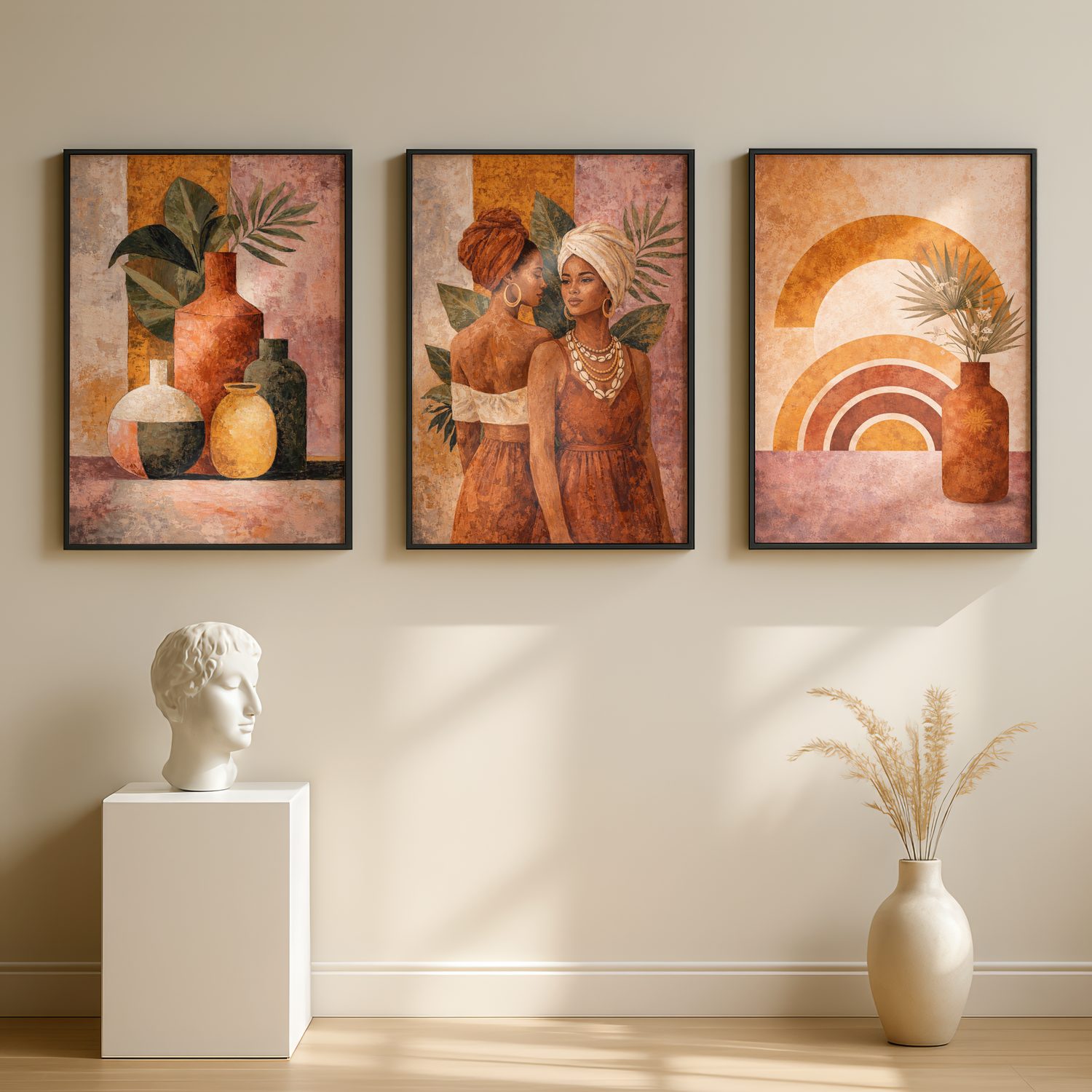
View the Boho Ethnic Set of 3 on Rustic Charm → from ₹4,999
You can also browse our boho and ethnic wall art ideas for Indian homes for more ways to bring rooted, earthy art into a contemporary space.
Frequently Asked Questions
What are the main types of Indian folk art? The most recognised Indian folk art styles are Madhubani (Mithila) from Bihar, Warli from Maharashtra, Pichwai from Nathdwara in Rajasthan, and Gond from Madhya Pradesh. Other major traditions include Kalamkari, Phad, Patachitra and Kerala mural art. Each has its own fixed motifs, traditional palette and ritual origin, and "madhubani painting" alone draws around 165,000 searches a month in India.
What is the difference between Madhubani and Warli painting? Madhubani is dense, colourful and every-inch-filled, using natural pigments and double-line borders with motifs like fish, peacocks and the tree of life. Warli is the opposite: spare, monochrome white figures on an earth-brown ground, built from triangles, circles and lines to show everyday village life. Madhubani suits a bold statement wall; Warli suits minimal, neutral interiors.
What do Madhubani painting motifs mean? In Madhubani painting, the fish signifies fertility and prosperity, peacocks stand for love and romance, the tree of life represents growth and continuity, and the sun and moon symbolise permanence. Almost nothing is purely decorative — every motif carries meaning, which is part of why the tradition feels so rooted on a modern wall.
Is it better to buy a hand-painted folk art original or a canvas print? It depends on your goal. A hand-painted original from a Mithila, Warli or Pichwai artist is one of a kind, supports the living tradition, and is the most meaningful way to own folk art — a comparable original can cost ₹50,000 and up. A giclée canvas print reproduces the same motif at a fraction of the price with archival, fade-resistant quality. Rustic Charm sells giclée canvas prints, not originals, and says so plainly.
Can I put Indian folk art in a modern apartment? Yes, and it often works better than imported prints because it reads as confidently Indian. Give a busy style like Madhubani or Pichwai a plain wall with space around it, pair a spare style like Warli with wood, cane and neutral tones, and keep one folk piece as the hero rather than mixing several traditions on one wall.
Are Rustic Charm folk-art canvases hand-painted? No. Rustic Charm's folk-motif pieces are giclée canvas prints — ultra-high-resolution reproductions printed with archival inks on 300 GSM acid-free cotton canvas, then hand-stretched on a wooden frame. They are not hand-painted originals. This gives you the look of the tradition at an everyday price, with consistent colour and 200+ year fade resistance away from direct sunlight.
Image credits: Madhubani painting — photograph by Raj Gopal Singh Verma (CC BY 2.0). Madhubani detail — photograph by Sarcastic_Speedster (CC BY-SA 4.0). Warli painting — by Omrmankar (CC BY-SA 4.0). Pichwai of Shrinathji — after Karodimal/Kajodimal Ratan Lal (CC BY-SA 4.0). Images used under their respective Creative Commons licences.