
If you have ever scrolled past a painting of Lakshmi standing on a lotus, or Krishna sitting cross-legged in Yashoda's lap, or Shakuntala lifting her sari to look back over her shoulder — you have already met Raja Ravi Varma. The picture in your head of how a Hindu goddess looks, how Sita carries herself, what Saraswati's veena should rest against — most of that visual grammar was settled, once and for all, by one man working in Kerala and Bombay between roughly 1870 and 1906.
This is the long, picture-led guide to his work: the most famous paintings of Raja Ravi Varma with their names and stories, what makes the style historically important, where you can see the originals today, and where his art is honestly available to buy in 2026 — from a ₹167.2-crore auction house all the way down to a printed canvas you can put up next weekend.
Who Raja Ravi Varma was, in one paragraph
Raja Ravi Varma (29 April 1848 – 2 October 1906) was a painter from the princely state of Travancore — present-day Kerala — born into an aristocratic family closely linked to the Travancore royal house. He learned watercolour from Rama Swami Naidu and was, by his own admission, reluctantly trained in oil painting by the British portraitist Theodore Jenson. He won an exhibition prize in Vienna in 1873, took home three gold medals from the World's Columbian Exposition in Chicago in 1893, and was awarded the Kaisar-i-Hind Gold Medal by Viceroy Lord Curzon in 1904. The title "Raja" itself was a personal honour conferred by Curzon — not a hereditary throne. He died in 1906, leaving behind a body of work that the Indian art critic Geeta Kapur would later describe as making him "the indisputable father figure of modern Indian art."
What made him singular was a fusion: European academic technique — chiaroscuro, anatomical realism, oil on canvas, perspective — applied to subjects nobody in European academies had ever painted. Hindu gods. Shakuntala. Damayanti. Draupadi. Sita. He painted them with the same seriousness Velázquez gave to Spanish royalty, and the result was startling on both sides of the world. To Indian audiences, he gave the gods faces and bodies and gestures that felt human. To European critics, he handed back the academic style with subjects they had never seen on a canvas.
The 10 most famous paintings of Raja Ravi Varma — with names, dates and stories
Below are ten of his best-known works, each with the date, the subject, and a short reading of why the painting still matters. These are not the only ten — he produced hundreds of canvases and the Ravi Varma Press he founded in 1894 churned out his designs as cheap oleograph prints by the tens of thousands — but if a list had to be ten, this is a defensible ten.
1. Shakuntala writing a love letter on a lotus leaf (c. 1898)
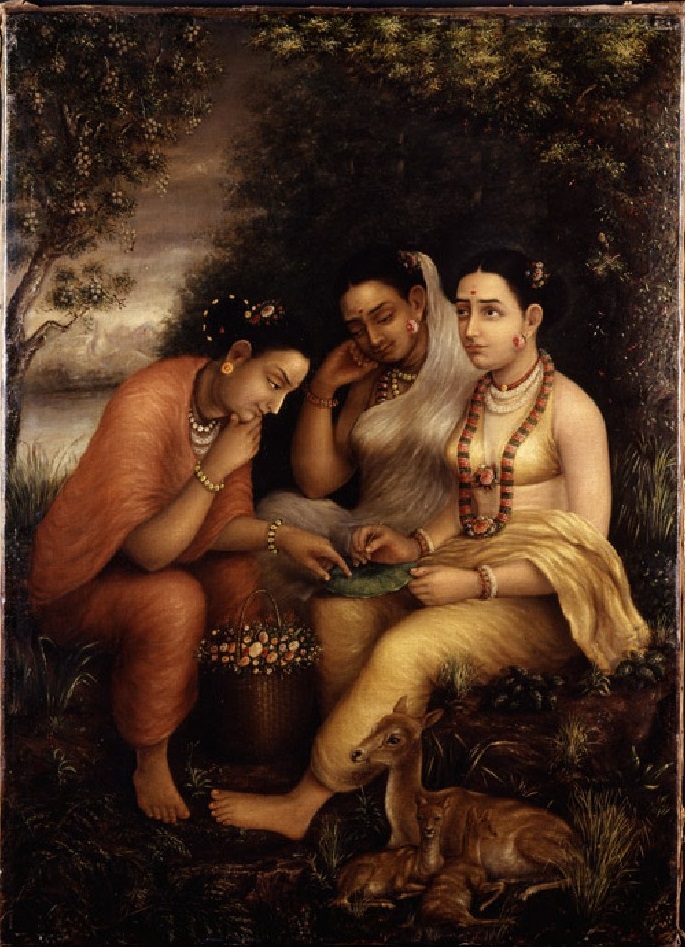
The Shakuntala of Kalidasa's play has fallen in love with King Dushyanta and is writing him a letter on a lotus leaf because nothing else is to hand. Varma painted Shakuntala in several attitudes across his career — pretending to remove a thorn from her foot in one canvas, lost in thoughts in another — and this lotus-leaf scene is the one that travelled furthest as a print. Look at the patience in the wrist and the way the lotus pad bends but does not break. He is showing you a kind of restraint that the high-pitched mythological prints of his time had no language for.
2. Hamsa Damayanti — Princess Damayanti and the Royal Swan (c. 1899)
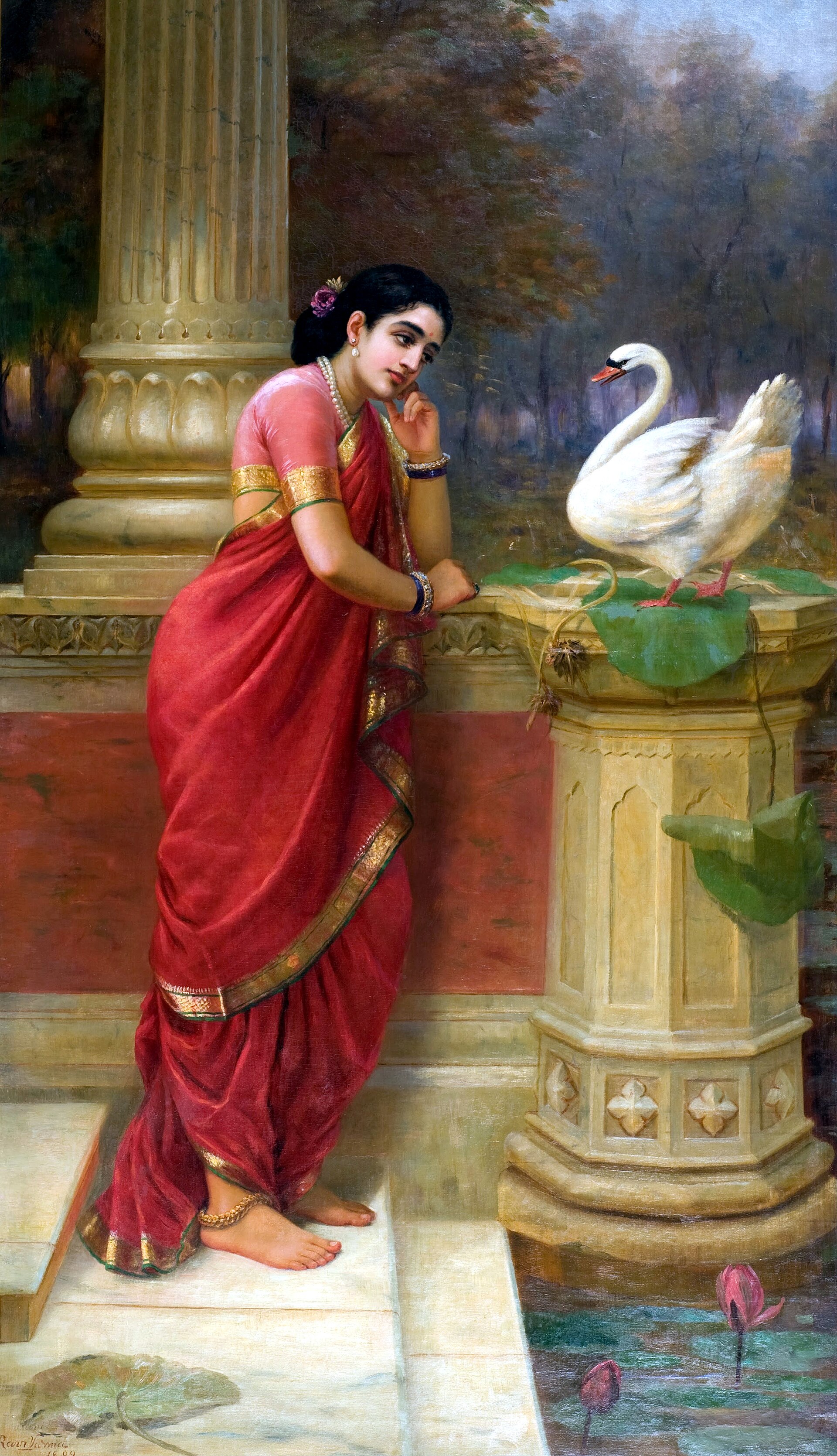
From the Nala-Damayanti episode of the Mahabharata: the princess Damayanti, daughter of the king of Vidarbha, learns about Nala from a golden swan who has flown south to find her. Varma painted this subject again and again — there is a Damayanti Vanavasa, a Swan Messenger, a Haunsa Damayanti Sanwada that became one of the press's most printed lithographs. India Post chose his Damayanti-and-Swan for his 1971 commemorative postage stamp. The composition still teaches young Indian illustrators how to draw a quiet conversation between a woman and a bird.
3. Galaxy of Musicians (1889)
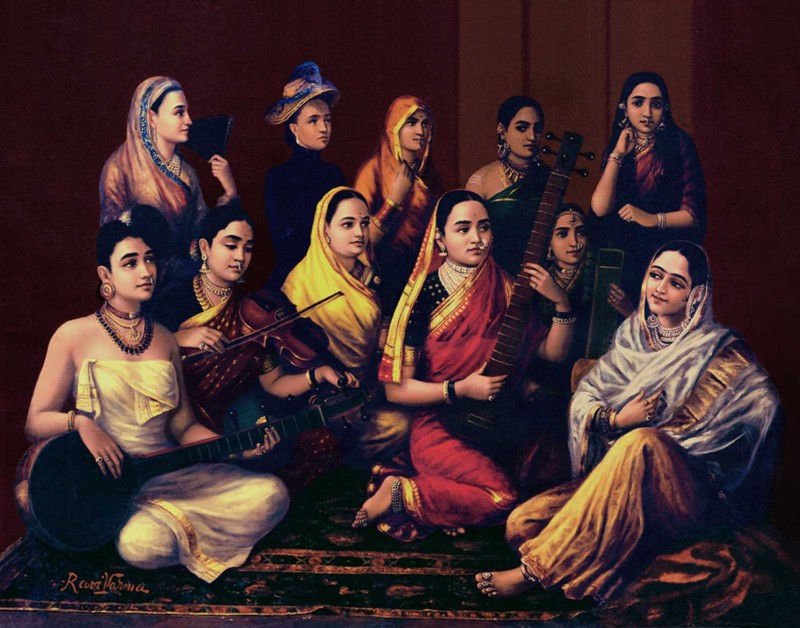
Eleven women, eleven musical instruments, eleven regions of India in eleven different saris. Painted for the Maharaja of Travancore, the Galaxy of Musicians is the closest thing he produced to a manifesto: an India that has always been many Indias, brought into one frame by music. Notice how each musician's clothing is precisely correct — Maratha nine-yard, Tamil madisar, Parsi gara, Bengali shantipuri — and how the central pair of musicians lean toward each other as if they are about to begin a duet. It is a painting and a national imagination at the same time. Modern Indian artist Nalini Malani later recreated this composition in her video installation Unity in Diversity to interrogate exactly that idealism.
4. Goddess Saraswati (1896)
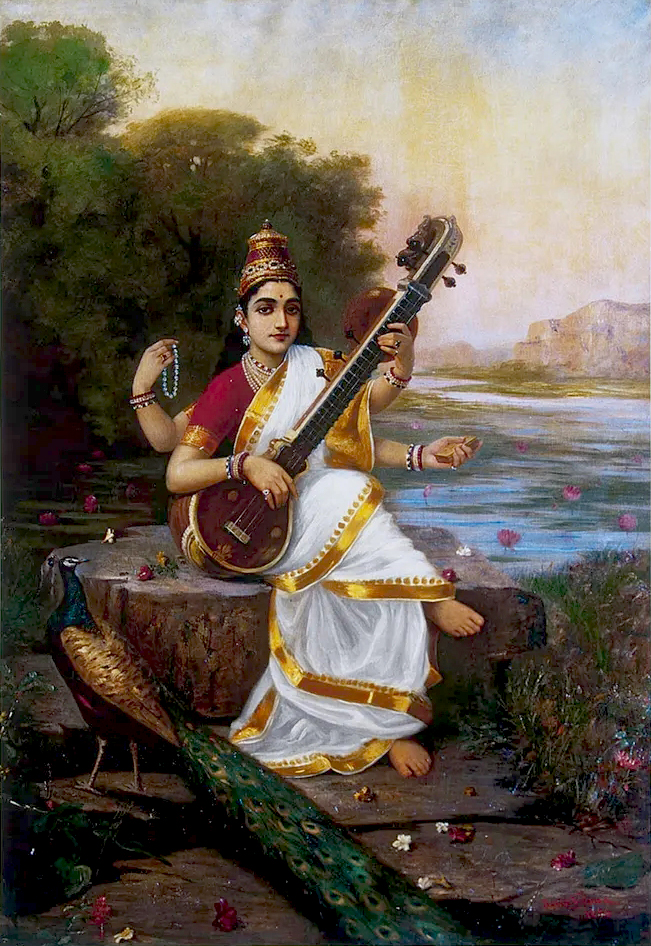
If you grew up in an Indian home and you have a mental image of Saraswati — seated on a lotus, dressed in white, a veena resting on her lap, a peacock at her feet — that image came from this painting. Before Varma, goddesses appeared in temple wall murals, in folk patachitra, in Mysore and Tanjore school traditions, but rarely in oil-on-canvas at this scale. After Varma, every calendar press in India printed a Saraswati that borrowed from his template. His decision to model her on an ordinary Indian woman, rather than on an iconographic ideal, is part of what made her feel approachable to the press's mass audience.
5. Goddess Lakshmi (1896)
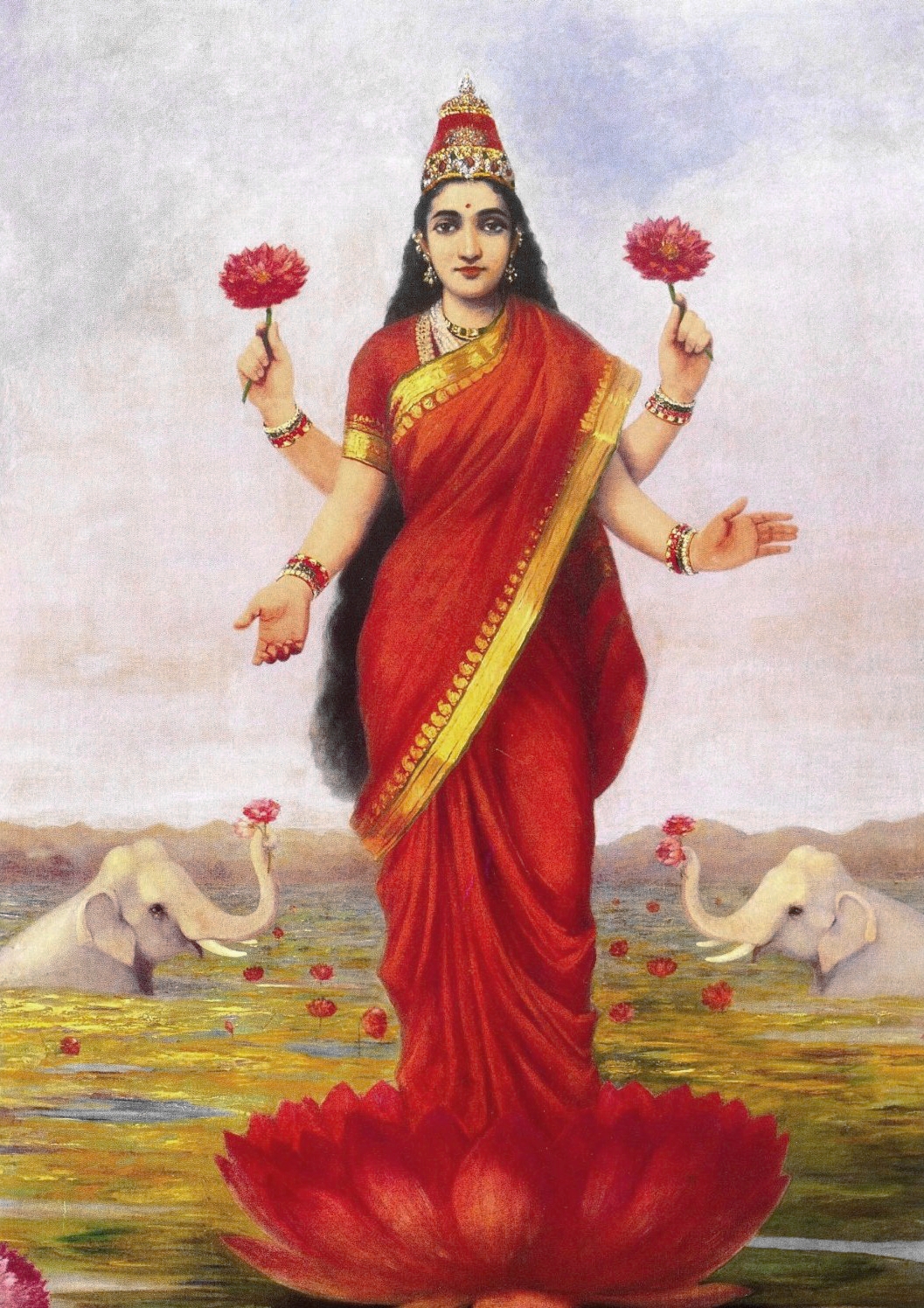
Painted the same year as the Saraswati and meant to hang as a pair, this Lakshmi standing on a pink lotus with two elephants pouring water over her became the single most reproduced devotional image in Indian printing history. It is the picture you have probably seen above the cash counter of a shop, in a grandmother's puja room, on the inside of a Diwali greeting card. The Ravi Varma Press oleograph from this painting was so commercially successful that "Lakshmi on a lotus" became a default — not a particular interpretation, just the way Lakshmi is.
6. Yashoda and Krishna (1890s)
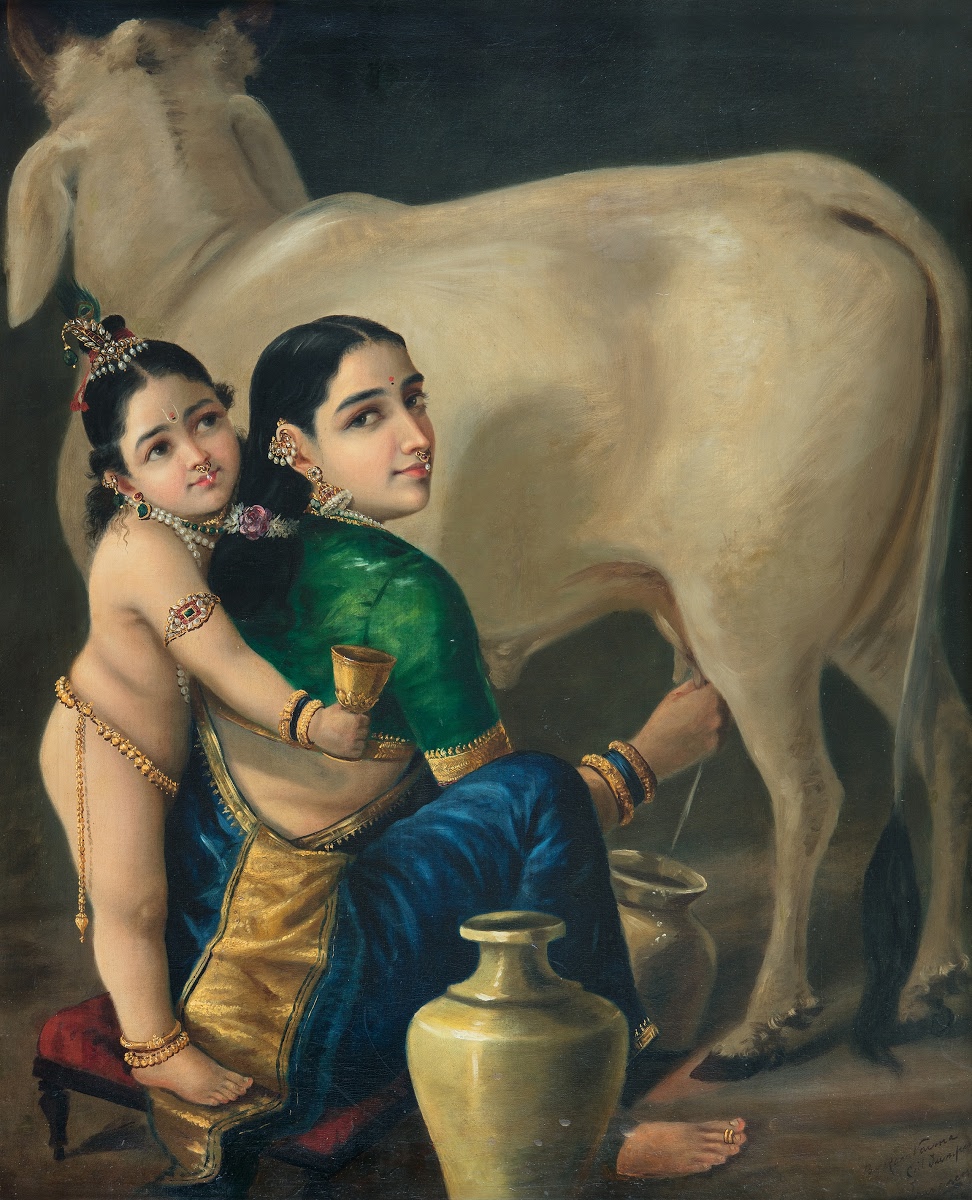
A small painting of Krishna's foster-mother Yashoda holding the infant Krishna in her lap. On 1 April 2026, this exact canvas was sold by Saffronart in their Mumbai auction for ₹167.2 crore (US$17.9 million) — the highest price ever paid at auction for a work of modern Indian art, surpassing M. F. Husain's Untitled (Gram Yatra), which had set the previous record at over ₹118 crore the year before. The buyer was Cyrus Poonawalla, the founder and managing director of Serum Institute of India. The price hammered well above the pre-sale estimate of US$8.6m to US$12.9m. If you want one data point to argue that Ravi Varma has not been forgotten by the market, this is the one.
7. Jatayu Vadham — Jatayu fights Ravana (1906)
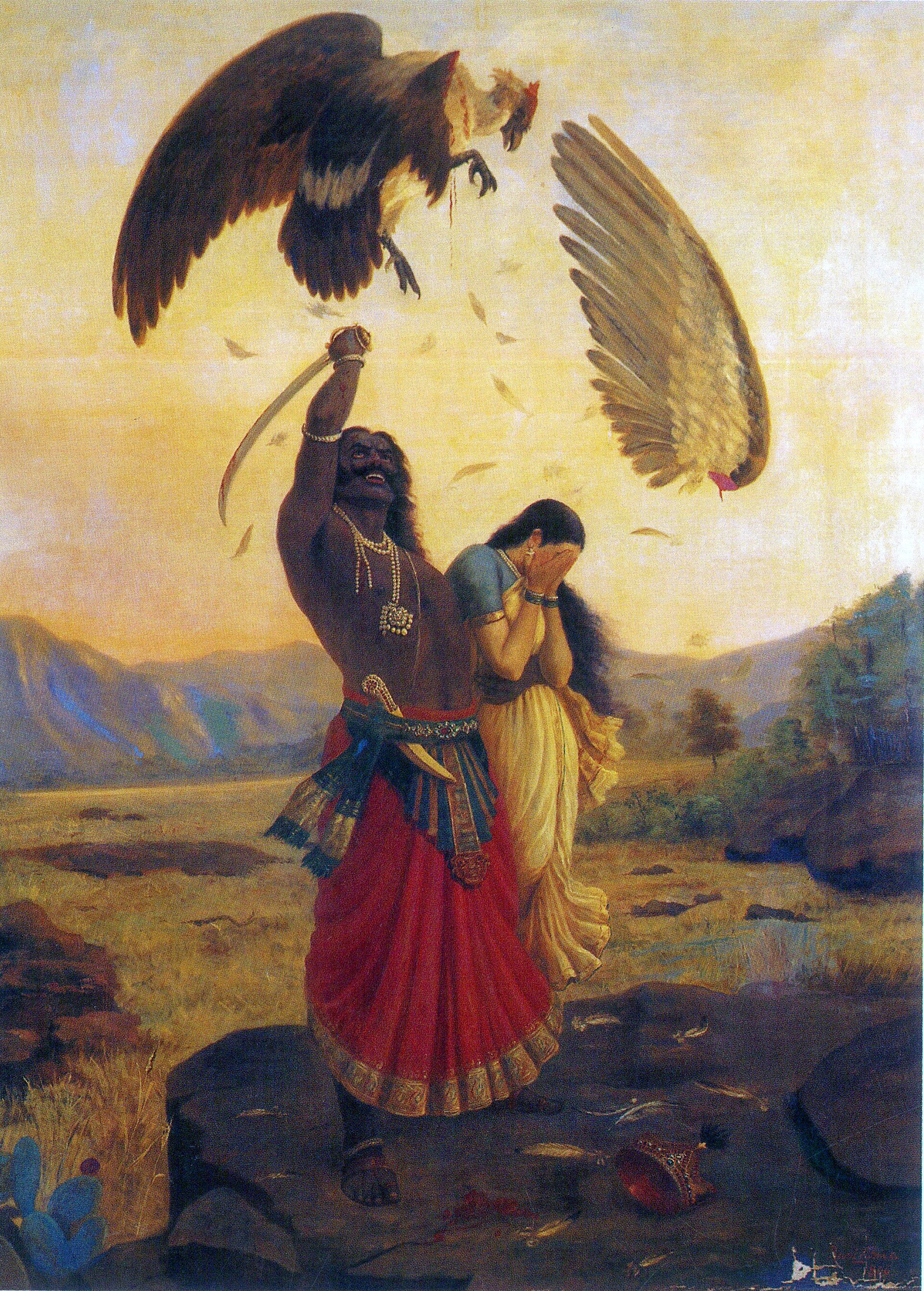
From the Ramayana: the vulture-king Jatayu has just intercepted Ravana, who is abducting Sita on his airborne chariot. The painting catches the moment Jatayu's wing is being severed — Sita is mid-cry, Ravana mid-swing, the whole composition exploding outward into the sky. Varma painted this in 1906, the year he died, and the canvas is one of his last great large-scale mythological scenes. It hangs today at the Sree Chitra Art Gallery in Thiruvananthapuram alongside many of his Travancore commissions.
8. Descent of Ganga — Gangavataran (c. 1890)
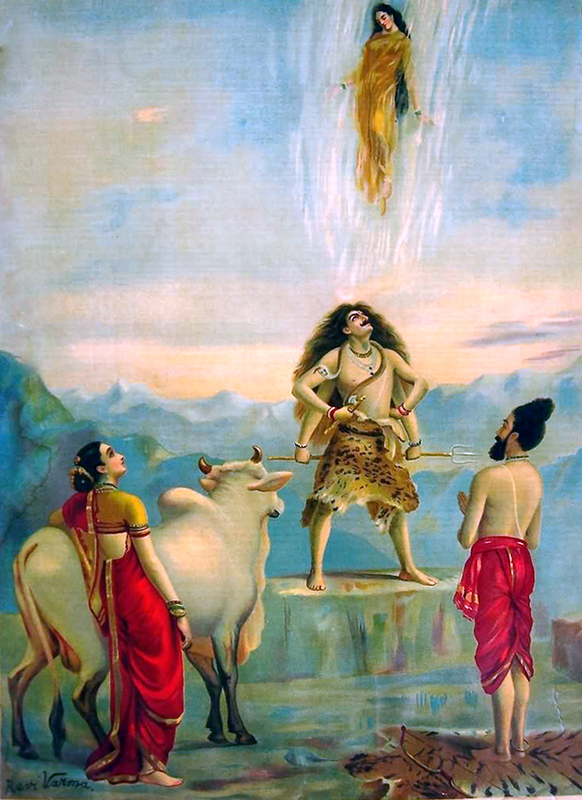
The Ganga falls from heaven and is caught in Shiva's matted hair so that the impact does not split the earth. Varma painted several versions and his studio produced more after his death. This composition matters because it has to do something nearly impossible: show a river arriving from the sky as a person. The way Ganga's body curves into Shiva's locks, half river and half woman, is the kind of solved-it-on-canvas problem that students still copy from. There is a smaller studio version of this subject at Laxmi Vilas Palace, Vadodara, in the very large princely collection of his work there.
9. There Comes Papa (1893)
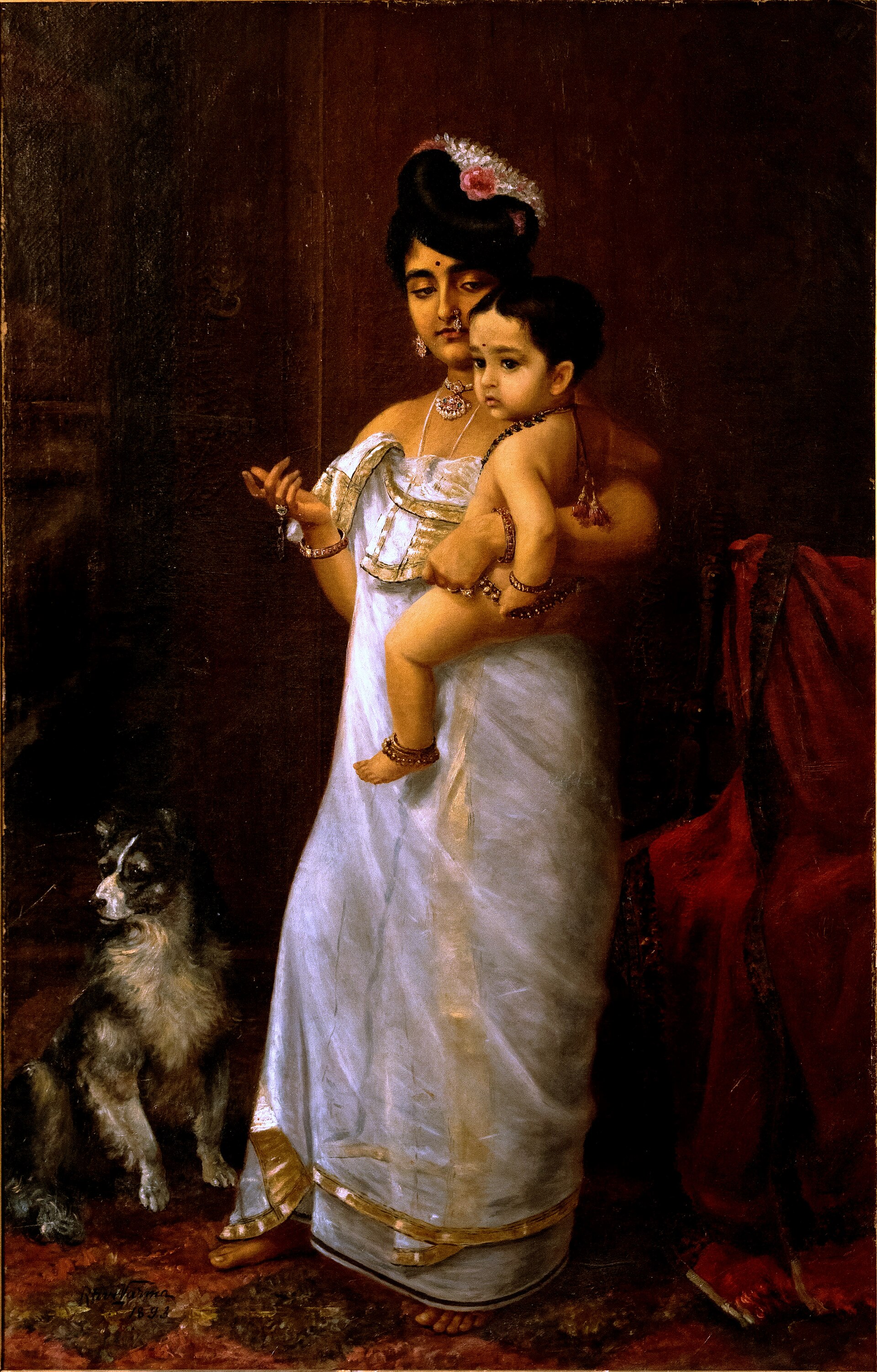
A young woman in a deep red sari stands in the verandah of a house, holding a baby. She has heard footsteps and her gaze has gone past the painter, to the door. Varma's daughter Mahaprabha Amma is the model — she features in two of his most famous paintings — and the baby is her son. This is not a goddess and it is not a mythological scene; it is a domestic portrait that operates with the same dignity. Among the painter's secular work, it is the one most often compared to John Singer Sargent. The Sree Chitra Art Gallery in Thiruvananthapuram holds an original. The press made an oleograph version that hung in middle-class drawing rooms across India for half a century.
10. Woman Holding a Fruit — Lady with Fruit (c. 1893)
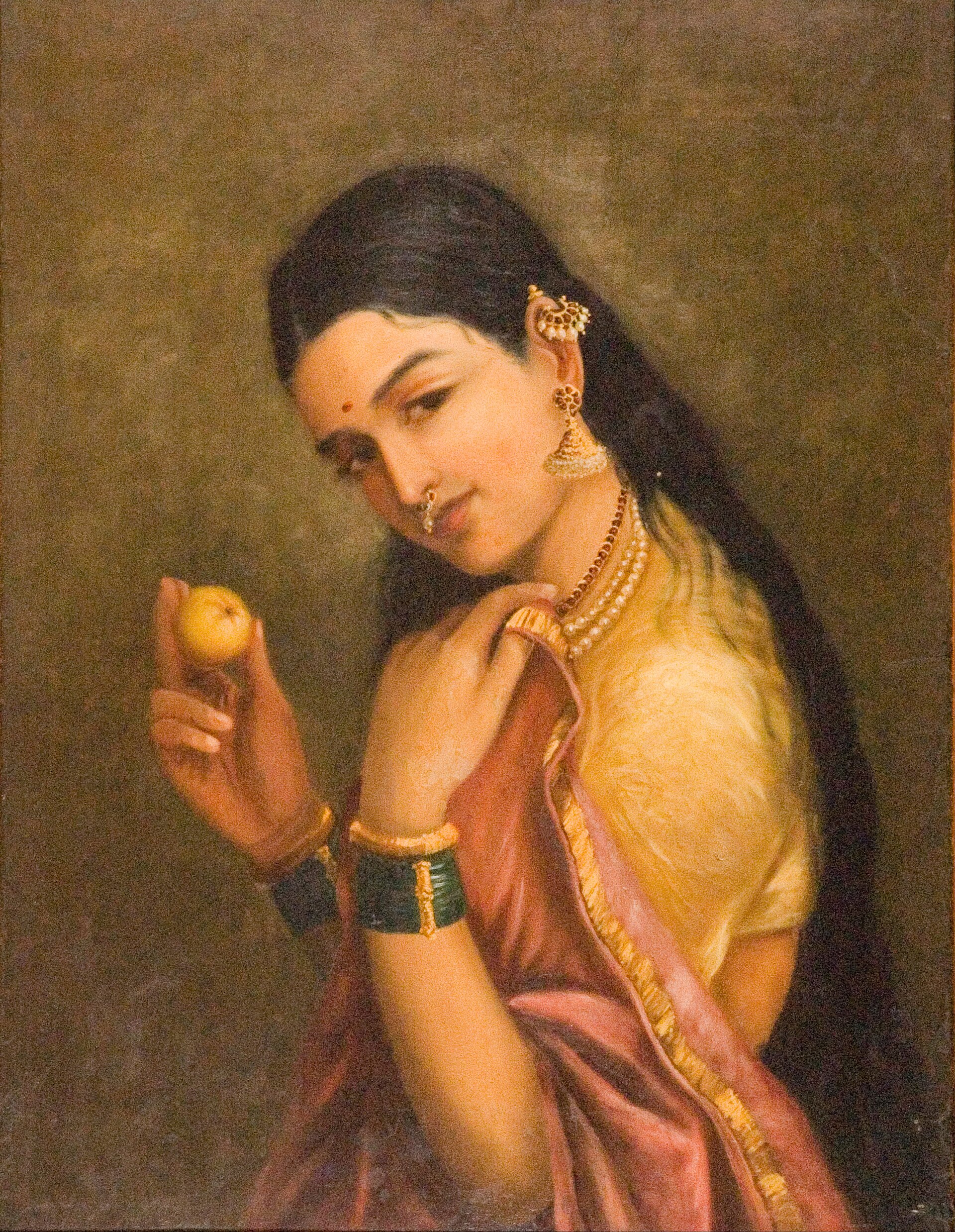
A young Indian woman, in a dark sari with a gold-bordered pallu, has turned her head over her right shoulder and is holding up a piece of fruit. The painting belongs to a series in which Varma painted ordinary Indian women — not princesses, not goddesses — with the seriousness usually reserved for European portraits. Google Arts and Culture released a digitised version of this painting in 2014, and the high-resolution scan made it one of the most studied of his secular portraits. The reason it has become a touchstone for contemporary Indian photographers (and the basis of the popular "Ravi Varma photoshoot" maternity-shoot trend on Instagram) is that turn-of-the-head pose: it is the single most-imitated gesture in modern Indian portrait photography.
What made his style historically important
Three things, briefly. First, he proved that the academic oil-on-canvas tradition — the European technique of careful drawing, anatomical correctness, controlled light, and varnished finish — could carry Indian subjects without flattening them. That argument had to be won, and he won it.
Second, he set up the Raja Ravi Varma Press in Ghatkopar, Mumbai in 1894 (later moved to Malavli, near Lonavala, Maharashtra in 1899). The press produced oleographs — coloured lithographic prints designed to imitate oil painting — of his Hindu gods and goddesses, his Mahabharata and Ramayana scenes, his Puranic episodes. These prints were cheap enough that an ordinary household could afford one. They were the first time fine-art-quality images of the gods entered Indian homes at scale. Calendar art, devotional posters, even Bollywood mythological cinema's visual grammar all trace back to those prints. The press was managed by his brother Raja Varma, ran into debt, and was sold in 1901 to his German technician Fritz Schleicher. It kept printing his designs until a fire destroyed the factory in 1972, taking many of the original lithographic stones with it.
Third, his legacy is contested in a way that proves how seriously the Indian art world still takes him. The Baroda School critic Ratan Parimoo dismissed him as "kitsch" and held him responsible for the visual vulgarity of later calendar art. The artist Pushpamala N. has spent years recreating Ravi Varma compositions with herself as the subject to deconstruct what she sees as their idealised femininity. Nalini Malani, as mentioned above, has restaged the Galaxy of Musicians as a video installation. None of this would happen if he were a minor figure.
Where you can see Raja Ravi Varma's original paintings today
If you want to stand in front of the actual canvases, the four most important places are these.
Sree Chitra Art Gallery, Thiruvananthapuram (Kerala) — opened in 1935 by the Maharaja of Travancore, this is the single largest public collection of his original work. The older gallery holds 43 originals; the newer 12,000-square-foot expansion adjacent to it holds 134 works in total, including 46 paintings, 14 oleographs and 16 pencil sketches. If you are in Kerala and you want to see the most Ravi Varma in one place, this is the trip.
Laxmi Vilas Palace, Vadodara (Gujarat) — the painter spent extended periods in Baroda as a guest of the Gaekwad royal family, and the palace today houses many of his most ambitious mythological canvases. The Maharaja Fatesingh Museum on the same campus extends the collection. The annual Maharaja Ranjitsinh Gaekwad Festival of Arts at the Durbar Hall in the palace includes the Raja Ravi Varma Award for Excellence in Visual Arts.
Jayachamarajendra Art Gallery, Mysuru (Karnataka) — housed inside the Jaganmohan Palace, the gallery's Ravi Varma room is one of South India's quietest pleasures.
Ravi Varma Press Museum, Manipal (Karnataka) — at the Hasta Shilpa Heritage Village, this museum reconstructs the Ravi Varma Press and displays surviving oleographs, lithographic stones and printing equipment.
The Government of Kerala also runs the official Raja Ravi Varma Art Gallery website (rajaravivarmaartgallery.kerala.gov.in), which functions as a central digital archive and visitor information site. Google Arts & Culture released over 300 of his works online to mark his 150th birth anniversary, so a fair amount of the catalogue is now viewable in high resolution from any laptop.
Where you can buy his art today — auction houses, oleograph specialists, and prints
At the top of the market: Saffronart. This is the auction house that handled the ₹167.2-crore Yashoda and Krishna sale in April 2026, and they regularly include Ravi Varma originals in their modern-Indian-art evening sales. MutualArt's auction database currently lists 191 Ravi Varma works that have come up at auction over the years. Pundole, AstaGuru and Christie's South Asian sales are the other auction venues to watch if you are looking for an original.
For authenticated oleographs and lithographs. The Ravi Varma Press oleographs — those mass-produced prints from the late nineteenth and early twentieth century — are now a collector category of their own. Surviving original prints from before the 1972 press fire are increasingly rare and sit roughly between fine-art originals and modern reproductions on the price scale. The Raja Ravi Varma Heritage Foundation (rrvhfoundation.com) authenticates them. Online specialists like Archer Art Gallery, Artisera, Art365, MeMeraki, Beyond Square and Chitravali offer curated collections of Ravi Varma Press oleographs and lithographs at various price points. Etsy India also lists vintage frames and prints, but provenance is buyer-beware there.
For modern reproductions and prints. If what you want is to put a Ravi Varma image on your wall, rather than collect a museum-grade original, there is now a healthy ecosystem of high-quality reproduction prints. Tallenge Store, ArtZolo, Dessine Art and Artociti all carry Ravi Varma reproduction collections on canvas and paper. Prices on these tend to start at a few thousand rupees and scale with size and material.
A reality check on price. "Original Raja Ravi Varma paintings for sale" is one of the most searched phrases in this category, and the honest answer is: original oil-on-canvas paintings by him are now rare, fully authenticated when they appear at auction, and routinely cross several crore. Original press oleographs from his lifetime are more findable but you should buy them through an authenticated dealer or the Heritage Foundation. Anything sold as an "original Ravi Varma" for under a few lakh of rupees is almost certainly a press reproduction or a modern print.
What Rustic Charm carries in this same spirit
We are honest about what we are: we do not own a Ravi Varma original, we do not print authenticated oleographs, and the art we sell is digitally printed using twelve-colour giclée technology and then hand-stretched and hand-finished onto premium canvas. What we do share with the tradition the painter started is the belief that gallery-quality art should be available to ordinary Indian homes — which is exactly the impulse behind his press in 1894.
If you have read this far and you would like to put a piece of narrative, painterly art on your own wall this week, three from our catalogue sit closest to the Ravi Varma sensibility.
Rose Garden Canvas Wall Art — Impressionist Floral
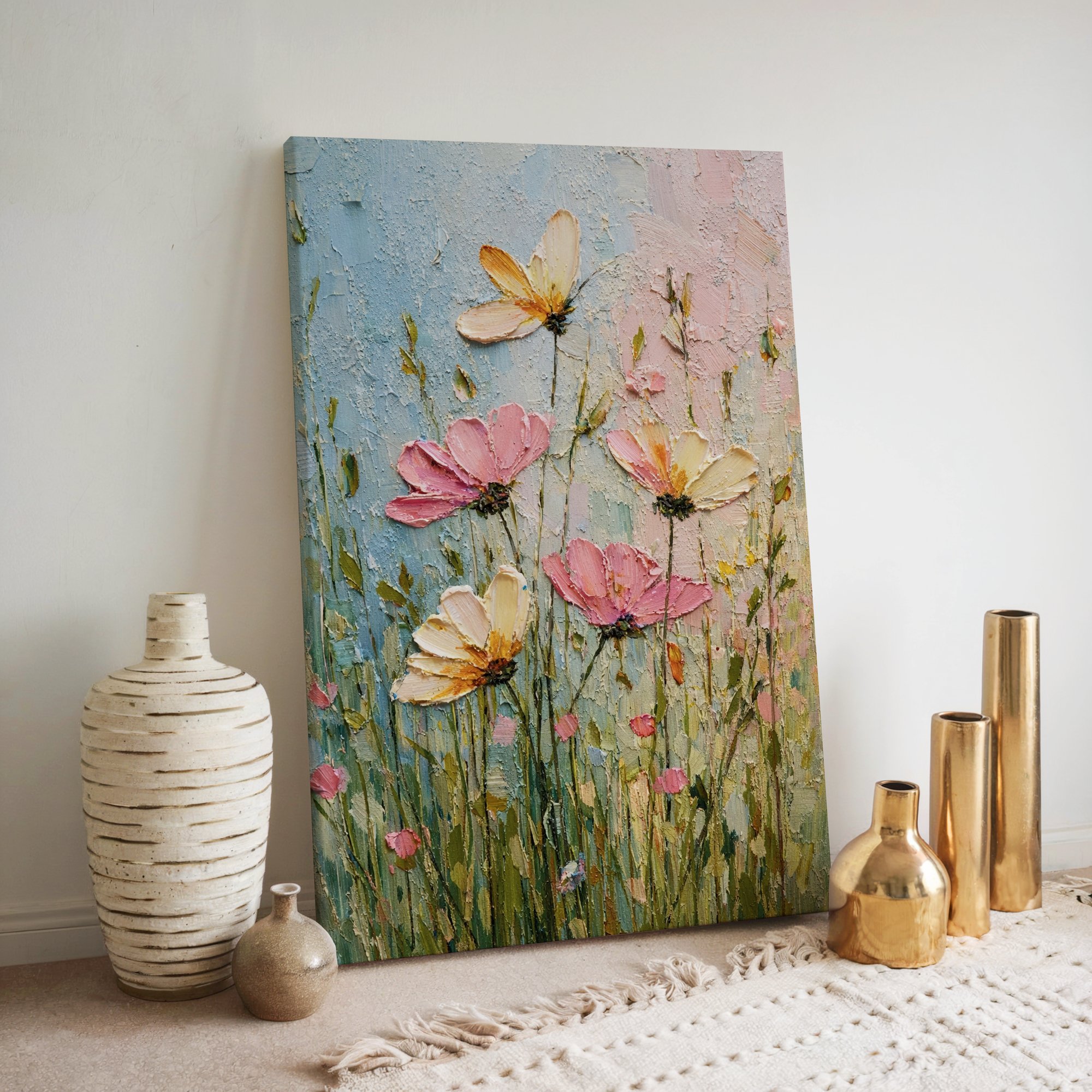
A romantic, painterly rose study in the European academic floral tradition — the same oil-painting lineage Varma learned from Theodore Jenson, applied to a subject any drawing room can carry. ₹1,899. View the Rose Garden canvas.
Royal Dog Portrait Canvas Wall Art — Renaissance Pet Painting
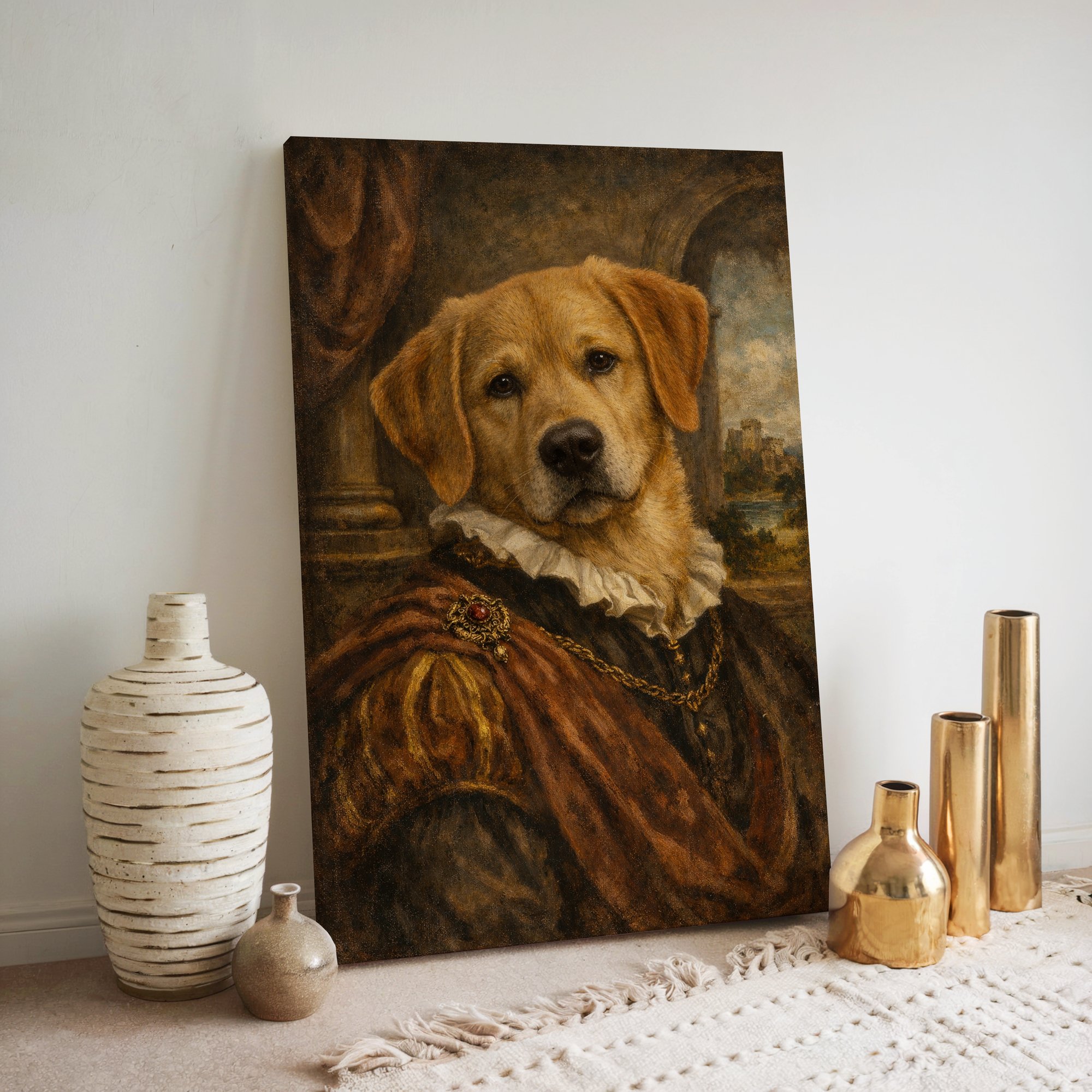
A renaissance-style pet portrait that does for the household dog what There Comes Papa did for a young mother — treats an everyday subject with the seriousness of formal portraiture. ₹1,899. View the Royal Dog Portrait canvas.
Abstract Face Canvas Wall Art — Modern Portrait
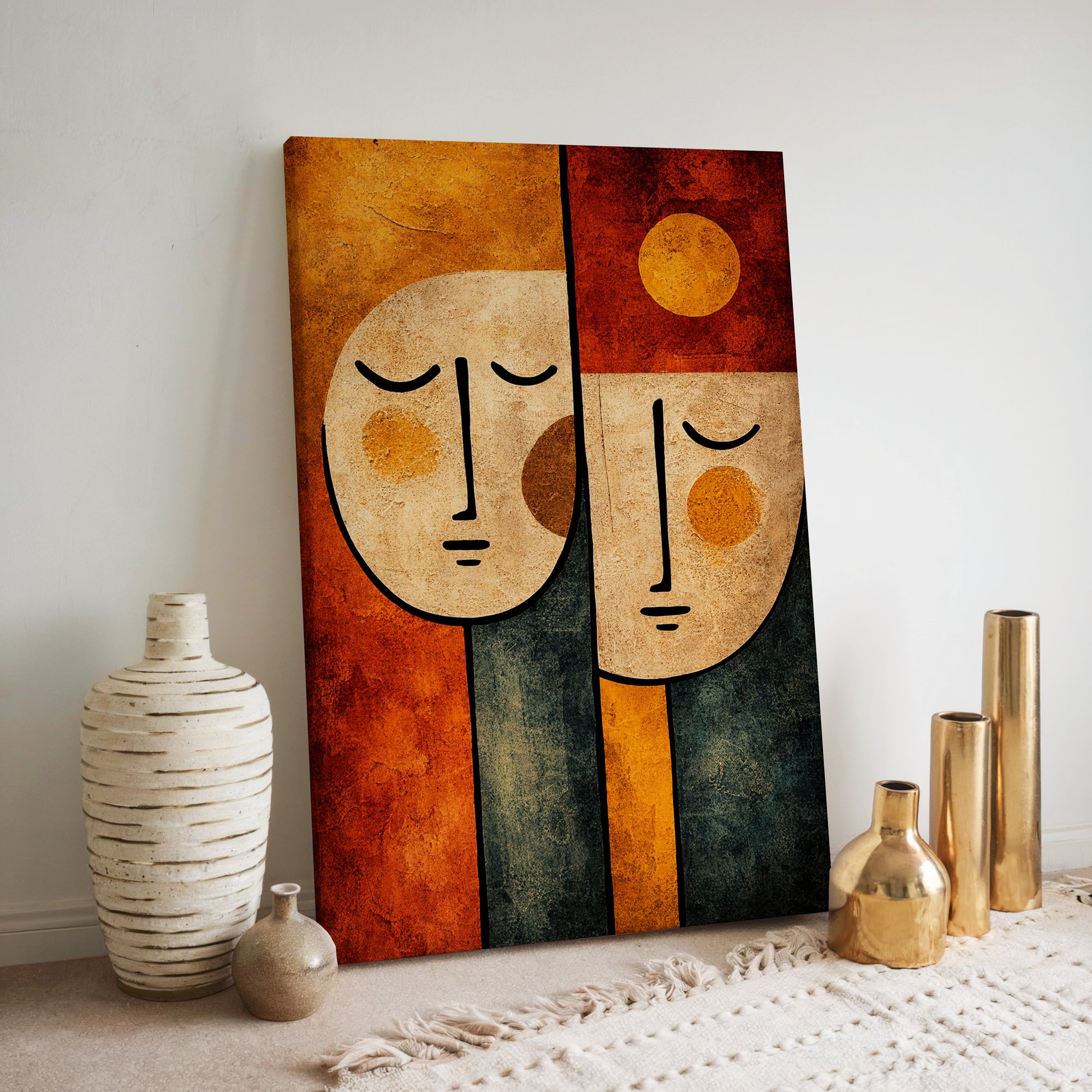
For homes that want a portrait, but a hundred-and-thirty-year jump forward — the modern, abstracted descendant of Varma's Indian-portrait tradition. ₹1,899. View the Abstract Face canvas.
All three are printed on premium archival canvas, hand-stretched in Bangalore, and shipped pan-India.
Raja Ravi Varma — frequently asked questions
How many paintings did Raja Ravi Varma paint? There is no official tally because the Ravi Varma Press also produced new compositions under his direction. The painter's hand-painted oil canvases number in the hundreds, and Google Arts & Culture released more than 300 of his works online to mark his 150th birth anniversary. The Sree Chitra Art Gallery alone holds 46 original paintings, 14 oleographs and 16 pencil sketches by him.
What is the most expensive Raja Ravi Varma painting ever sold? Yashoda and Krishna, sold by Saffronart in Mumbai on 1 April 2026 for ₹167.2 crore (US$17.9 million) to Cyrus Poonawalla. It is also the highest auction price ever paid for any work of modern Indian art, surpassing the previous record held by M. F. Husain's Gram Yatra.
Where are most of Raja Ravi Varma's original paintings today? The single largest public collection is at the Sree Chitra Art Gallery in Thiruvananthapuram, Kerala. The Laxmi Vilas Palace in Vadodara, Gujarat, holds another large group, and Mysuru's Jayachamarajendra Art Gallery has a smaller but important set. Many remain in private collections and in the Travancore royal family.
What is the difference between a Ravi Varma original and a Ravi Varma oleograph? An original is an oil painting on canvas by his hand. An oleograph is a coloured lithographic print produced by the Ravi Varma Press from 1894 onwards, designed to imitate the look of an oil painting. Originals are extremely rare and expensive; oleographs were mass-produced in their time and surviving press-era prints are now a separate collector category.
Where can I see Raja Ravi Varma paintings online for free? Google Arts & Culture's Raja Ravi Varma collection holds over 300 high-resolution images of his works. The Kerala government's official Raja Ravi Varma Art Gallery website also functions as a digital archive. Wikimedia Commons hosts public-domain scans of most of his major paintings.
Why is Raja Ravi Varma considered the father of modern Indian art? He was the first Indian painter to use the full European academic oil-painting technique on entirely Indian subjects — Hindu gods, scenes from the Mahabharata and Ramayana, ordinary Indian women — and the first to mass-produce his work as affordable lithographs so that fine-art imagery entered ordinary homes. The art critic Geeta Kapur called him "the indisputable father figure of modern Indian art."
What is the Ravi Varma photoshoot trend? It is a maternity-photography and portrait-photography style, popular on Indian Instagram from roughly 2018 onwards, that recreates the lighting, draping, jewellery and over-the-shoulder pose of Varma's portraits — particularly Woman Holding a Fruit and his various Damayanti compositions.
Can I still buy original Ravi Varma Press oleographs? Yes, but carefully. Surviving press-era oleographs from before the 1972 fire are available through authenticated specialists — the Raja Ravi Varma Heritage Foundation, Archer Art Gallery, Artisera, MeMeraki, Art365, Chitravali — and at auction. Anything sold cheaply online as an "original Ravi Varma" is almost certainly a modern reproduction.
A short closing note
A hundred and twenty years after his death, the picture in your head of how Indian gods look is still mostly the picture he painted. He took a European technique he learned reluctantly, gave it Indian subjects, printed it cheaply enough for ordinary homes, and changed the visual grammar of an entire subcontinent for at least a century. Whatever wall you are looking at right now, somewhere in the lineage that ended up on it, there is a man in nineteenth-century Travancore with a brush.
Image credits — all paintings reproduced in this article are works by Raja Ravi Varma (1848–1906), now in the public domain, sourced via Wikimedia Commons: Shakuntala writing a letter on a lotus leaf, Princess Damayanti and the Royal Swan, Galaxy of Musicians, Goddess Saraswati (1896), Goddess Lakshmi (1896), Yashoda and Krishna, Jatayu Vadham (1906), Descent of Ganga, There Comes Papa (1893), and Woman Holding a Fruit (Google Art Project).