An AI can now produce a thousand wall-art images in the time it takes you to read this sentence. Type a prompt — "impressionist coastal scene at golden hour, vertical, warm tones" — and a perfectly composed picture appears, free, infinitely variable, ready to print.
So here is the question we keep coming back to at Rustic Charm: if any image is now this cheap, why do people still spend three weekends scrolling for the one piece that belongs above their sofa? Why does the wall above your bed deserve more thought than the photo on your lock screen? Why does the painting you chose for your hallway start to feel, after a year of living with it, like part of the family?
We think the answer is older than AI, older than us, and worth saying out loud — because it is the reason this brand exists, and the reason it will keep existing.
The thing AI can copy, and the thing it can't
The American economist Alex Imas wrote recently about an idea he calls the humanness premium. The argument runs roughly like this: art, music, performance — anything where the maker matters — is part of a special category of goods. You are not just consuming the thing. You are entering into a relationship with the person, the place and the moment behind the thing.
When you fall in love with a song, you start reading about the band. Where they grew up. Why they named themselves what they did. The looped Ukrainian choir on the bridge. You don't need any of this to enjoy the music — the audio file is the same audio file — but knowing it changes the music. The grooves and lyrics start carrying weight they did not carry the first time you heard them.
The same thing happens with the painting on your wall. You start to remember the day you first saw it on a friend's phone. The argument you almost had about whether it would clash with the rust-coloured rug. The morning, six months in, when the light caught the upper-right corner in a way you had never noticed before. The artwork is doing more than decorating a flat surface — it is collecting your life. That is not a feature an algorithm can ship.
We have been here before
The idea that a new technology might "kill" art is not new at all. It is roughly 187 years old.
In 1839, the daguerreotype — the first practical photograph — was introduced to the public, and people lost their minds. The French painter Paul Delaroche reportedly looked at one and announced that "from today, painting is dead." He had a point. For centuries, the highest skill a painter could possess was the ability to faithfully reproduce reality — light on water, the texture of moss, a grandmother's face — and that skill took a lifetime to learn. Now a metal plate could do it in a few minutes for a fraction of the cost.
Look at this stretch of New England coast, painted by William Trost Richards around 1885. Every wave is in the right place. The clouds genuinely catch the late sun. The birds have weight. This kind of fidelity used to be the entire job description.
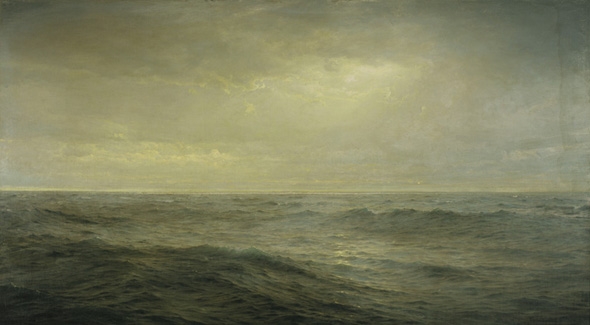
William Trost Richards, "Old Ocean's Gray and Melancholy Waste," 1885. Pennsylvania Academy of the Fine Arts.
Or, in a quieter register, the same patient attention applied to an autumn woodland:
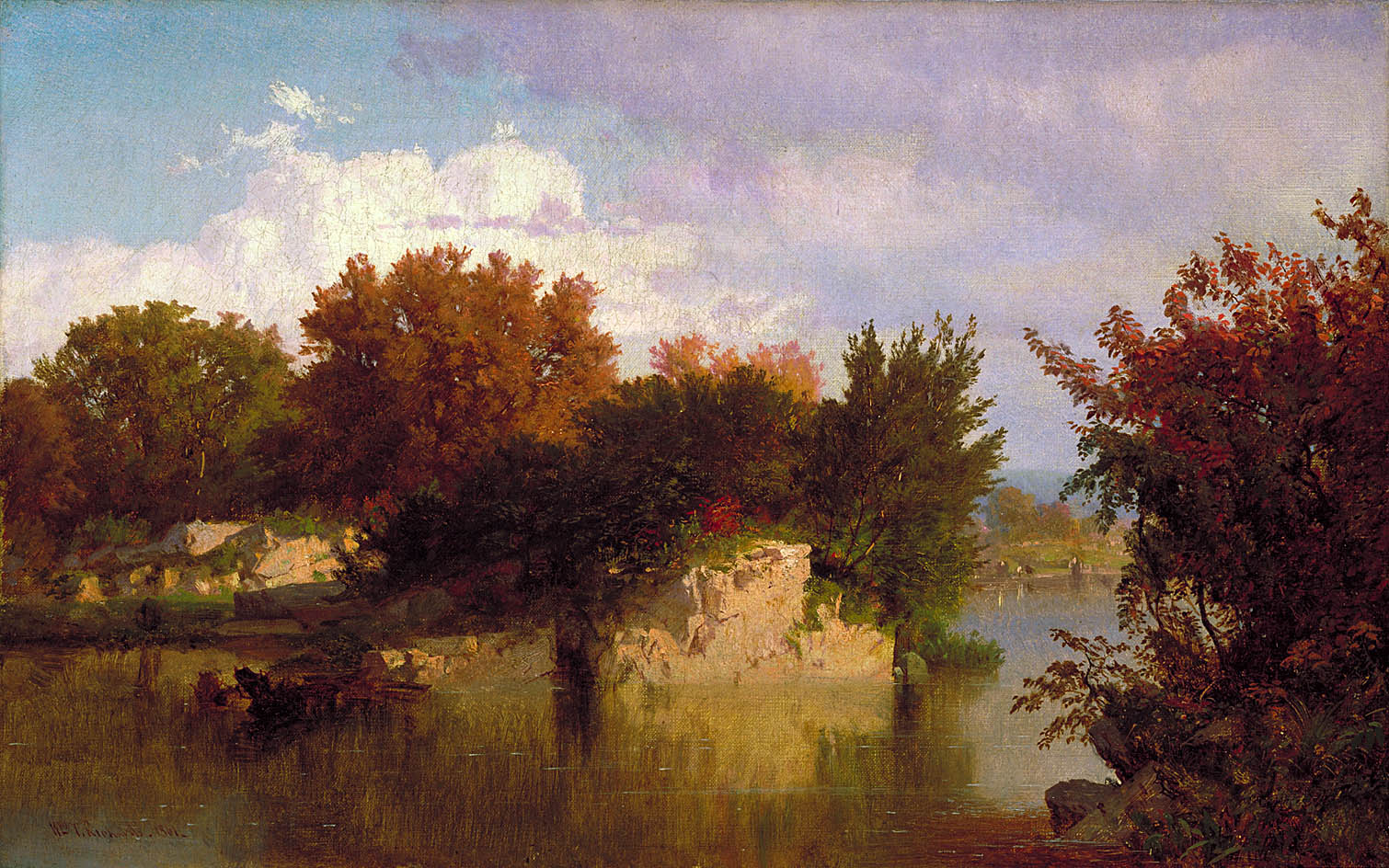
William Trost Richards, "Trees along Stream in Fall." Smithsonian American Art Museum.
By the 1850s, Parisian studios were churning out tens of thousands of photographic portraits a year. Many portrait painters did, in fact, lose their living. The pessimists were not wrong about the disruption — they were wrong about what came next.
What came next was Impressionism. And after Impressionism, Post-Impressionism. And after that, Cubism, Expressionism, Surrealism, Abstract Expressionism — easily the most explosive period of creative change in Western art. With photography handling the job of recording the world, painters were freed to do everything photography could not. They started painting the experience of seeing instead of the appearance of things. The light on the haystack at dawn, then the same haystack at dusk. The feeling of a fleeting moment.
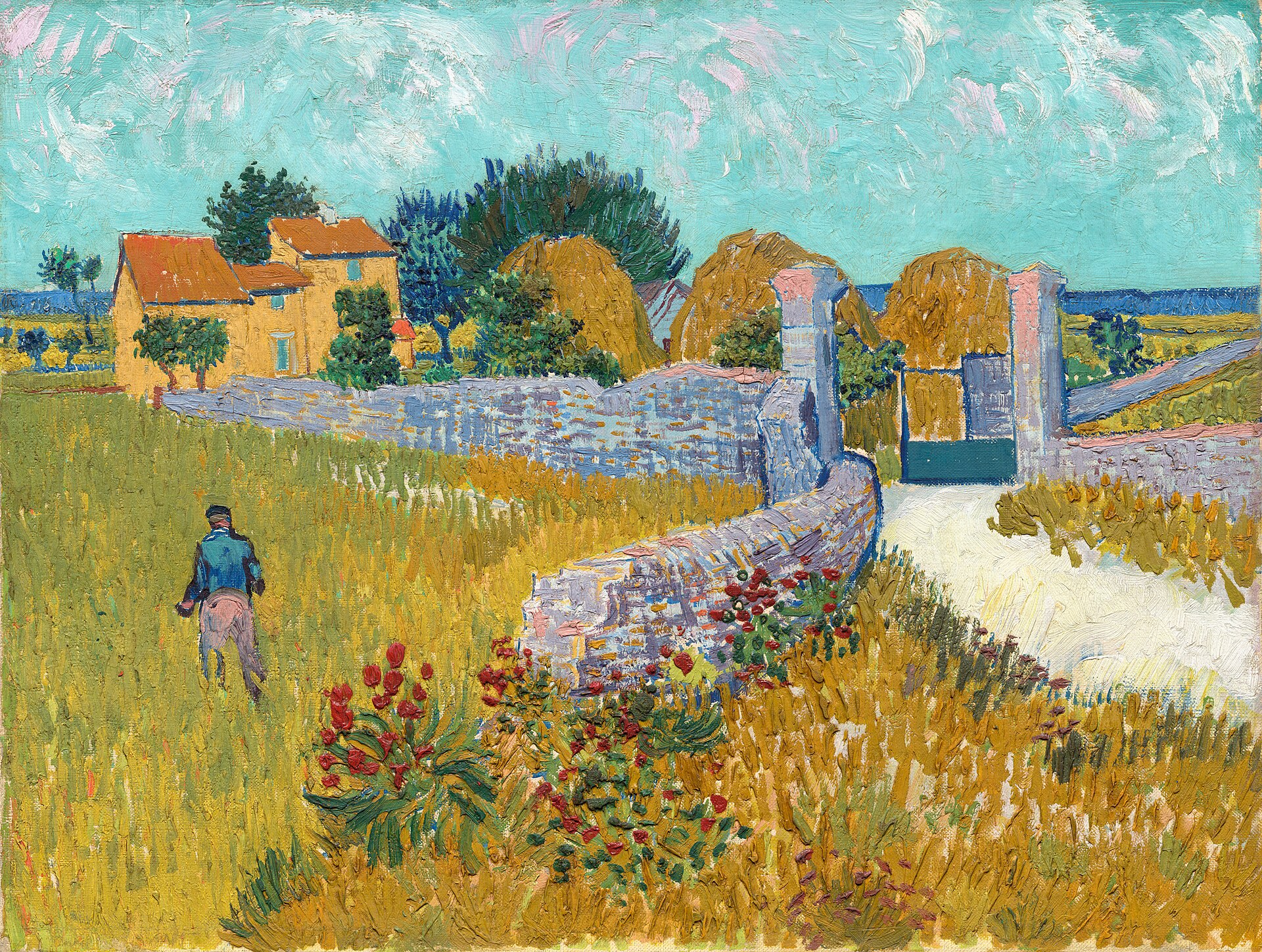
Vincent van Gogh, "Farmhouse in Provence," 1888. National Gallery of Art, Washington.
Van Gogh openly described his own breakthrough as a deliberate departure from photographic realism. Edvard Munch put it more elegantly: "I have no fear of photography as long as it cannot be used in heaven and in hell." Painting did not die. It expanded. It walked into rooms photography simply could not enter.
The lesson is direct and it is now playing out a second time. A technology that automates the mechanical part of a creative practice does not erase the practice. It transforms it. It forces everyone who keeps doing it to discover what their craft was actually about underneath — and that turns out to be the part the machine cannot reach.
What this means for the wall above your sofa
We think the same thing is about to happen to the art people choose for their homes — and in a quieter way, it is already happening.
A generated image is now effectively free. A piece of art on your wall is not, and never will be, only an image. It is a series of small commitments, made by you, in your own taste, over your own time. Choosing it. Sizing it. Picking the frame colour. Deciding which wall it lives on. Living with it through monsoon, Diwali, three Sundays of low grey light, the move from your old flat to the new one. By year two it has become part of how the room remembers you.
That accumulation is what an AI image on a phone screen does not do. The screen image refreshes. The piece on your wall stays.
There is also something to be said about provenance, even at the modest end of the market. Live concerts have not become cheaper because the same songs are streaming. People still pay extraordinary money to be in the room. In a world where images are infinitely reproducible, the real, considered, physical one — the one you actually picked — keeps its meaning. Possibly gains some.
Where we sit, honestly
This is also the right place to be honest about what Rustic Charm is, because some of the language in our category is misleading and we would rather not add to it.
We are not a hand-painted-by-an-artist brand. The art on a Rustic Charm canvas is a 12-colour giclée print on 300 GSM acid-free cotton — museum-grade, the same printing technique many serious galleries use to reproduce artists' work. What is done by hand is the finishing: the stretching of the canvas over solid wood, two layers of UV-protective satin coating, the inspection, the framing. Each piece is made to order, in Bangalore, after you choose it.
That distinction matters here. The "humanness" of a Rustic Charm wall is not in the brushwork on the canvas. It is in your part of the process — the choosing, the room, the years. Our job is to make that choice worth making: to curate pieces with real visual character, print them at a quality that holds for the next 100 years, and finish them carefully enough that the canvas you receive feels like an object, not a poster. The humanness is collaborative. We bring craft to the materials and the making. You bring taste, life, and time.
Two pieces from our catalogue, and what to look for in art you live with
Below are two of our own canvases that we think reward the kind of looking we have been writing about. Use them as examples; the larger point is the question you should ask before any art enters your home, ours or otherwise: will I still want to look at this in five years?
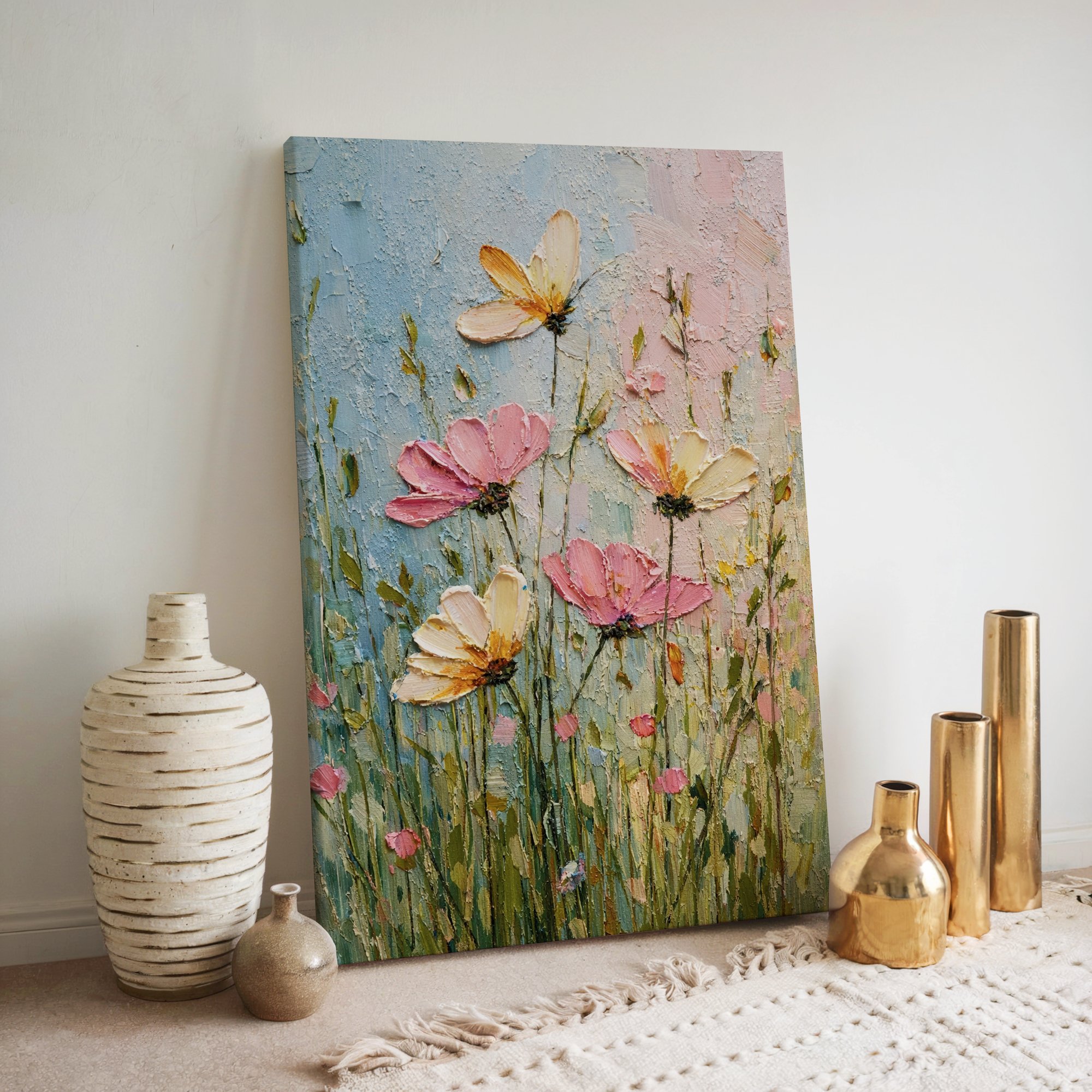
View Rose Garden on Rustic Charm → from ₹1,899
The Rose Garden canvas sits squarely in the lineage of the post-photography painters who decided that the feeling of a flower mattered more than the precise outline of a petal. Layered impasto-style brushwork, warm coral, peony pink, ochre and a soft green that holds the composition together. It does the thing a generated floral never quite does — it breathes. Hang it where you will see it both in flat morning light and in the gold of 6 pm; this kind of canvas is essentially designed to behave differently depending on the hour, and that is part of its job.
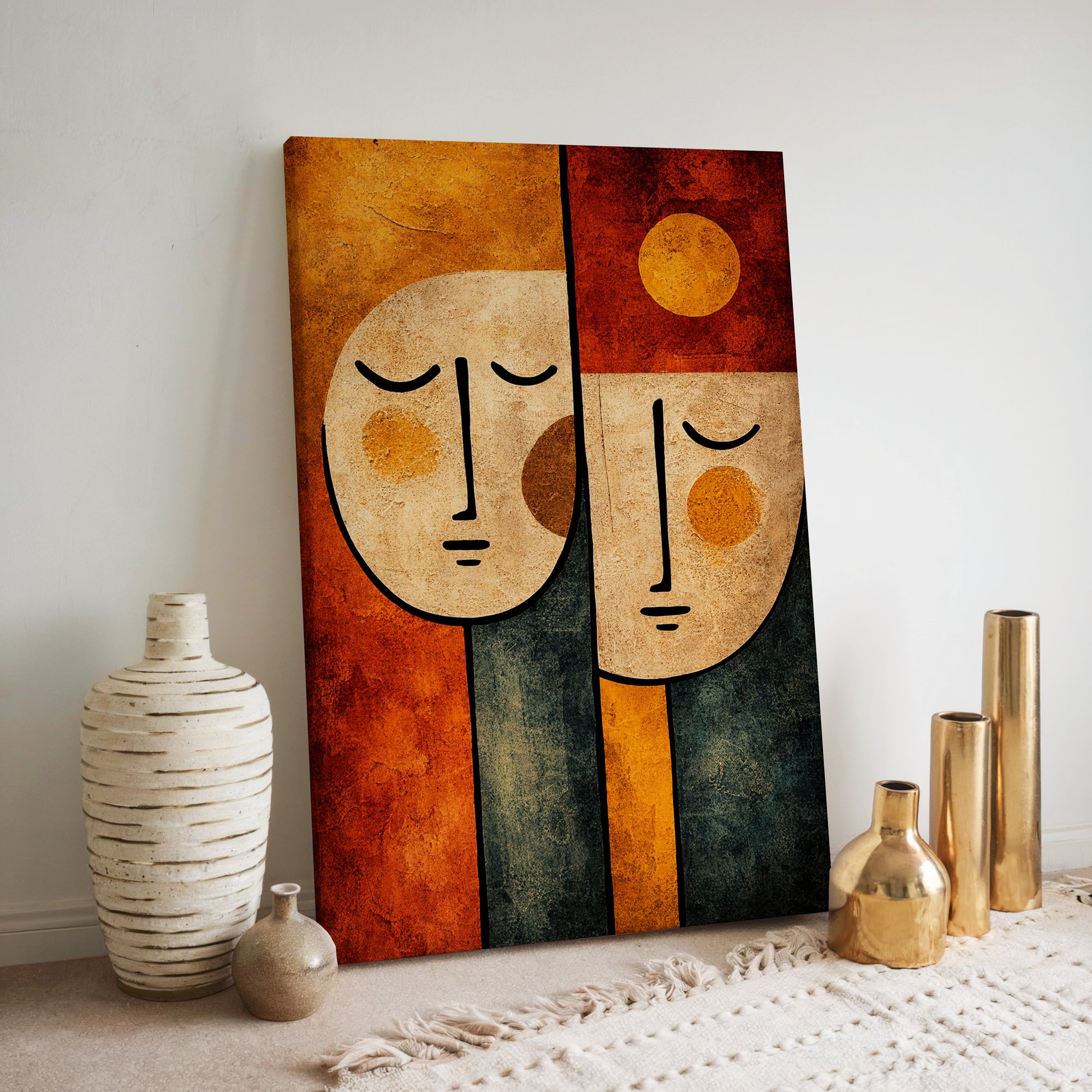
View Abstract Face on Rustic Charm → from ₹1,899
Abstract Face is the other end of the same idea. The painters who came after photography stopped trying to render a face accurately and started rendering what a face means — what its weight feels like, what it withholds. This canvas is in that conversation: warm terracotta, deep teal, cream and ochre, two stylised figures rendered in flat geometric forms. It works particularly well as a single statement piece on a calm, neutral wall — a living room behind a sofa, or above a console in a long entryway.
For more on choosing pieces in this spirit, see our longer guide on how to choose wall art for your home, or — if you want to think about how a piece's colour will sit with the room over time — our notes on wall art colour psychology.
A short FAQ
Will AI make custom wall art cheaper or worse?
Both, almost certainly. Cheaper, because generating a passable image is essentially free now. Worse on average, because the floor of the category will be flooded with images that no person specifically chose to be on a wall. The pieces that hold their value will be the ones a real person curated, finished, and committed to — the same logic that keeps live concerts expensive in a world of free streaming.
Should I just generate something and get it printed locally?
You can, and many people will. The honest trade-off is that the generated image is the easy part. What is harder, and what most cheap printers cannot do, is the materials and the finishing — printing on archival cotton canvas, sealing it against UV, stretching it on solid wood without warping, framing it cleanly. A poster-grade print on the wrong substrate fades or sags within a year or two. The image is free; the object is not.
Why does a 100-year colour guarantee matter for a digital print?
Because the difference between a piece that becomes part of your home and a piece you replace in two years is, in large part, whether the colours hold. Cheap dye-based printing fades fast in Indian sunlight and humidity. Pigment-based giclée on 300 GSM cotton, sealed with UV-protective coating, is built to outlast you. That is the whole point of treating a canvas like an object rather than a poster.
How do I tell if a piece is "right" for my home?
The cheapest test we know: live with the image on your phone for a week. Set it as your wallpaper, look at it in the morning, in the kitchen, when you are tired. If you still want to see it on the seventh day, it is a candidate for your wall. Most images do not survive day three. The ones that do are the ones worth committing to.
What is the role of AI in your own work, then?
Honestly: a real one, but a small one. We use modern tools to research what a wall in an Indian living room looks like, to mock up sizing for customers over WhatsApp, and increasingly to help write practical guides like this one. None of that changes the part of our work that actually matters — selecting pieces with character, printing them on materials that will last, and finishing each one carefully enough that the canvas feels like something you bought once and live with for a long time.
A century and a half ago, a metal plate that could record reality scared painters into discovering everything painting could do that the plate could not. We think this is the story again, on a different wall.
If you want help thinking about what would belong in your home, our free art consultancy on WhatsApp is exactly that — a real person, a real conversation, no pressure. Send us a photo of your wall.
Image credits: William Trost Richards, "Old Ocean's Gray and Melancholy Waste" (1885) — Pennsylvania Academy of the Fine Arts. William Trost Richards, "Trees along Stream in Fall" — Smithsonian American Art Museum. Vincent van Gogh, "Farmhouse in Provence" (1888) — National Gallery of Art, Washington. All works are in the public domain.